Corporate Venturing Squads: A novel way to scale innovation across borders

Scaling innovation across borders … Corporate Venturing Squads. Image: Unsplash+
- Allowing multiple companies and startups to collaborate, Corporate Venturing Squads offer a promising means of innovation.
- Such partnerships facilitate knowledge-sharing, access to capital, and scaling innovation across borders.
- A pioneering approach to economic growth, CV Squads are particularly useful in advancing common objectives, such as ESG goals, that demand cross-industry collaboration.
Fragmentation, uncertainty and accelerating technological change are redefining the innovation landscape. When it comes to breaking new technological ground, Corporate Venturing Squads (CV Squads) offer companies a way to exchange knowledge, expertise and best practices; improve access to deal flow; and scale innovation across borders. This exciting model aligns with global calls to rethink how we approach complex challenges and pursue shared value, as emphasized by the World Economic Forum.
CV Squads, a term we introduced in our 2020 study, are partnerships between multiple corporate companies and startups; a smarter way for established organizations to engage with innovation. Instead of going in alone, companies join forces by pooling resources, co-investing in pilots and solving challenges together. In a recent study, IESE Business School examined 50 of these squads across Europe, the Americas, the Middle East and Asia-Pacific. In total, 262 global corporates have used this model to promote innovation collaboratively.
The evolution of corporate venturing
Corporate venturing is the collaboration between established companies and innovative startups. This can be done through investments and acquisitions, venture builders, and venture clienting, to name a few. CV Squads are a new twist on that playbook – involving multiple entities, rather than a one-on-one partnership, working on a shared goal, like smart agriculture, mobility and transportation, or decarbonization. These corporations often collaborate with a view to accelerating growth and bringing new ideas to market.
Some squads are short-term. Others become multi-year alliances. Leadership can come from a neutral third party or one of the corporates. But the core idea remains: Team up, share knowledge and learn together.
Examples such as the 100+ Accelerator and MobilityXlab illustrate how large corporates like AB InBev, Coca-Cola and Volvo Group are engaging in structured, multi-party alliances with startups. These initiatives illustrate how the CV Squad model emerges in practice and were among the examples analyzed in IESE’s research.
From green infrastructure to inclusive digital transformation, today’s global challenges are too complex for any single actor. CV Squads let members share intelligence, exchange ideas and harness cross-sector strengths – transforming collaboration into a scalable engine for purpose-driven innovation.
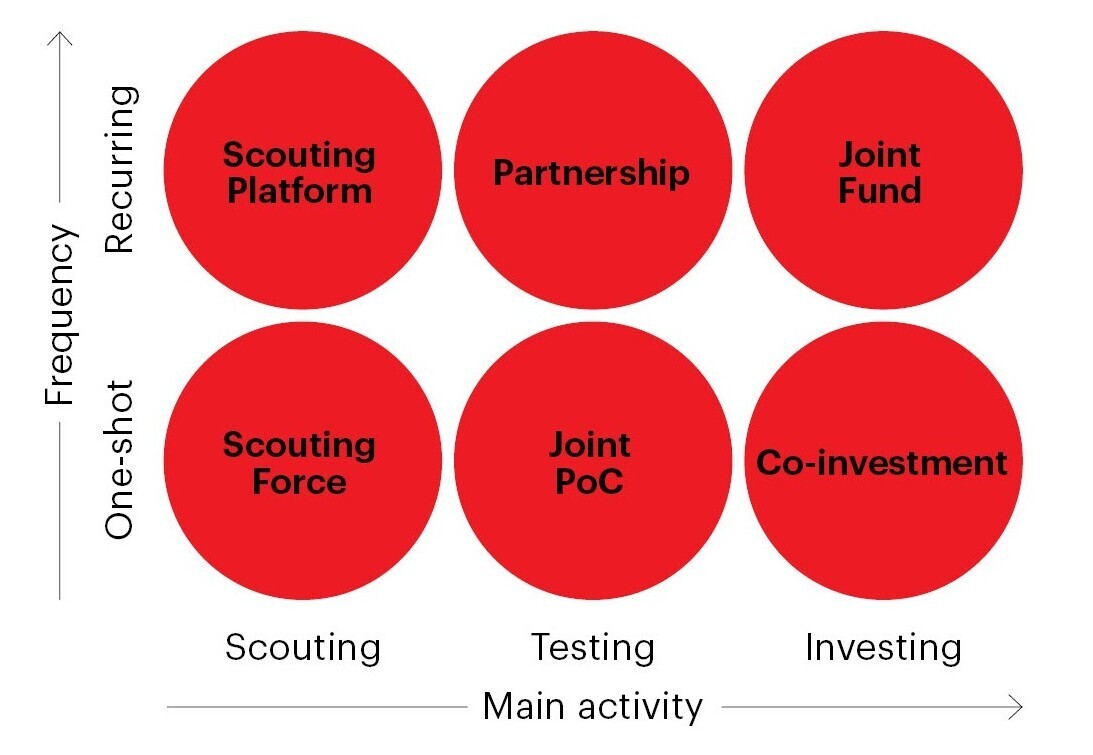
Six CV Squad typologies
Our research identified six structures among global CV Squads:
- Scouting force. A one-off initiative to explore startups, such as automakers and telecom firms jointly scouting mobility and connectivity solutions.
- Scouting platform. A recurring call to engage startups systematically. It is a recurrent version of a scouting force, where collaboration continues over time, often emerging after a successful first edition.
- Joint proof of concept. A one-time collaboration where corporates and a startup co-develop a solution, such as logistics and energy firms trialling green mobility.
- Partnership. A repeated form of joint proof of concept with multiple rounds, such as telcos running successive AI pilots.
- Co-investment. A one-time pooled investment in startups, such as industrial firms co-funding battery recycling.
- Joint fund. A recurrent vehicle to support startups over time, such as corporates setting up a mobility innovation fund.
Impact in practice
Evidence shows that companies join these squads to capture concrete benefits. We found that members report better access to promising startups (in 37% of cases analyzed), stronger positioning in innovation networks (29%), and better knowledge-sharing (26%) thanks to shared insights and best practices.
The impact is global. The 100+ Accelerator – with partners like AB InBev, Coca-Cola, Colgate-Palmolive, Danone, Mondelēz and Unilever – has backed nearly 200 startups in over 40 countries since its creation in 2018, piloting solutions tied to ESG priorities. In Sweden, MobilityXLab, founded in 2017 by Autoliv, CEVT, Ericsson, Volvo Cars, Volvo Group and Zenuity, has run 120+ proof-of-concept projects and 25 accelerations with startups from 19+ countries, some advancing to R&D integration.
Together, these cases highlight outcomes that can often be harder to achieve through single-company initiatives – from scaling sustainability pilots to building global innovation pipelines.
What leaders need to know
In terms of the vital ingredients that make CV Squads work, our research revealed two recurring patterns. First, while governance can be one of the toughest issues at the outset, most CV Squads rely on structured facilitation – whether from a corporate venturing manager, a neutral platform, or a lead corporate – to keep the group aligned and moving. Second, many squads learn from one another and leverage the complementary knowledge, skills, and cross-industry expertise of their members.
CV Squads are still gaining traction, but their early results are encouraging. With the right support – managing platforms to bring partners together, flexibility and peer-to-peer learning – they have the potential to evolve into a widely used tool for collaborative innovation.
As the World Economic Forum highlights the need to navigate a fractured world and reimagine growth, CV Squads represent a novel approach that aligns with these priorities. They demonstrate that multi-corporate collaboration can accelerate innovation, increase resilience, and create shared value across regions and industries. When structured around trust, flexibility and shared purpose, CV Squads highlight the potential of multi-corporate alliances to fast-track startup innovation and generate shared value, particularly in advancing ESG goals that demand collaboration across industries and markets.
Don't miss any update on this topic
Create a free account and access your personalized content collection with our latest publications and analyses.
License and Republishing
World Economic Forum articles may be republished in accordance with the Creative Commons Attribution-NonCommercial-NoDerivatives 4.0 International Public License, and in accordance with our Terms of Use.
The views expressed in this article are those of the author alone and not the World Economic Forum.
Stay up to date:
Innovation
Related topics:


Forum Stories newsletter
Bringing you weekly curated insights and analysis on the global issues that matter.
More on BusinessSee all

Maria Basso and Michael Römer
February 12, 2026


