The data centre boom needs a resilient workforce – here’s how to build one

The rapidly growing data centre industry needs more skilled employees. Image: istock/kali9
- The market value of the data centre industry is expected to exceed $135 billion by 2026 as it powers everything from streaming to artificial intelligence (AI).
- But a persistent skills gap threatens to hold the industry back, just as demand is increasing due to the rise of these advanced technologies.
- Creating and training a growing data centre workforce will require more collaboration between governments, industry leaders and educational institutions.
The data centre industry is the engine of our digital world, powering everything from cloud computing and artificial intelligence (AI) to streaming services and smart cities. Its growth is staggering, with the US market alone projected to exceed a market value of $135 billion by 2026.
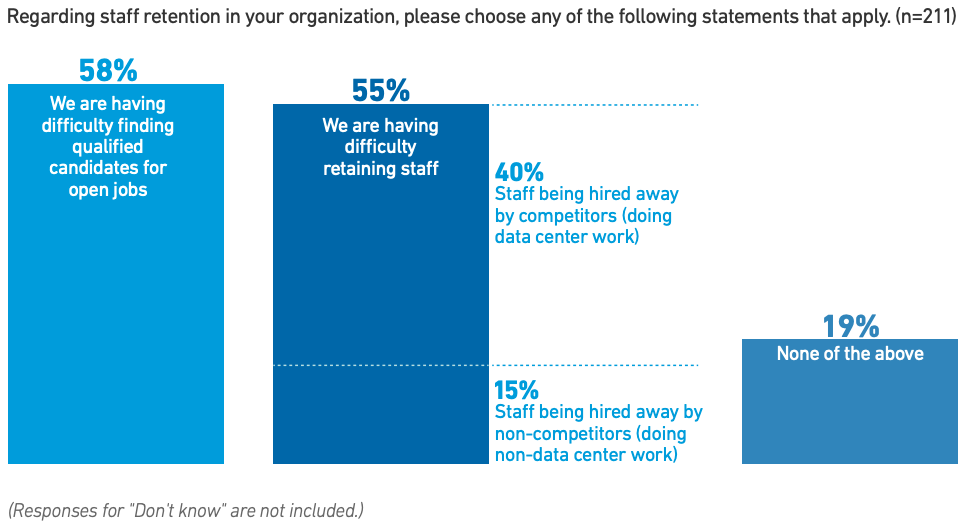
This expansion is creating a significant challenge, however: a persistent skills gap that threatens to constrain innovation and efficiency. Over half of data centre operators struggle to attract and retain qualified staff, according to a study by industry standard-setter the Uptime Institute. This is creating a looming shortage of hundreds of thousands of candidates.
The solution to this human capital crisis lies in a multi-faceted approach that requires collaboration between industry, government and educational institutions. Building a resilient workforce capable of meeting this demand means rethinking how a new generation of data centre professionals are trained, recruited and empowered.
Data centres need more than tech experts
The traditional image of a data centre professional as an expert in server racks and network cables is outdated. While technical proficiency remains foundational, the modern data centre demands a much more diverse skillset. Analysis of in-demand roles reveals that nearly 60% of required skills are actually non-technical.
The most sought-after non-technical skills include problem-solving, critical thinking and adaptability. Communication and teamwork are also paramount, as modern data centre environments are collaborative and require clear, documented processes. Attention to detail is non-negotiable because a minor oversight can lead to a major operational disruption.
On the other hand, essential technical skills include a foundational knowledge of server hardware, networking and cooling systems. With the rise of AI, cloud and edge computing, expertise in these areas, as well as cybersecurity and automation, is becoming increasingly critical.
Furthermore, the rapid emergence of technologies like AI is reshaping every role. A recent study suggests that up to 80% of workers in the US could see at least 10% of their daily work activities impacted by AI. This dynamic underscores the importance of a mindset of continuous learning and adaptability, ensuring workers can evolve alongside technology.
Building the data centre talent pipeline
To bridge this widening skills gap, the industry must pivot from a reactive hiring model to a proactive, long-term talent development strategy. This requires a fundamental shift in how educational pathways are viewed and utilized based on three key strategies:
1. Aligning curricula with industry demands
Vocational training and community colleges are essential, but their curricula must be directly aligned with the needs of a modern data centre. Partnerships between educational institutions and employers are crucial. This collaboration can take the form of advisory boards, which help academic programmes stay current with technological advancements and market demands. These partnerships create a strong connection between theoretical knowledge and practical application, providing students with hands-on experience that makes them job-ready from day one.
2. Investing in short-term, targeted programmes
Short-term, targeted programmes can be a highly effective alternative to traditional, multi-year degrees. They can prepare people for entry-level careers in construction and operation of data centres, for example by partnering with community colleges to create specialized, short courses in data centre operations and fiber optics. These programmes not only provide immediate pathways to employment but also serve as a crucial entry point for a more diverse talent pool.
3. Fostering a culture of lifelong learning
In an industry defined by rapid change, lifelong learning is a necessity. Companies that invest in personalized, competency-based training are better positioned to overcome hiring challenges and retain talent. This approach ensures that employees continuously develop the skills required to navigate evolving industry standards, keeping them and their organizations competitive.
Several organizations are already demonstrating how strategic partnerships can successfully address the data centre workforce challenge.
Microsoft's Datacenter Academy is a prime example of a global technology company collaborating directly with local community colleges and vocational schools. Microsoft provides the curriculum, equipment for hands-on labs, scholarships and mentorship opportunities. And the training students receive is directly aligned with the skills needed for a career in a Microsoft data centre. This programme addresses the immediate hiring needs in the communities in which Microsoft operates. But it also creates a sustainable talent pipeline by empowering local educational institutions to train future generations.
AWS is also partnering with community colleges and trade schools through AWS Workforce Accelerator. These collaborations help align curricula with employer needs, train faculty in state-of-the-art technology and upgrade educational facilities. The Ivy Tech partnership, for example, has developed a four-week programme as part for the accelerator that covers both technical skills and essential people skills like communication and leadership.
Google’s Skilled Trades and Readiness (STAR) Program is another example of a company cultivating local talent. By focusing on short-term training and providing ongoing support, this programme creates a direct talent pipeline for data centre communities. It shows how companies can demonstrate a commitment to local economic development while securing their own operational needs.
Expanding the talent pool
The barriers to a prepared data centre workforce, such as skills shortages, access disparities and outdated curricula, cannot be overcome by any single entity. The solution lies in building robust, collaborative ecosystems. Governments, industry leaders and educational institutions must work together to create frameworks that support continuous skills development. This includes aligning funding with industry needs, promoting the data centre industry as a viable career path and creating clear, accessible training pathways.
To expand the talent pool, actively recruiting from underrepresented groups, including women, people of colour and individuals from diverse professional backgrounds, will bring fresh perspectives that drive innovation. At the same time, companies should prioritize upskilling and reskilling their existing workforce. By providing clear pathways for employees to grow and transition into more advanced roles, organizations can retain valuable institutional knowledge and build a more adaptable and loyal team.
As the demand for data centre services continues to rise, the success of these training initiatives will be crucial. By shifting focus from simply hiring to developing a skilled, adaptable and diverse workforce, the data centre industry will have the human capital it needs to power the future digital society.
Don't miss any update on this topic
Create a free account and access your personalized content collection with our latest publications and analyses.
License and Republishing
World Economic Forum articles may be republished in accordance with the Creative Commons Attribution-NonCommercial-NoDerivatives 4.0 International Public License, and in accordance with our Terms of Use.
The views expressed in this article are those of the author alone and not the World Economic Forum.
Stay up to date:
Cybersecurity
Related topics:


Forum Stories newsletter
Bringing you weekly curated insights and analysis on the global issues that matter.
More on Jobs and the Future of WorkSee all

Abayomi Olusunle
March 20, 2026


