From margins to momentum: How AI could transform women’s health
Women’s health has been systematically underserved. Image: REUTERS/Shannon Stapleton
- Women’s health has been systematically underserved due to bias and underinvestment.
- Artificial intelligence could help diminish the women’s health gap by reducing data deserts, bias and gaps.
- Meaningful progress relies on analysing data through a sex-specific lens to reduce inequities rather than reinforcing them.
Neglecting women’s health comes at a staggering cost, in human suffering and lost economic potential.
Chronic underinvestment and bias have left women systematically underserved by healthcare systems, leading to a public health issue and a trillion-dollar blind spot. The World Economic Forum estimates that closing the women’s health gap could add at least $1 trillion in global economic output annually by 2040.
Behind every statistic is a personal struggle. A woman with heart attack symptoms is 50% more likely to be misdiagnosed and sent home. Another may endure nearly a decade of pain before being diagnosed with endometriosis. These outcomes are the predictable result of a system that has failed to acknowledge women’s distinct biology and health experiences.
Artificial Intelligence (AI) has changed the game. Able to analyse vast and complex datasets, it offers a powerful tool to expose the gaps and blind spots that have persisted in women’s health.
Unlike incremental improvements of the past, AI holds the potential to fundamentally reshape our understanding of women’s biology and deliver more precise, equitable care, transforming outcomes for generations to come.
Data deserts and biased blueprints
A major barrier to innovation in women’s health is the lack of robust, representative data. Historically, women have been underrepresented in clinical research, with the male body often treated as the default.
Datasets default to male physiology and disease patterns, creating a silent ceiling on discovery. The tangible consequences of this bias are clear. It can lead to a higher likelihood of misdiagnosis and delayed diagnosis for conditions that primarily affect women.
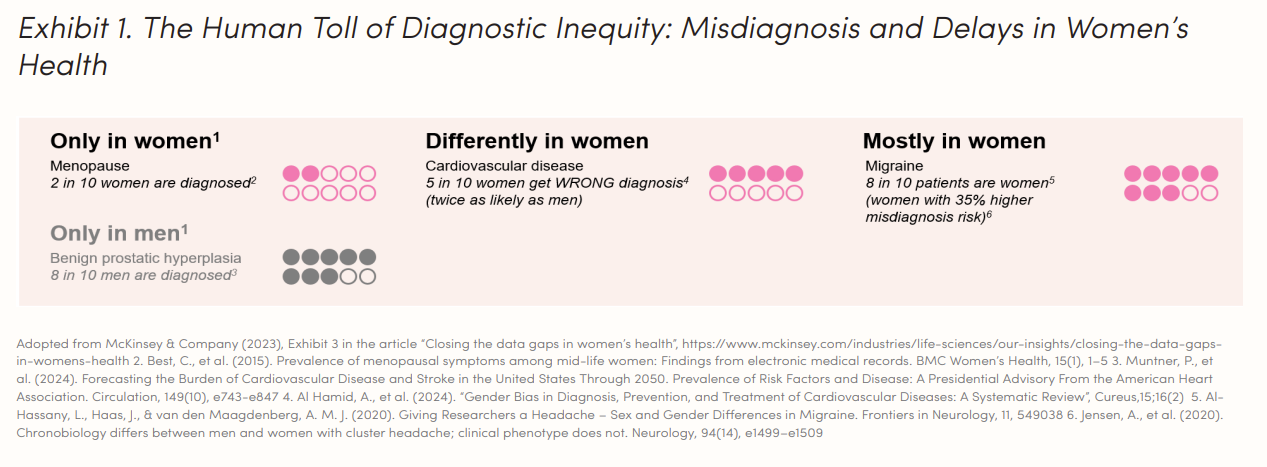
AI systems trained on such incomplete or biased data risk perpetuating inequities rather than solving them.
To understand these gaps, we utilize the FemHealth Framework, which classifies women’s health conditions into “only in women,” “mostly in women” and “differently in women.”
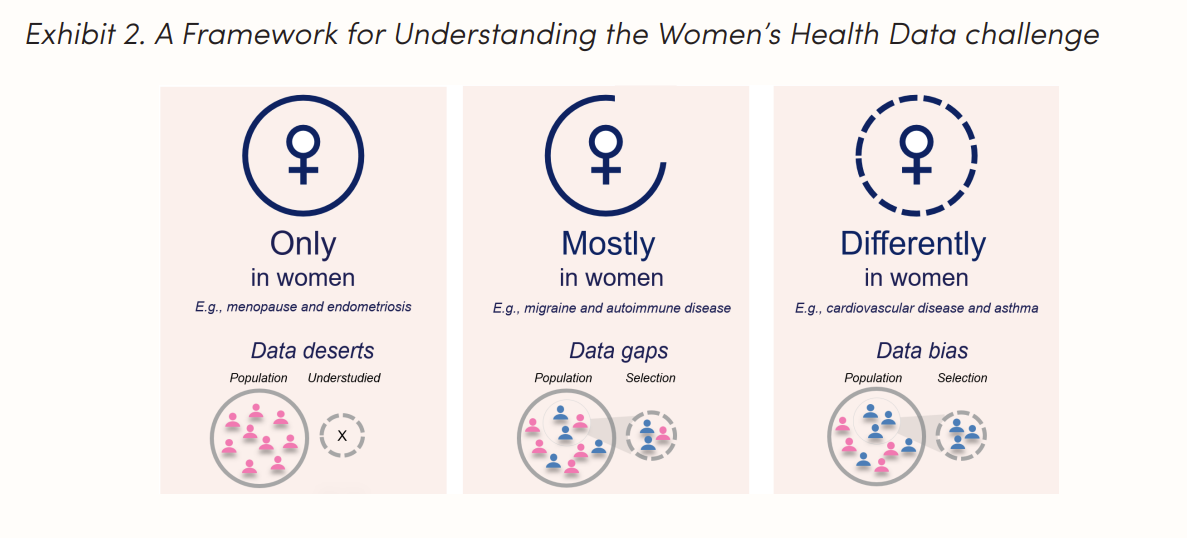
- Data deserts – The “only in women” crises: Conditions biologically unique to women, such as endometriosis and menopause, often lack quality datasets. An exception is infertility, which benefits from decades of structured data collection e.g. through national registries in Europe and the United States.
- Data gaps – The “mostly in women” mysteries: Conditions such as migraines and autoimmune diseases affect both sexes but disproportionately impact women. Data are often not disaggregated by sex, obscuring critical differences. Without this detail, AI misses patterns unique to women.
- Data bias – The “differently in women” dangers: Conditions such as heart disease and diabetes affect both sexes but were historically mainly calibrated to male norms. AI trained on such skewed data risks reinforcing these blind spots, amplifying inequities rather than fixing them. The withdrawal of the drug Zelnorm in 2007, after female-specific risks were belatedly identified, is a stark reminder.
Leapfrogging the past
AI presents a unique opportunity to leap ahead now. Women’s health is less tied to legacy systems and uniquely positioned to adopt cutting-edge, AI-driven tools from the outset.
Only in women: Unlocking data goldmines
- Here and now: Infertility offers a strong starting point for AI, supported by rich, structured data. AI models trained on fertility registries have already improved IVF success rates by better predicting individual responses to treatment.
- Looking ahead: For conditions with limited clinical data, AI-generated synthetic data can help fill critical gaps when real-world data is scarce. Additionally, leveraging patient-generated data and advanced text mining of clinical notes can uncover patterns even when formal studies are lacking.
Mostly in women: Addressing the invisible majority
- Here and now: Many diseases that disproportionately affect women, such as migraines, are data-rich but underutilized. AI can forecast attacks by integrating data on menstrual cycles, sleep patterns and stress levels, enabling timely prevention.
- Looking ahead: The greatest potential lies in moving from symptom management to mechanism-based insight. By combining real-world data with genomics and digital tools, advanced AI can help uncover disease subtypes and identify female-specific biomarkers.
Differently in women: Uncovering sex-based gaps
- Here and now: Conditions such as cardiovascular disease are often analysed without accounting for sex-specific differences. AI offers a critical opportunity to re-examine existing datasets through a sex-informed lens.
- Looking ahead: Studies and AI systems must treat sex as a fundamental variable. Pregnancy history, hormonal cycles and menopause, often excluded today, are critical predictors of cardiovascular and asthma risk. Curating balanced datasets and validating algorithms separately by sex is the path forward.
Closing the women’s health gap
Uniting AI’s analytical power with purposeful, sex-aware data can transform women’s health. However, technology alone isn't enough. The biggest barriers are structural: research defaults to male norms, funding ignores sex-specific data and regulations accept sex-blind trials.
AI can either amplify these blind spots or dismantle them; which future we get depends on our actions now:
- Funders can require sex-disaggregated data in research they support and direct capital toward only in women and other less prioritized conditions.
- Researchers should design AI models that treat sex as a first-order variable, validating findings separately for women and men.
- Industry can adapt clinical trial design to better represent women and use sex-disaggregated data from real-world evidence and other sources to uncover sex-specific patterns.
- Policy-makers and regulators can drive innovation in women’s health by creating financial incentives, clear AI guidelines and expedited approval pathways to ensure new treatments are effective for all patients.
The question is no longer whether AI can reshape healthcare. It is whether we will align data, incentives, and standards fast enough to unlock its potential for the half of humanity who have too often been an afterthought. The opportunity is clear. The responsibility is ours.
Don't miss any update on this topic
Create a free account and access your personalized content collection with our latest publications and analyses.
License and Republishing
World Economic Forum articles may be republished in accordance with the Creative Commons Attribution-NonCommercial-NoDerivatives 4.0 International Public License, and in accordance with our Terms of Use.
The views expressed in this article are those of the author alone and not the World Economic Forum.
Stay up to date:
Artificial Intelligence


Forum Stories newsletter
Bringing you weekly curated insights and analysis on the global issues that matter.
More on Health and Healthcare SystemsSee all

Saia Ma’u Piukala
April 5, 2026


