How Gen X is leading the world in consumer spending

Gen Xers often act as the household CFO, making key decisions on consumer spending across generations. Image: Unsplash/silverkblack
- The Generation Z and millennial age groups often attract the most media attention, but Gen Xers have quietly become the world’s top spenders.
- Gen X’s outsized influence on consumer spending can be attributed to the fact that many members are at the centre of business and family life.
- As a result, Gen X spending reflects responsibility and family priorities, while women control half of global spending for the first time ever.
Gen X is often viewed as “the forgotten generation”. Born between 1965 and 1980, which makes them between about 45 and 60 years old in 2025, the world’s approximately 1.4 billion Gen Xers comprise just 17% of the global population. But their impact on consumer markets is strong and still growing.
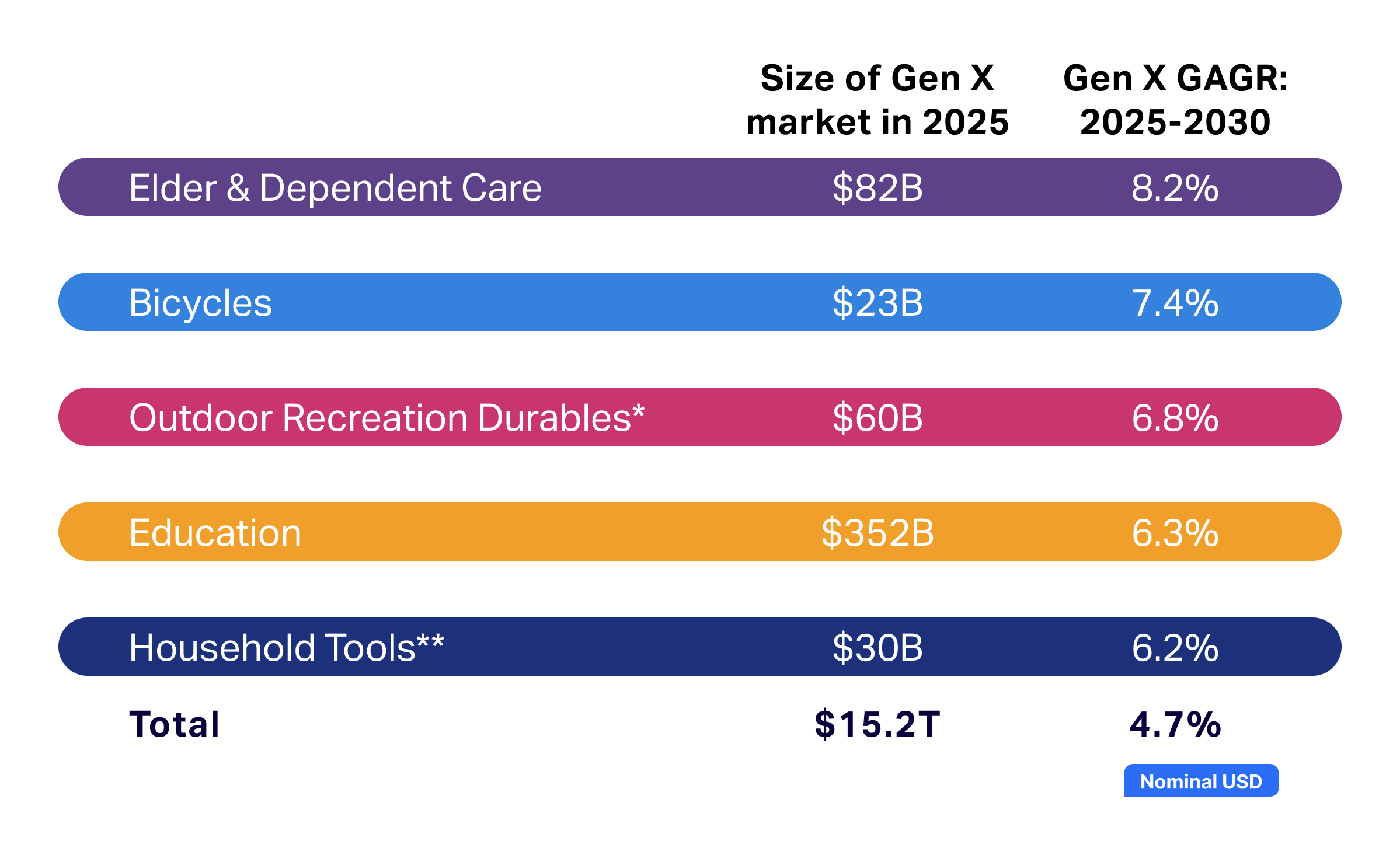
In 2025, Gen X is expected to drive $15.2 trillion in global spending. If Gen X were a country, it would be the world’s second-largest consumer market, spending twice as much as China’s consumers at present. Recent research from NIQ and World Data Lab explores Gen X’s rise to the top of consumer spending and its impact on global markets in the years ahead.
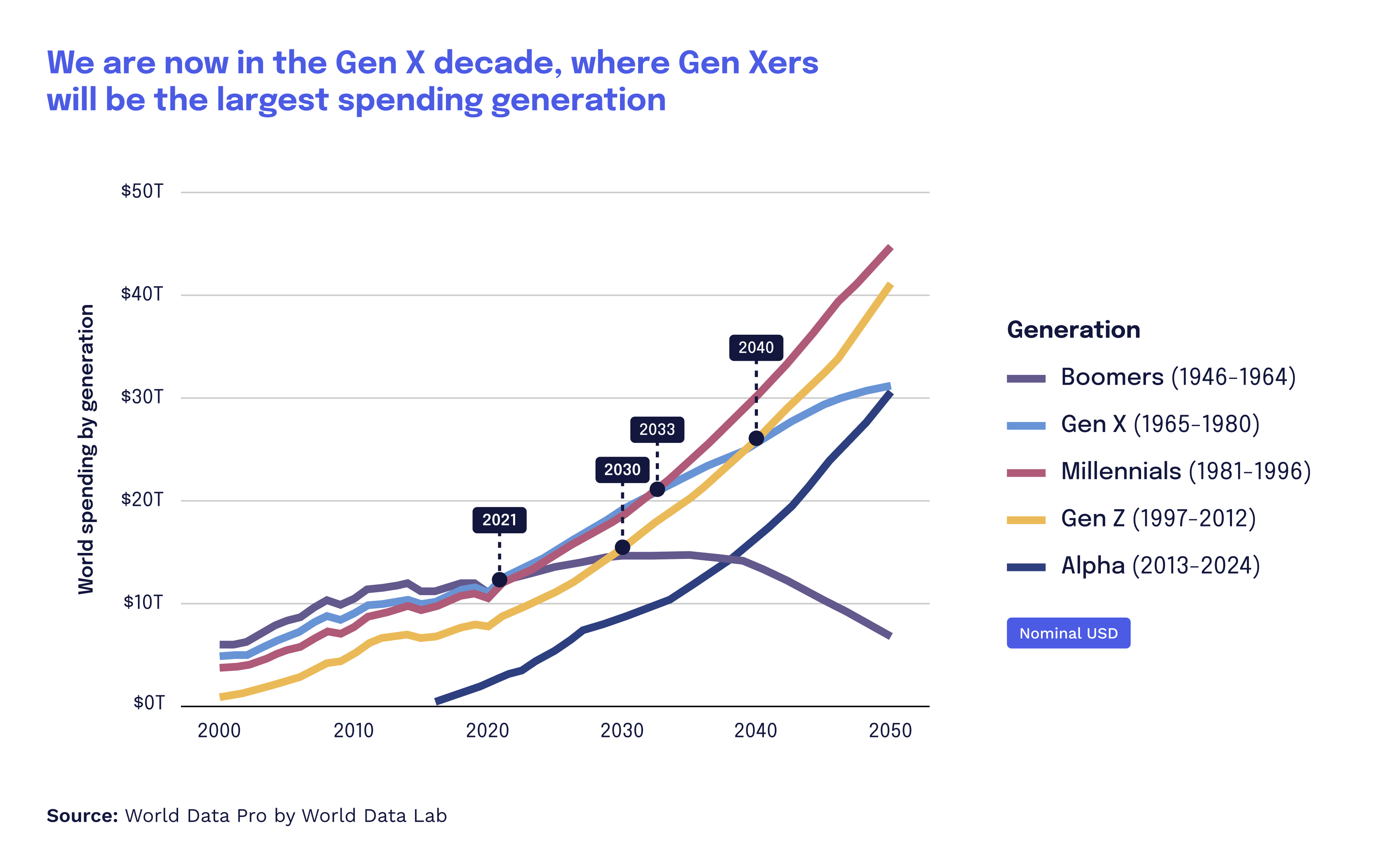
The “Gen X decade” began in 2021 when Gen Xers started leading global consumer spending. And they will continue in this pole position for another eight years, through 2033. In high-income markets like Germany, Japan, the UK and the US, their spending dominance is expected to continue until 2036.
Now in their peak spending and earning years, Gen Xers are well-educated global leaders at the height of their careers. They also sit at the centre of both their family and economic lives. Many care for their millennial or Gen Z children and often for their aging Boomer parents too, garnering the nickname “the sandwich generation”. In this “caretaker consumer” role, Gen Xers act as the household CFO, making key decisions on consumer spending across generations.
Gen X women in particular are an increasingly powerful group, influencing 70%–80% of all consumer spending. Globally, women spend $31.8 trillion annually. In the US, Gen X women spend $75,879 annually, on average. By 2030, that spending will approach $100,000.
'Sandwich generation' spending patterns
Gen X spending priorities reflect their responsibilities to others. In the next three years, Gen Xers will spend the most on elder and dependent care, education, recreation durables such as musical Instruments and gaming consoles, and travel.
Despite limited discretionary budgets, they will continue to invest in “quality-of-life” categories. This includes alcohol, a category in which Gen X accounts for 26% of global spending, across wine ($238 billion), spirits ($176 billion) and beer ($278 billion). It also covers beauty, with Gen X spending one-quarter of global totals in this category and expected to contribute an additional $80 billion by 2030. Two-thirds of that growth will come from Asia Pacific and North America.
Over the next 10 years, Gen X will continue to lead spending in travel, healthcare and education. Millennials (currently aged between 29 and 44 years old) will surpass them in total spending by the early 2030s, however, as Gen X’s caregiving responsibilities start to fall and the demographic experiences a decline. Gen X will still maintain high per capita spending though – comparable to today's Boomers, who are currently aged 61 to 79 years old.
In the longer term (10+ years), as the youngest Gen Xers enter retirement, spending will shift toward healthcare and financial services. Their spending will mirror Boomers’ patterns, but with a stronger emphasis on wellness and simplicity. During this time, Gen Xers will also be the primary beneficiaries of the "great wealth transfer" from Boomers.
Gen X: Regional differences and impact
While Gen X dominates spending in high-income countries, their impact is already declining in some low- and middle-income countries due to relatively low average life expectancy in those regions. Wealthier regions, including Europe and North America, account for two-thirds of Gen X spend worldwide, while low-income regions, such as Sub-Saharan Africa, skew much younger relative to spend.
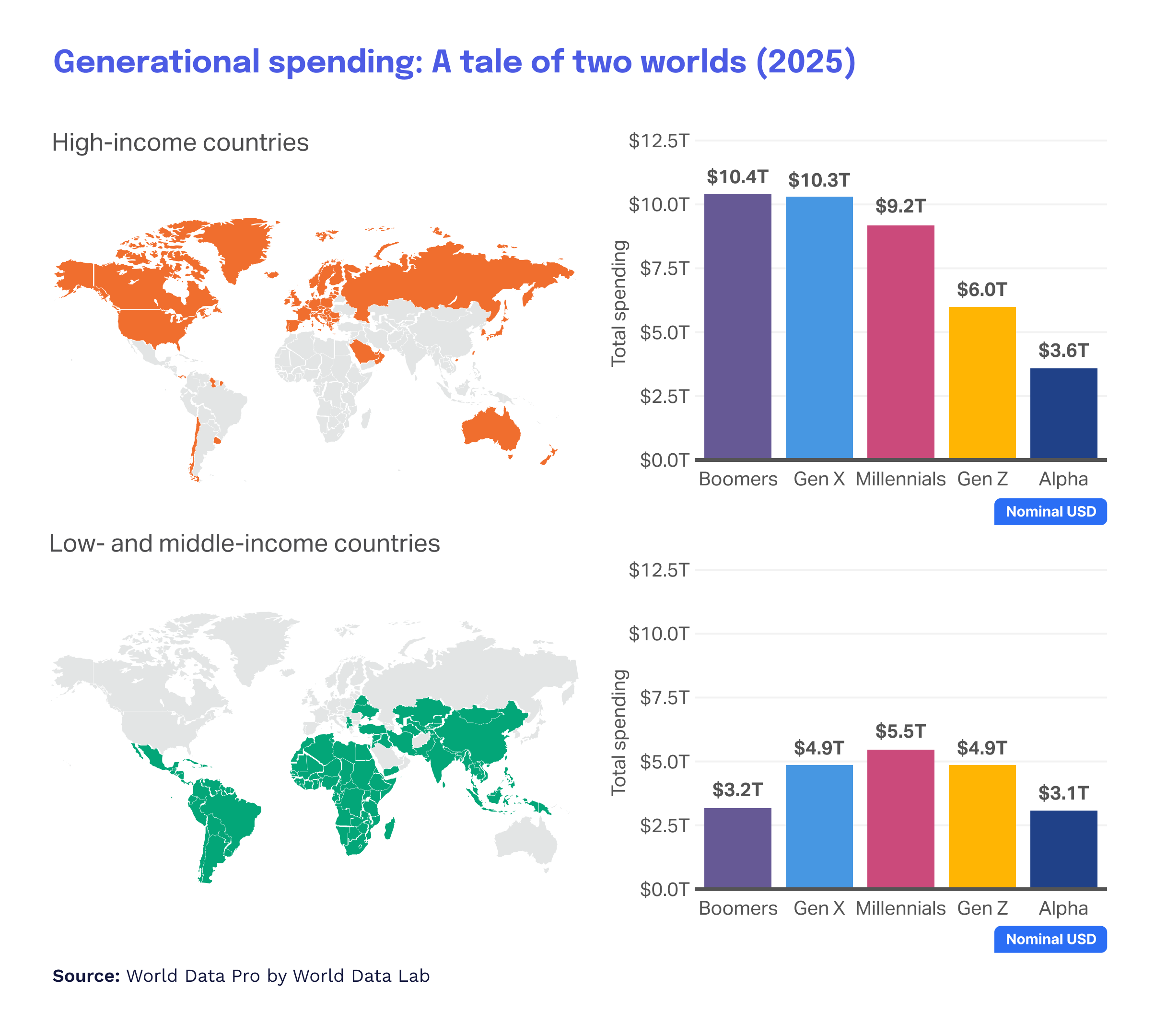
Notably, 61% of Gen Xers were born in Asia Pacific. In China, Gen X and millennials have been competing for dominance since 2015. Globally, millennial spending will overtake Gen X for good in 2033, but in the Asia Pacific region, millennial spending has already surpassed Gen X today.
Latin America shows mixed patterns. While millennials already dominate Mexico’s economy, Gen Xers will start to lead spending in Brazil beginning in 2028. They will retain that lead for five to six years.
Regional nuances appear within categories too. When it comes to travel, hotel spending is growing fastest in Latin America (6.8%) and the Middle East & North Africa (9.8%). In beauty, Gen X will account for one-quarter of global spending in 2025 and will contribute an additional $80 billion by 2030, with two-thirds of that growth coming from Asia Pacific and North America.
Passing the wallet
As previously noted, millennials will overtake Gen X as the highest-spending generation globally by the mid-to-late 2030s. And by 2040, Gen Z will surpass Gen X in total spending power as well.
In the meantime, the data is clear: Gen X holds the wallet and the influence.
Don't miss any update on this topic
Create a free account and access your personalized content collection with our latest publications and analyses.
License and Republishing
World Economic Forum articles may be republished in accordance with the Creative Commons Attribution-NonCommercial-NoDerivatives 4.0 International Public License, and in accordance with our Terms of Use.
The views expressed in this article are those of the author alone and not the World Economic Forum.
Stay up to date:
Future of Consumption
Related topics:


Forum Stories newsletter
Bringing you weekly curated insights and analysis on the global issues that matter.
More on Economic GrowthSee all

Larry Fitzgerald Jr and Kelvin Beachum Jr
April 6, 2026