The state of global labour markets in 2025, and other trends in jobs and skills this month

Labour markets in 2025 are more than a tale of unemployment rates. Image: Unpslash/kate.sade
- This regular roundup brings you essential news and updates on the labour market from the World Economic Forum’s Centre for the New Economy and Society.
- Top stories: Unemployment and wage trends from around the world; World Economic Forum Chief People Officer Outlook 2025; UK four-day week adoption rises.
As the world enters the final quarter of 2025, labour markets are telling a complex story of divergence and transformation.
While unemployment rates remain historically low in many higher-income economies – the OECD reports a stable 4.9% rate in April, having hovered at or below 5% for the past three years – wage growth patterns reveal stark regional differences, with the rise of artificial intelligence (AI) potentially reshaping job opportunities across skill levels.
The post-pandemic labour recovery is playing out at vastly different speeds. Here’s a snapshot from across the globe:
Mexico celebrated a low unemployment rate of 2.6% in July, while South Africa’s latest quarterly labour force survey reveals a significant 32.9% jobless rate. The UK sees hiring slow even as wages grow 5% annually, while Japan maintains ultra-low unemployment at 2.5% yet experiences its sixth consecutive month of real wage declines.
Wages are at record highs in Brazil, as unemployment fell to 5.8% in Q2 2025 – the lowest level since the time series began in 2012. And in the United States, wages are cooling just as unemployment steadies at 4.2%, reports the US Bureau of Labor Statistics.
The forces reshaping the landscape
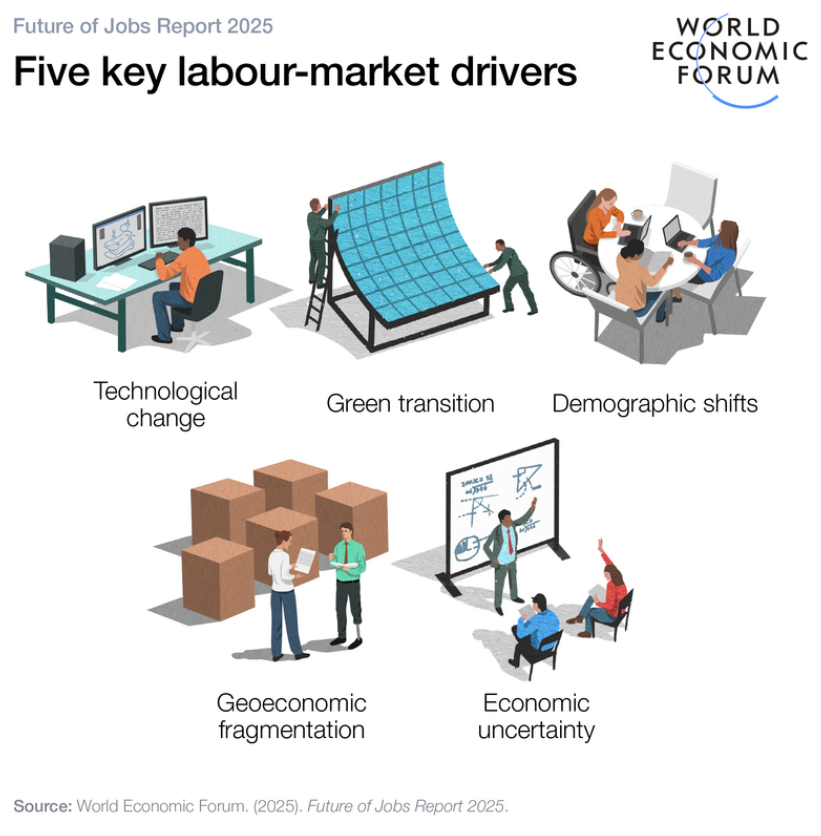
Beneath the headline numbers, several powerful shifts are influencing jobs and wages, according to the World Economic Forum's Future of Jobs Report 2025:
Demographics: Ageing populations in higher-income economies are creating worker shortages, while younger populations in lower-income regions are flooding into the labour market.
Technology: Digital access and AI are transforming work, while boosting demand for big data and cybersecurity skills.
Economic uncertainty: Rising costs of living and slowing growth are squeezing wages and job creation, increasing demand for adaptability and resilience.
Green transition: Climate-change mitigation and adaptation are generating new demand for renewable energy engineers, EV specialists and environmental roles, while reshaping traditional industries.
Geoeconomics: Trade restrictions, subsidies and shifting industrial policies are forcing companies to rethink supply chains, fuelling demand for security, cybersecurity and resilience skills.
For workers themselves, remote and flexible work remain priorities, reshaping how and where people participate in the labour market.
Yet participation itself is uneven. In some economies, low unemployment masks the reality that fewer people are in work at all, especially women, young people and older workers, according to research from McKinsey and Company.
How is the World Economic Forum promoting equity in the workplace?
The missing piece: participation
Headline unemployment figures don’t reveal who has actually left the workforce altogether.
Labour force participation rates help fill that gap. In the US, the rate has slipped to 62.2%, Reuters notes, as both accelerated immigration policy and ‘baby boomer’ retirements shrink the labour pool. In contrast, New Zealand retains a higher participation rate of 70.5%, although this has reduced slightly alongside a small rise in unemployment.
For employers, participation rates matter as much as unemployment. A low jobless rate paired with weak participation means a smaller pool of available workers, amplifying skills shortages.
For policymakers, it highlights the need to remove barriers that keep people – especially women, young people and older workers – on the sidelines.
How are business leaders responding?
Employers are already adapting to this uncertainty.
The World Economic Forum’s Chief People Officers Outlook - September 2025 shows 42% expect continued turbulence in the year ahead. According to the Outlook, many organizations are postponing hiring or restructuring decisions as they assess an evolving landscape, yet alongside this are recognizing a longer-term need for transformation.
The Outlook identifies three clear priorities for the year ahead:
- Redesigning roles to integrate AI
- Strengthening workplace culture to retain talent
- Ensuring responsible technology use
Labour markets in 2025 are more than a tale of unemployment rates, with wage growth, participation, demographics and technology creating starkly different realities across regions and sectors.
More labour news in brief
The International Labour Organization could face further staff cuts after the US proposed a $107 million funding reduction. The agency is reviewing the impact on its operations, with further staff reductions possible after 225 jobs were cut earlier this year.
More than 2.7 million UK workers now report working a four-day week. They represent almost 11% of the workforce across full-time and part-time employees, with businesses citing higher motivation, improved recruitment and cost savings.
Over 2.4 billion workers worldwide are already feeling the impact of extreme heat, with productivity falling 2-3% for every degree above 20°C, according to latest data from the World Health Organization and the World Meteorological Organization.
In a trend now spreading across major cities in China, young adults are paying to ‘clock in’ at mock offices, as youth unemployment remains above 14%, using the space to job hunt, build skills, and even keep up appearances for parents and schools.
Don't miss any update on this topic
Create a free account and access your personalized content collection with our latest publications and analyses.
License and Republishing
World Economic Forum articles may be republished in accordance with the Creative Commons Attribution-NonCommercial-NoDerivatives 4.0 International Public License, and in accordance with our Terms of Use.
The views expressed in this article are those of the author alone and not the World Economic Forum.
Stay up to date:
Future of Work


Forum Stories newsletter
Bringing you weekly curated insights and analysis on the global issues that matter.
More on Jobs and the Future of WorkSee all

Keith E. Ferrazzi and Wendy Smith
April 9, 2026


