Reimagining doughnut economics for the Global South
What is a more appropriate model of doughnut economics for the Global South? Image: Reuters/Naseer Ahmed
- Doughnut economics offers a vision of what it means to thrive in the 21st century, based around a social foundation and an economic ceiling.
- Under the model, societies should shift from growth to balance once they meet basic needs – a point of balance beyond much of the Global South.
- Rather than adopting the doughnut 'as is’, the Global South must reinterpret it as a two-step process: just growth followed by the stabilization phase.
When economist Kate Raworth developed the concept of ‘doughnut economics’, it offered a vision of what it means to thrive in the 21st century and how to think beyond traditional notions of growth.
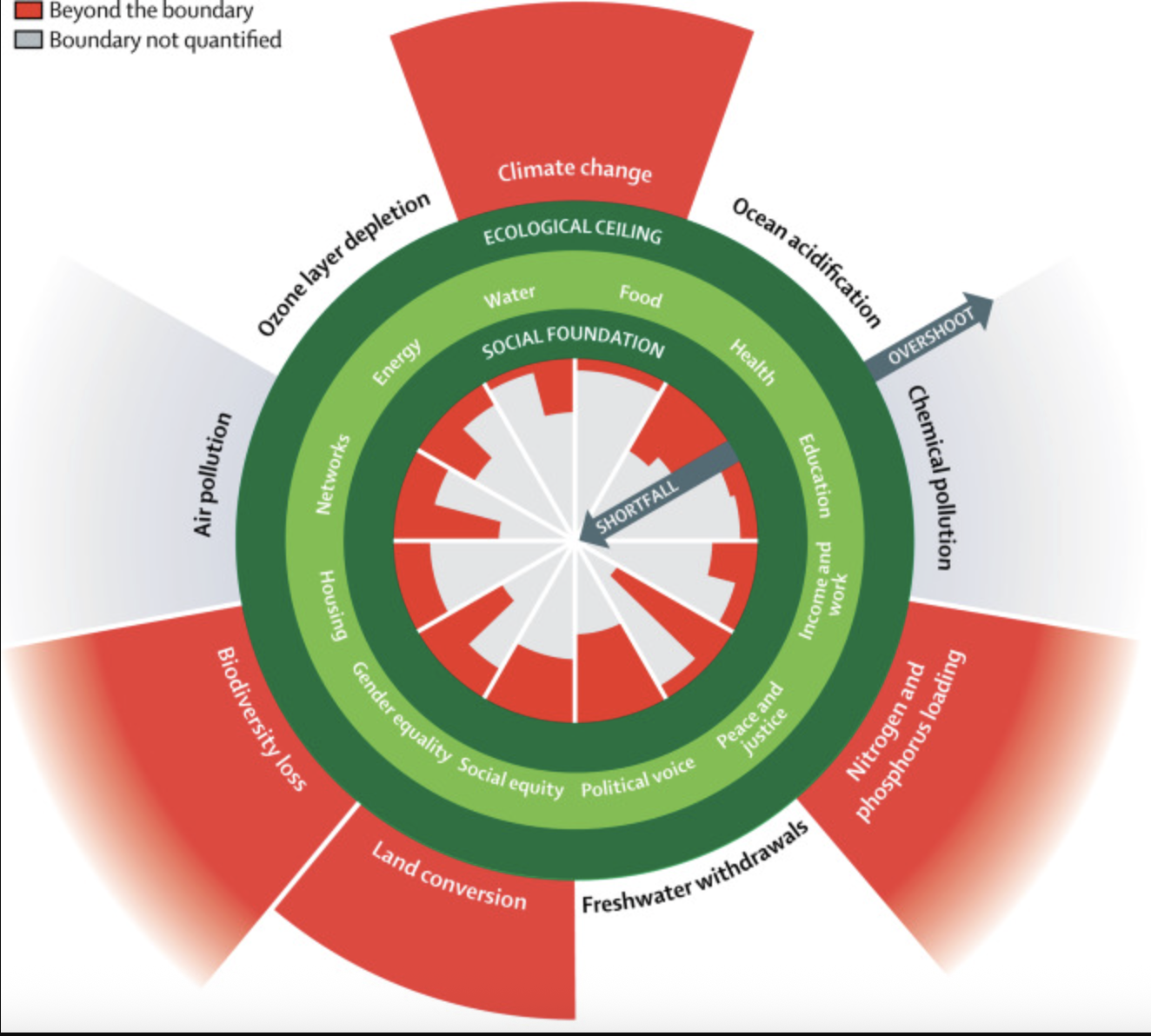
The ‘doughnut’ is a visual framework based around two concentric rings – a social foundation, covering basic human needs, and an ecological ceiling, based on environmental thresholds – to identify a safe and just space where both humanity and ecology thrive together.
The concept promotes ‘stabilization’, which suggests that once societies meet their basic needs, they should shift from growth to balance. However, for much of the Global South, reaching this point of balance remains a distant goal.
These countries are not starting from the same baseline as the Global North; it is more like a marathon where some runners begin miles behind the starting line. They must first cover this extra ground – building social foundations and reducing poverty – before they can stabilize and focus on long-term sustainability.
Before the Global South can reach a point of stability, it needs to grow. This challenges some assumptions in the ‘degrowth’ discourse – which focuses on reducing economic activity to lessen resource use – and instead frames growth in terms of new success measures that better fit the realities of developing countries.
Degrowth is one part of a broader ‘post-growth’ conversation. The post-growth approach questions the need for endless economic expansion and instead promotes economies designed to support well-being and sustainability. It holistically frames the well-being economy and aims to balance social, economic and environmental goals without ignoring the benefits of economic growth – benefits that remain especially important for the Global South.
However, degrowth skews too far away from economic dimensions, which limits the ability of the Global South to achieve its social foundations.
Lessons from the Global South
So, where do we begin to determine a more appropriate model of doughnut economics for the Global South?
Balance with nature, reciprocity and solidarity are key principles embedded in many Indigenous cultures – from the Americas, to China, India and Kenya. And these Indigenous economies promote sufficiency rather than infinite growth; equity and redistribution of wealth rather than accumulation. Many subsistence economies are also characterized by circular agriculture models, which minimize waste and emissions.
Take the Pashtun culture of Afghanistan and the north-western Pakistan as an example. It is traditionally guided by values of community cohesion and participatory governance through institutions like “Hujra”, where Indigenous knowledge is transferred through intergenerational collaboration between communities.
The Pashtun live in a region rich with minerals and cultivable land still needs to be productive through modern industries. As the region faces conflicts and environmental disasters, it needs to follow a collaborative and ethical framework of development that both helps increase production from natural resources, while reducing inequality and ensuring the availability of natural resources for future generations.
Ashar is another tradition of Pashtun/Afghan culture, which is based on collectively managing community tasks and providing a sense of belonging to every member. Ashar is usually seen during harvest time in activities like collective farming and house building, but it could also support shared economic well-being and growth, creating fairer opportunities to work and increasing GDP without widening class divides.
Tribes such as the Gonds, Santhals and Bhil in India understand the delicate balance between the natural world and their survival. Their sustainable practices – from sustainable hunting methods to agroforestry that preserves forest ecosystems – help prevent overexploitation and ensure long-term ecological stability.
In Peru, nearly one-fifth of the population is Quechua or Aymara. In their Andean worldview, life is organized into three interconnected communities, or ayllus: the natural world, the human and domesticated world, and the sacred world. Well-being (Sumak kawsay) comes from keeping these three in balance through mutual exchange and care (ayni).
Youth as catalysts for equitable doughnut economies
Young people can play a vital role in reshaping and promoting cultural practices by combining them with sustainable and technology-based approaches. As awareness of climate resilience grows, more youth are actively involved in supporting Indigenous knowledge systems. When these traditional practices are blended with modern technologies such as artificial intelligence, they can offer powerful solutions for both social and environmental well-being.
Building on the role of young people, it’s important to recognize that many nations in the Global South have not yet reached economic stability. A sudden leap to a “post-growth” model – an approach that shifts economies away from prioritizing endless GDP increases and instead towards prioritizing well-being and sustainability – can risk overlooking essential developmental needs.
In these contexts, youth can help shape pathways that gradually integrate sustainability and innovation without compromising the basic growth required to secure social foundations. For example, a gradual pathway might involve expanding green industries and community enterprises that create jobs and improve living standards, while steadily reducing environmental harm.
A doughnut economic vision is very compelling, but countries with low GDP still require a phase of growth that is rooted in their local traditions, equity, health and education, to create a foundation for a just transition. In this perspective, youth already challenging the current systems must be allowed to reimagine the way of economic expansion and blend it with human development.
According to the World Economic Forum’s 2025 The Future of Jobs report, agriculture will become a major source of employment. Youth from around the world are turning more to sustainable and climate-smart farming practices, marking a positive shift towards a regenerative economy.
However, in the Global South, it is essential to engage in activities that are based on modern technology with Indigenous wisdom. Youth must have capacity building in such activities and encourage them to lead sustainable agriculture practices that are more resilient and locally grounded.
A good example of this is the initiative of Future50 by the World Economic Forum, along with the Global Shapers Community and Strategic Foresight Network, which will train 50 participants from across the world on using foresight tools and developing a regional perspective of how the future will look in the upcoming decades, and integrating foresight into policies.
Towards a doughnut for the Global South
Rather than adopting the doughnut “as is”, the Global South must reinterpret it as a two-step process:
- Just growth: Unlike the Global North, which focuses on the post-growth agenda, the South should focus on just growth that supports decent economic growth to address the basic needs of the growing population. Focusing on green and inclusive growth that brings just development before sustainability thresholds can be enforced. Overall, 85% of people worldwide who lack access to electricity now live in Sub-Saharan Africa. Due to this, Africa will need a huge investment in clean and green energy that’s affordable and scalable to the entire population.
- Stabilization phase: The stabilization phase in the Global South should not be based on a universal carbon cap, but instead on access to financial pools for driving investments in the upgrading of carbon-intensive industries towards green energy.
Additionally, the Global South also include indicators based on cultural frameworks that define a balanced point. For example, Bhutan’s philosophy of measuring happiness based on gross national happiness set a boundary or threshold through social-ecological well-being indicators. This approach shifts the focus of national progress from pure economic growth to a broader standard of social and ecological well-being, influencing how policies and resources are prioritized.
Raworth also advocates that doughnut economics is not a specific solution that is to be followed by everyone as it is, but it's a framework that can be adjusted and adapted to local needs with indicators that best define the sustainability of the community.
Just as her economic framework has been tested in Amsterdam, so in the same manner it should be tested in cities of the Global South, but with an aim to reach the development to the balanced phase of GDP growth and then move towards the post-growth phase of doughnut economics.
Don't miss any update on this topic
Create a free account and access your personalized content collection with our latest publications and analyses.
License and Republishing
World Economic Forum articles may be republished in accordance with the Creative Commons Attribution-NonCommercial-NoDerivatives 4.0 International Public License, and in accordance with our Terms of Use.
The views expressed in this article are those of the author alone and not the World Economic Forum.
Stay up to date:
Circular Economy


Forum Stories newsletter
Bringing you weekly curated insights and analysis on the global issues that matter.
More on Economic GrowthSee all

Larry Fitzgerald Jr and Kelvin Beachum Jr
April 6, 2026