How the US GENIUS Act and EU’s MiCA signal transatlantic convergence on crypto rules
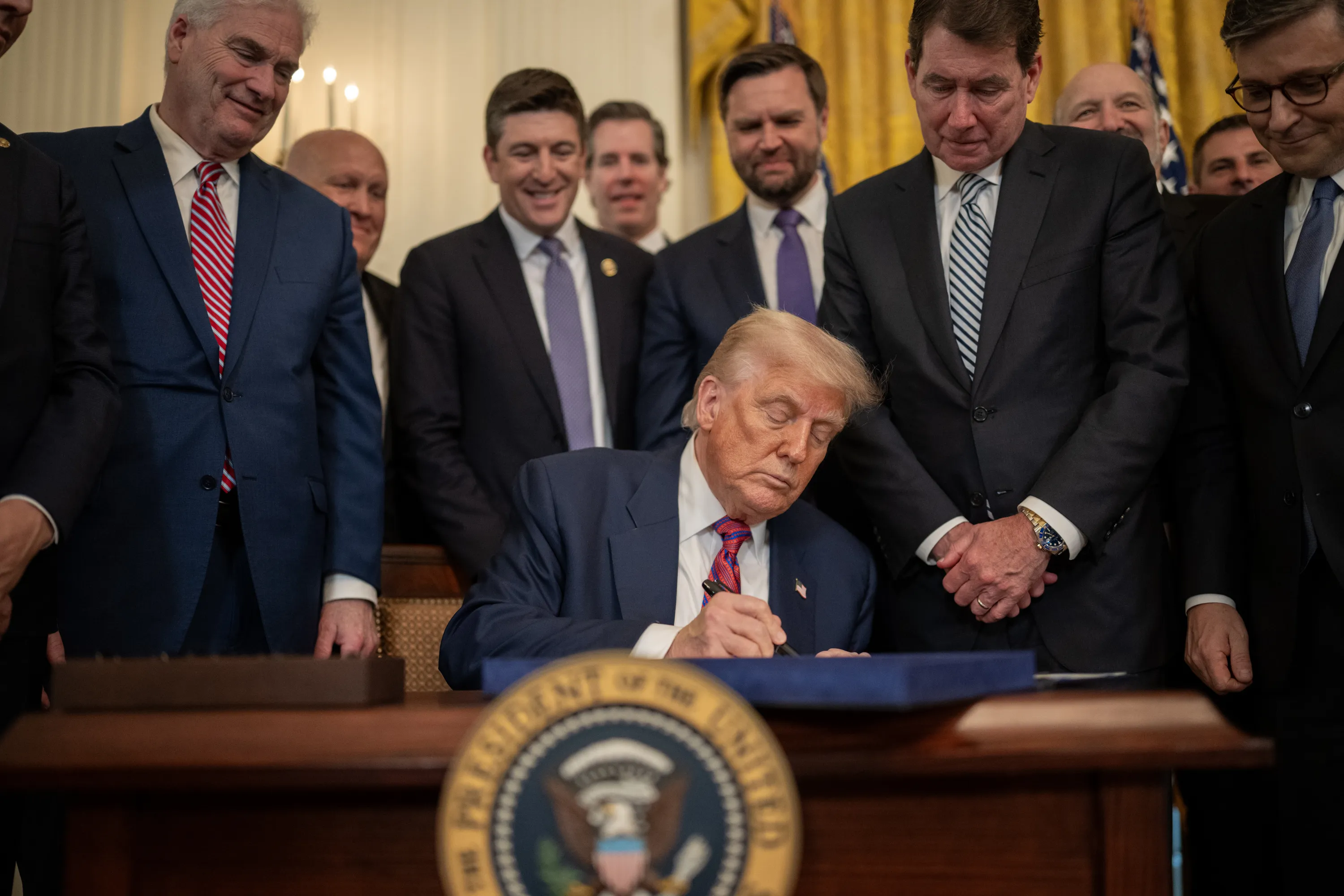
US President Donald Trump signs the GENIUS Act into law in July 2025. The act has much in common with EU crypto regulation, but also goes further in some respects. Image: Whitehouse.gov
- Regulating the growing cryptocurrency market has become an increasingly important issue for many governments.
- The latest US rules under the GENIUS Act show some alignment with EU crypto regulations, which could mitigate regulatory arbitrage.
- Policy-makers should aim to create the right environment for a trusted, open money source that can power the next chapter of the digital economy.
The passage of the GENIUS Act in July 2025 – a landmark bipartisan US stablecoin law providing long-needed regulatory clarity for crypto markets – has ignited fresh debate in the EU about the risks such developments may pose to the bloc.
Policy-makers are voicing concerns over monetary and payment system sovereignty, as well as raising questions as to whether the EU’s far-reaching 2023 Markets in Crypto-Assets Regulation (MiCA) is fit for purpose to avoid global regulatory arbitrage.
Like all frameworks in emerging tech domains, MiCA must achieve product–market fit with private sector actors, while also finding harmony with other global regimes – none more important than the transatlantic relationship between the EU and the US.
How MiCA and the GENIUS Act converge
There is more harmonization between MiCA and the newly-passed GENIUS Act than first meets the eye. This should assure EU regulatory and prudential authorities, including the European Central Bank, that the US Congress did not take a very different approach in bringing payment stablecoins into the regulatory perimeter.
For example, US-regulated stablecoins are now treated as peers to electronic money, bearing the designation “payment stablecoins” under GENIUS. This mirrors the EU’s e-money token regime.
On both sides of the Atlantic, regulated stablecoin issuers must also hold reserves in a conservative, one-for-one ratio against all stablecoins in circulation. Deposits are held in a bankruptcy-protected structure on issuers' balance sheets. This prevents payment stablecoins and e-money tokens from straying into securities or capital markets territory, which would necessitate a separate set of rules to regulate broader crypto markets and market conduct.
Both GENIUS and MiCA entitle crypto holders to the right of redemption at par – a safeguard long absent from the stablecoin sector. Each framework also imposes obligations on crypto exchanges and the broader value chain through which stablecoins reach end users.
In Europe, for example, exchanges faced a stablecoin “fiscal cliff” deadline requiring the de-listing of non-compliant tokens by 30 December 2024. In the US, GENIUS introduces criminal penalties for falsely advertising non-compliant products. It also compels exchanges to sharply restrict market access to issuers that fail to comply.
As with MiCA, compliance under GENIUS requires would-be stablecoin issuers to establish a locally regulated entity subject to the full spectrum of rules. This ranges from trust, transparency, disclosure and accountability standards, to strict adherence with anti-money laundering, counter-terrorist financing and sanctions obligations.
How GENIUS goes beyond MiCA
In key respects, the GENIUS Act is even more conservative than MiCA.
It eschews bank-related risks by prohibiting issuers from holding longer maturity bonds in their reserves. It also doesn't require either 30 or 60% of reserves to be held in banks, which could introduce credit risks from banking into stablecoin activities.
Moreover, under GENIUS, banks are required to issue payment stablecoins from a separate entity and balance sheet that’s set apart from its core banking business. This ensures these funds remain insulated from the leverage, maturity transformation and lending activities of the bank’s core operations. This same requirement does not exist under MiCA.
And when it comes to oversight, in the EU, e-money token issuers can be licensed and supervised by national competent authorities, but once they surpass certain thresholds of size, circulation or reach, they must “graduate” to pan-European co-supervision by the European Banking Authority.
The GENIUS Act embraces a similar model. It permits state-based licensing and supervision of stablecoin issuers, but once circulation exceeds $10 billion – a provision that mirrors the US dual banking system – issuers must also “graduate” to direct federal oversight by either the Federal Reserve, the OCC or the NCUA, the national credit union regulator. In all cases, payment stablecoin issuers are held to a common set of rules.
However, GENIUS goes one step further than MiCA in this area by empowering and encouraging the US Department of the Treasury to pursue regulatory passporting and harmonization with comparable jurisdictions. This opens the door for US-regulated issuers to expand internationally with the backing of a home-court regulator, while international issuers from credible jurisdictions with substantially similar regimes – like the EU – may gain continued access to US markets without having to establish separate US entities.
Protecting consumers from vanity coins
The original concerns that gave rise to MiCA, GENIUS, and the broader central bank digital currency (CBDC) space race were fears of big tech taking over money. But both EU and US regimes are unequivocal: Public authorities on both sides of the Atlantic will not permit another big tech vanity coin such as the ill-fated Libra project, which animated concerted global efforts at crypto rulemaking.
Despite the allure for commercial giants to enter banking and payments, EU and US competition laws impose guardrails, while the US has also maintained a long-standing regulatory separation of banking and commerce. The GENIUS Act goes further by creating a special committee, chaired by the Treasury Secretary and other banking principals, with authority to approve or block any big tech or commercial payment stablecoin structure.
Beyond regulation, the market itself has shown little appetite for branded, closed-loop stablecoins linked to incumbents. They typically resemble little more than monetary airline miles – usable only within closed networks – rather than true, open, universally portable mediums of exchange. In this, both MiCA and GENIUS reinforce not only consumer protection, but the sovereignty of state-backed money itself.
The real competition is not between jurisdictions or regulators, but for trusted, open money that can power the next chapter of the digital economy. This outcome demands transatlantic leadership and harmonization, not rivalry.
Don't miss any update on this topic
Create a free account and access your personalized content collection with our latest publications and analyses.
License and Republishing
World Economic Forum articles may be republished in accordance with the Creative Commons Attribution-NonCommercial-NoDerivatives 4.0 International Public License, and in accordance with our Terms of Use.
The views expressed in this article are those of the author alone and not the World Economic Forum.
Stay up to date:
Cybersecurity


Forum Stories newsletter
Bringing you weekly curated insights and analysis on the global issues that matter.
More on Financial and Monetary SystemsSee all

Matt Strahan and Daniel Murphy
April 9, 2026


