How entrepreneurship education can bridge the global leadership gap

Entrepreneurship education could better prepare the next generation for leadership positions. Image: Centre for Ageing Better/Unsplash
Jean Daniel LaRock
President and Chief Executive Officer, Network for Teaching Entrepreneurship (NFTE)- Leaders capable of navigating uncertainty, mobilizing communities and bridging divides are in short supply.
- This threatens economic dynamism, the resilience of democratic institutions and our collective ability to tackle challenges like climate change, inequality and digital disruption.
- Through entrepreneurship education, we can empower leaders who survive complexity and transform it into opportunity.
Despite billions invested each year in leadership development, a global gap persists. Leaders capable of navigating uncertainty, mobilizing communities and bridging divides are in short supply. The 2023 Edelman Trust Barometer found that business and government leaders are widely perceived as failing to prepare societies for the future, while the World Economic Forum’s Future of Jobs Report 2025 highlights resilience and leadership as among the fastest-growing in-demand skills.
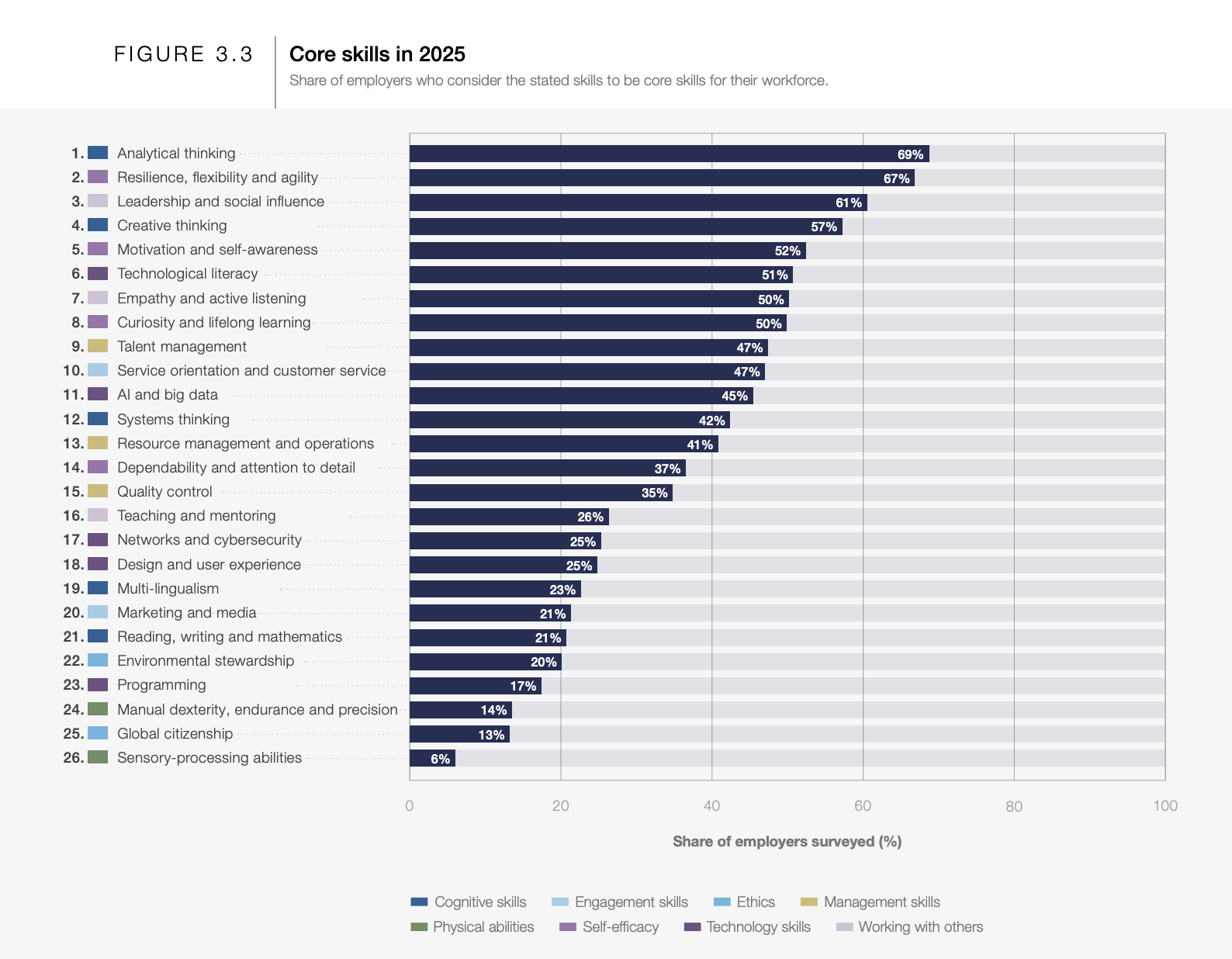
Without urgent action, this gap threatens economic dynamism, the resilience of democratic institutions and our collective ability to tackle challenges like climate change, inequality and digital disruption.
Entrepreneurship education offers a scalable solution. Beyond teaching students how to launch businesses, it develops a mindset of initiative, resilience, adaptability and creative problem-solving, the qualities leaders need to thrive in today’s complex world. By positioning entrepreneurship education as a leadership development strategy, policymakers, funders and educators can strengthen global pipelines of civic, business and social leaders prepared to renew institutions and sustain democratic ecosystems.
Closing the leadership gap with entrepreneurial skills
Many traditional leadership programmes often emphasize theory, but fail to prepare individuals to act amid ambiguity and rapid change. Entrepreneurship education builds transferable capabilities: recognizing opportunities, taking calculated risks and learning from failure. The OECD’s Education 2030 framework identifies these competencies as essential for future-ready learners, yet they remain underdeveloped in most education systems.
Universidad de las Américas (UDLA) in Ecuador provides a powerful example. Its UDLA para la vida curriculum, designed with the Minerva Project, requires every student to complete a cross-disciplinary entrepreneurship course. Coupled with Cosmos, the university’s innovation hub, this approach turns ideas into tangible projects, blending human-centred design with incubation and pre-acceleration support.
The results speak for themselves: more than 8,870 students have participated and in its first cohort, over 2,000 students enrolled in the entrepreneurship course. Cosmos has supported 21 student entrepreneurs and trained more than 4,000 entrepreneurs in a nationwide effort that connects them with the private sector. As UDLA Vice Chancellor Carlos Emilio Larreátigui explains: “We are committed to turning dreams into realities and helping others along the way.”
Leadership for social innovation and civic engagement
Entrepreneurship also fosters leaders who can mobilize resources and inspire communities to confront shared challenges. In India, The Global Education & Leadership Foundation (tGELF) deploys its SKILLD curriculum — developed with Harvard and Columbia Universities — across more than 3,000 schools, reaching over 5 million students. The gamified, experiential modules strengthen 21st-century skills, while its Youth Leader programme channels student energy into year-long civic projects. Alumni include Ramya Ahuja, a deep-tech entrepreneur pioneering sustainable materials and Sookrit Malik, founder of renewable energy company Energeia. They exemplify how entrepreneurial learning can seed long-term civic and economic leadership.
As Shiv Khemka, Chairperson of tGELF, said: “We need leaders who are ethical, altruistic, and innately capable. At tGELF, we are passionate about finding, supporting and igniting such leadership.”
In Latin America, Democracia+ is redefining how political leadership is cultivated. Operating across seven countries, the platform identifies, trains and connects emerging leaders who are both more effective in governing and more representative of the societies they serve. By bringing together multipartisan cohorts, Democracia+ strengthens democratic culture and builds the skills needed to collaborate across ideological divides. Rooted in an entrepreneurial mindset, the programme treats political innovation like venture creation — encouraging participants to identify civic problems, prototype solutions and scale impact through evidence-based governance. Since 2021, its programmes have reached more than 14,000 citizens and trained over 1,100 political leaders, with 85–94% of elected alumni running for office for the first time. Half of every cohort are women and half identify as non-white, directly challenging Latin America’s historic gaps in representation.
Across the network, local incubators are showing tangible results. In Brazil, RenovaBR has seen 180 alumni elected to office and 471 enter public service. In Costa Rica, +CostaRica helped 13 of 51 candidates win municipal elections in their first campaign cycle. And, in Argentina, Potencia Argentina received over 9,000 applications from across the country in its first year, selecting and training 250 leaders from 23 political parties. As Demoracia+ CEO Andrés Valenciano notes: “Democracy fulfils its promise when it delivers real results for people’s lives. That requires leaders with the courage and skills to turn dialogue into action and division into common purpose.”
Scalable and transferable models
Perhaps the greatest strength of entrepreneurship education is its scalability across contexts. Aflatoun International reaches over 45 million children and young people in 100+ countries with curricula blending financial and social education. From AflaTot (ages 3–6), which builds early decision-making skills, to AflaYouth (ages 16–24), which emphasizes employability and green entrepreneurship, Aflatoun’s model empowers learners to act as agents of change in their communities.
Independent evaluations back this impact. A World Bank study of Aflatoun’s Entrepreneurial Mindset Development Programme in India showed significant gains in student agency, academic performance and entrepreneurial skills — particularly among girls, who displayed enhanced confidence in business pitch scenarios. Kirsten Theuns, Director of Strategic Partnerships & Development at Aflatoun, explains: “Entrepreneurship education isn’t just about business skills — it’s about developing young people who see challenges as opportunities and understand their power to create positive change.”
A global imperative
Taken together, these cases illustrate how entrepreneurship education can be a unifying strategy for leadership development. Whether cultivating civic agency in rural India, preparing Ecuadorian students for uncertain labour markets, renewing democratic participation in Latin America or embedding life skills in global classrooms, these programmes share common DNA: experiential learning, mentorship and a values-driven approach.
At a moment when democratic trust is fragile, institutions are under strain and youth face existential uncertainty, scaling these approaches is not optional, it is essential. Entrepreneurship education is not about producing CEOs; it’s about nurturing a diverse generation of resilient, creative and integrity-led leaders.
As the World Economic Forum’s Global Future Councils gather to chart systemic responses to global risk, here’s a call to action: embed entrepreneurship education within the architecture of skills policy, democracy revitalization and human capital investment. The evidence is clear: bridging the leadership gap starts with rethinking how we educate the next generation. Through entrepreneurship, we can empower leaders who don’t just survive complexity, but transform it into opportunity.
Don't miss any update on this topic
Create a free account and access your personalized content collection with our latest publications and analyses.
License and Republishing
World Economic Forum articles may be republished in accordance with the Creative Commons Attribution-NonCommercial-NoDerivatives 4.0 International Public License, and in accordance with our Terms of Use.
The views expressed in this article are those of the author alone and not the World Economic Forum.
Stay up to date:
Entrepreneurship
Related topics:


Forum Stories newsletter
Bringing you weekly curated insights and analysis on the global issues that matter.
More on Education and SkillsSee all

Mirielle Eaton
April 1, 2026


