Opinion
How neuroscience is reshaping the way we grow and eat
Embedding neuroscience into food systems can nourish the body and also improve brain health. Image: Getty Images
- Brain health should be a global priority in the 21st century, with brain illnesses the leading cause of disability worldwide.
- Nutrition, environmental exposures, stress and social context are critical determinants of brain health, but are often treated in silos.
- By applying neuroscience to food systems, nutrition can improve brain health and well-being, as well as nourish the body.
In the same way that the 20th century saw heart health become a global priority, the 21st century could do the same for brain health. Today, brain illnesses — from depression and anxiety, to dementia and stroke — are the leading cause of disability worldwide, costing trillions annually.
Yet food systems — how we grow, process, distribute, and consume what sustains us — rarely account for the brain explicitly. Nutrition, environmental exposures, stress and social context are all critical determinants of brain health, but they are often treated in silos.
A growing body of promising evidence demonstrates that a neuroprotective diet is among the leading preventions of brain illness. Yet, this knowledge has not been systematically embedded into the design of food systems.
The Brain Health Initiative (BHI) Brain Health Circular Bioeconomy approach seeks to change this. By embedding neuroscience into agriculture and supply chains, food systems can not only nourish the body but also sustain cognitive performance, mental resilience and emotional well-being.
Why we need to enhance food systems now
The urgency is clear. Global food demand is rising as climate pressures intensify. The burden of neurodegenerative disorders is escalating and mental health challenges — already worsened by the pandemic — continue to grow. Without intentional design, food systems risk fuelling, rather than mitigating, brain illness and inequity.
Conversely, redesigning food systems for brain health offers a rare triple dividend:
- Economic return (ROI): Companies that measure and market brain-healthy practices can achieve premium positioning and efficiency gains.
- Value on investment (VOI): Trust and environmental, social and governance (ESG) credibility improve when organizations transparently report on nutrient integrity, workforce safety, and regenerative practices.
- Brain health return (BOI): Societies benefit when populations age with resilience, children learn better, and workplaces thrive with lower stress and higher productivity.
Together, these returns make the BHI Brain Health Bioeconomy not just a public health imperative, but a compelling business case.
The New Frontiers of Nutrition platform at the World Economic Forum exists to catalyse this kind of innovation: turning science into scalable standards that governments, businesses and communities can co-create and adopt.
A circular food systems model
"Molecules to metabolism, soil to synapse” is a brain health initiative that offers a framework to integrate agriculture, neuroscience, medicine, nutrition, public health and sustainability.
“From molecules to metabolism” describes the journey of nutrients. It begins with identifying protective compounds in plants — vitamins, flavonoids and other bioactives — and follows them through processing and into the body, where metabolism makes them available to support health and resilience.
Meanwhile, “from soil to synapse” connects agriculture to the nervous system. It begins with healthy soils and sustainable farming, continues through safe production and consumption and ends at the synapse — the communication point between nerve cells in the brain and body. Synapses control how we think, learn, move and respond to the world around us.
Together, these phrases capture the circular connection between farming, food, metabolism and the health of both brain and body.
The approach has been devised by the Brain Health Initiative, a global nonprofit powered by the interdisciplinary expertise of the BHI Brain Health Consortium, together with Fruitist — a superfruit brand and a member of the World Economic Forum Unicorns community. The model follows a simple but powerful logic.
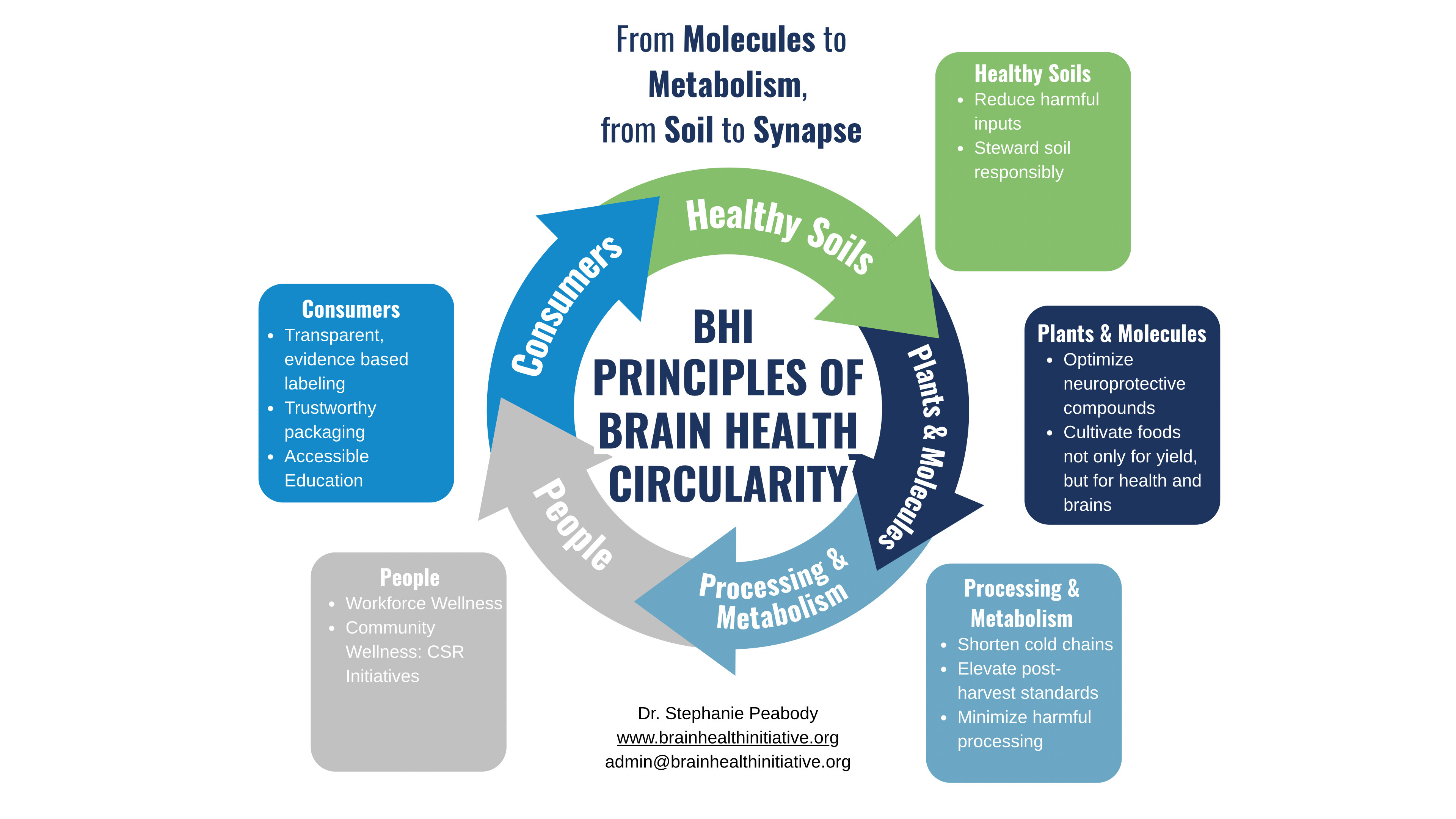
It begins with the soil: healthy soils and regenerative practices circularize food systems, protect ecosystems and support the neurobiology of those who grow and consume food. By addressing harmful inputs, these practices also reduce toxin exposure for both workers and consumers.
From the soil, attention shifts to plants and molecules. Through molecular profiling, neuroprotective compounds — from flavonoids to vitamins — can be identified and optimized, ensuring that cultivation harnesses both genotype and management to deliver food that supports yield, ecosystem health and brain health.
The journey continues through processing and metabolism. By shortening cold chains, elevating postharvest standards and eliminating unnecessary processing, brain-relevant bioactives are preserved so they remain available for absorption and metabolism, directly linking agricultural practices to brain function.
At the same time, workforce and community well-being are prioritized. Using a proprietary BHI Brain Health Vital Signs (BHVS) screener and the BHI Brain Health Perception and Prioritization Surveys, brain health protective factors and risk factors of brain illness are screened and data-informed programming offered to support the workforce, their families and the agricultural communities — reinforcing that healthy food systems and healthy people are interwoven in a virtuous cycle. Corporate social responsibility initiatives further support farming communities in fostering cultures that protect both health and well-being.
Finally, at the consumer level, the model closes the loop with metabolism and synapse. Evidence-based labelling, trustworthy packaging and accessible education empower families to make deliberate choices that strengthen their brain health while also protecting the health of the planet.
Prototype for improving brain health through food
The BHI Brain Health Circular Bioeconomy traces its origins to a small community farm, where Ed Chiles and his team at Gamble Creek Farm, Manatee County, Florida, pioneered sustainable and regenerative practices — transforming a local experiment into a global blueprint for advancing both brain and planetary health.
In partnership with the Brain Health Initiative (BHI) and leading academic collaborators, Fruitist, a fresh-produce company, is the inaugural prototype partner, now exploring how regenerative agriculture, molecular profiling, workforce wellness and consumer communication can be unified within a single, science-based certification system – scaled globally across continents.
This is not about passing a test. No agricultural company today would score perfectly on the BHI Brain-Healthy Circular Bioeconomy Certification, nor should they be expected to. Instead, the evaluation process produces evidence-based recommendations that highlight leadership, reveal gaps, and guide continuous improvement.
Early phases (1A and 1B) show promise. Regenerative practices are reducing chemical inputs; molecular assays are being designed to identify neuroprotective compounds in berries; workforce surveys will capture protective and risk factors across executive leadership, operations and field workers, and driving data-informed support; and consumer-facing packaging is being reconsidered as both an educational and sustainability tool.
By aligning these elements, Fruitist is demonstrating how profitability, human well-being and planetary stewardship can reinforce one another rather than compete.
Setting standards and scaling impact
The brain health circular bioeconomy offers a blueprint for collaboration across industry, government, and society. Standards only work when they are interoperable and widely adopted.
To scale brain-healthy food systems globally, governments, growers, retailers, consumers payers, and investors must work together to co-create these standards.
We invite:
- Governments to incorporate brain health into food and nutrition policy.
- Growers to adopt regenerative practices while increasing profitability.
- Retailers to prioritize brain-healthy SKUs and consumer literacy.
- Consumers to demand transparency, choose brain-healthy options, and champion sustainable practices that support both people and planet.
- Payers and investors to recognize brain health as a key metric of long-term value.
The brain health circular bioeconomy is aspirational, but achievable. Just as heart health reshaped industries in the last century, brain health can define this one.
This work was highlighted at the World Economic Forum’s Sustainable Development Impact Meetings and will continue to inform conversations leading up to the Forum’s Annual Meeting in 2026.
Brain health is the human capital of the present. Just as heart health reshaped industries in the 20th century, brain health can define the 21st. By intentionally designing it into food systems — from molecules to metabolism, from soil to synapse — we can reduce illness, extend healthy years and build more resilient societies, while keeping agriculture both economically vibrant and environmentally sustainable.
With thanks to Tom Snyder, Andy Moose, Dr Mike Jaffee, Dr Uma Naidoo, Dr Shelley Carson, Dr. Scott Angle, Dr Charlie Messina, Dr Jean-François Meullenet, Dr Gabrielle Bachtel, Ed Chiles, Marshall Shafkowitz, Alaina Kleine and Sarah Benchea for their contributions.
Don't miss any update on this topic
Create a free account and access your personalized content collection with our latest publications and analyses.
License and Republishing
World Economic Forum articles may be republished in accordance with the Creative Commons Attribution-NonCommercial-NoDerivatives 4.0 International Public License, and in accordance with our Terms of Use.
The views expressed in this article are those of the author alone and not the World Economic Forum.
Stay up to date:
Food Systems


Forum Stories newsletter
Bringing you weekly curated insights and analysis on the global issues that matter.
More on Food, Water and Clean AirSee all

Duncan Wood
March 22, 2026


