Impact investment's open secret is spotty data. Better measurement can change that

Business leaders need to develop better strategies for measuring impact in the impact investing sector. Image: Unsplash/ScottGraham
Lauren Kaufmann
Assistant Professor of Business Administration at the Darden School of Business, University of VirginiaMaoz (Michael) Brown
Research Director, Impact, Value, and Sustainable Business Initiative, Wharton School, University of Pennsylvania- Impact investing focuses on creating positive impacts instead of merely avoiding social or environmental harm.
- But it can be difficult to measure, leaving business leaders unsure about how to implement it and whether it's having any real effect.
- Recent academic research highlights the benefits of impact measurement and shows how managers should track impact investing efforts.
Impact investing has now surpassed $1.1 trillion in assets under management.
Distinct from from ESG (environmental, social and governance) investing, philanthropy or corporate social responsibility (CSR), impact investing focuses on creating positive impacts instead of merely avoiding social or environmental harm.
A highly diverse field, impact investing is populated by family offices, high-net-worth individuals and specialized firms like Zurich-based responsAbility Investments, as well as industry giants like Goldman Sachs and Allianz.
But the methods used to measure the impact of this type of investing remain imperfect. Impact measurement involves using data to see whether an investment has led to a reduction in carbon, an increase in biodiversity or a fortification of social networks. This is much more difficult than tracking financial performance.
And the astonishing fact is that industry players know about the challenges of measuring impact. More than 90% of industry participants report struggles in capturing meaningful impact investing data, according to a recent survey by the Global Impact Investing Network (GIIN). Practitioners have called this problem of spotty impact data the industry’s “most open secret”.
Managers are also sometimes cautioned against deeper engagement in targeted impact measurement because impact measurement takes a lot of effort. For it to be effective, it needs to fit organizational strategy. Also, not every measurement tool will provide relevant insights and sometimes it just serves to prove what decision makers already know.
Unexpected benefits of measuring impact
Recent research published by the European Group for Organizational Studies, based on 135 interviews with US-based impact investors, reveals that impact measurement can create three unexpected benefits.
First, impact measurement facilitates communication and alignment. Measurement provides a shared language for investors, asset managers and executives, helping them set priorities and navigate expectations, even when the data itself is not fully reliable.
Second, measurement categorizes investments. Instead of evaluating effectiveness in absolute terms, it is often used to classify investments as "impact-driven", differentiating the more promising avenues to pursue impact.
And third, impact measurement sustains industry legitimacy. Since impact is central to the field’s identity, measurement – despite some of its flaws – remains necessary to validate claims and maintain credibility.
These insights provide important lessons to managers in any field of responsible and sustainable business. The pursuit of positive environmental and social impact is now central to corporate messaging and governance. Companies representing a market capitalization of $85 trillion already share some information on environmental and social performance. Business leaders should overcome their hesitation – as these benefits show, measurement is becoming essential.
Improving impact measurement
As managers continue or start measuring impact, they should enhance strategies designed to navigate the difficulties of impact assessments and make them more effective across industries.
As responsible business expands and the urgency of social and environmental challenges grows, the following four key actions, drawn from our research, should help managers track their organizations’ progress on the impact they create and ultimately guide investments toward the most effective solutions:
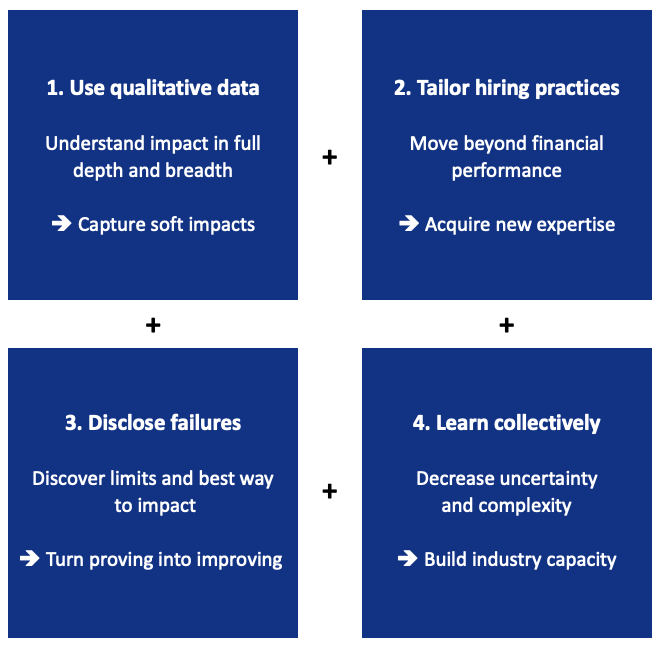
These actions will enable managers to address the challenges of impact measurement, but also, and more importantly, to increase their companies’ ability to create greater impact with their investments.
Tracking impact
There are also more immediate measures that managers can implement directly to track impact, as well as longer-term measures that would require more fundamental changes in managerial practices:
1. Integrate qualitative insights with quantitative data
Measurement is often reduced to numerical indicators, but biodiversity protection, social impact and behavioural change cannot be fully captured through metrics alone. Contextual narratives and stakeholder insights provide essential depth.
2. Hire experts beyond finance and compliance
Many firms struggle with impact measurement because it is handled by finance or accounting teams that lack subject-matter expertise. Hiring professionals with degrees in biology, psychology and policy analysis can improve the accuracy and relevance of assessments.
3. Normalize transparency about failure
Companies often tend to focus on showcasing success, but this prevents meaningful improvement. Reporting failures and unexpected outcomes helps refine strategy and ensures that future investments learn from past setbacks rather than repeat them.
4. Strengthen cross-industry learning
During COVID-19, when this research was conducted, managers seemed particularly keen to talk openly. But they revealed that while the challenges their companies encountered in measuring impact were acknowledged internally, these insights were rarely shared beyond their firms. More transparency, especially about failures, could help elevate measurement standards collectively across entire industries.
Advancing impact measurement
Impact measurement gives the industry meaning, aligns expectations and moves the field in the right direction on a step-by-step basis.
Managers governing funds and working with asset owners should not lean back and be satisfied with the status quo, however. Embracing qualitative data, hiring analysts with specialist degrees, talking about failure and creating industry-wide sounding boards for knowledge exchange will advance the field of impact investing.
These actions will ensure the practice of impact measurement maintains its unexpected benefits surrounding the alignment of expectations or the preservation of industry legitimacy. But they will also enhance the capacity of impact measurement to steer investment performance more deliberately.
Don't miss any update on this topic
Create a free account and access your personalized content collection with our latest publications and analyses.
License and Republishing
World Economic Forum articles may be republished in accordance with the Creative Commons Attribution-NonCommercial-NoDerivatives 4.0 International Public License, and in accordance with our Terms of Use.
The views expressed in this article are those of the author alone and not the World Economic Forum.

Forum Stories newsletter
Bringing you weekly curated insights and analysis on the global issues that matter.