What every manufacturing and supply chain leader should know about quantum technologies

In the face of increasing supply chain disruption, quantum technologies could offer vital efficiencies. Image: Unsplash/CHUTTERSNAP
- Quantum technologies could reshape global manufacturing and supply chains, unlocking new efficiencies and fortifying security.
- From Boeing to the Port of Rotterdam, examples of early use cases for quantum computing, sensing and security are growing.
- The World Economic Forum and Accenture explore strategies for adoption in the new white paper Quantum Technologies: Key Opportunities for Advanced Manufacturing and Supply Chains.
Quantum technologies are rapidly transitioning from the realm of theory into practical, value-creating tools for the manufacturing sector. For example, IBM and Boeing used quantum computing in research to find corrosion-resistant materials.
This shift could fundamentally reshape global manufacturing and supply chains, unlocking new efficiencies, fortifying security and providing forward-thinking leaders with a strategic edge.
The World Economic Forum and Accenture have been collaborating through the Quantum Application Hub and Industry Track to accelerate the adoption of quantum technologies across industries and inform policy development.
In a new white paper, Quantum Technologies: Key Opportunities for Advanced Manufacturing and Supply Chains, the Forum and Accenture share an overview of quantum’s relevance to industrial operations, including early case studies with measurable benefits such as efficiency gains, cost savings and improved resilience.
Here is what every manufacturing executive needs to know about the implications and opportunities presented by quantum technologies – plus how early action can help ensure future competitiveness.
The quantum imperative: Transformative potential in manufacturing
The past few years have highlighted the vulnerabilities of traditional manufacturing and supply chains, from pandemic-driven disruptions to escalating ransomware attacks and climate-induced shocks.
Last year, global supply chain disruptions rose by 38% year-on-year, driven by extreme weather, geopolitical tensions and labour strikes. At the same time, cybersecurity threats against industrial organizations surged 87%, with manufacturing accounting for 69% of ransomware attacks.
In this era of complexity and risk, quantum technologies are emerging as next-generation enablers.
Quantum computing, quantum sensing and quantum security systems are now poised to drive breakthroughs, offering unprecedented efficiency, accuracy and resilience that go far beyond the capabilities of classical technologies.
By accelerating production schedules, enabling ultra-precise measurements and ensuring mission-critical communications remain secure even in a post-quantum world, quantum innovations are set to redefine how manufacturers design, produce and move goods globally.
Quantum leaps: Early case study wins
Quantum technologies are uniquely positioned to address the challenges of complexity and security – and they are already delivering value.
Here are three emerging applications being piloted by manufacturers and supply chain leaders:
- Ford Otosan’s production scheduling optimization
Ford Otosan achieved a 50% reduction in vehicle manufacturing scheduling time at one of its sites by leveraging D-Wave's hybrid classical-quantum annealing. The company faced growing complexity in producing more than 1,500 highly customizable vehicle variants of Ford Transit vehicles. Each change in specifications, such as roof height or wheelbase, required reprogramming welding robots across 250 stations, often leading to delays. Scheduling production runs for 1,000 vehicles can take up to 10 minutes using conventional computing, and even longer with open-source tools, creating bottlenecks in the manufacturing process. To address this, Ford Otosan adopted a new scheduling approach using quantum annealers (quantum computers designed to solve optimization problems). This solution enabled the company to generate production schedules in under five minutes, even managing up to 16,000 constraints for a single production run.
- Driving 3D semiconductor innovation with quantum diamond sensors
Hidden flaws in microchips can cause production delays for the semiconductor industry. The adoption of quantum diamond sensors has enabled advanced quality assurance and diagnostic capabilities for next-generation 3D semiconductors. QuantumDiamonds' Quantum Diamond Microscope (QDM) creates precise 3D images of magnetic fields within chips, detecting faults without causing any damage. Unlike older methods, the QDM operates at room temperature and avoids the need for complex setups like vacuum chambers or cryogenics. The company is working with 7 out of 10 global semiconductor manufacturers, with the first QDM installation operational at Fraunhofer EMFT in Munich. This case study demonstrates how quantum-enabled tools can address industry bottlenecks in metrology, paving the way for more reliable, scalable chips in sectors like automotive, communications, and artificial intelligence.
- Rotterdam’s Quantum-Secure Port Communications
The Port of Rotterdam handles nearly 500 million tons of cargo annually and contributes over 8% to the Dutch GDP. It partnered with Dutch connectivity provider Eurofiber to pilot a quantum-secured fibre-optic network using Q*Bird's scalable quantum key distribution (QKD) technology. This network ensures that sensitive digital infrastructure and maritime communications remain "untappable" – providing full visibility into any tampering attempts and enabling instant key regeneration if intrusion is detected. This technological leap is not only about compliance, but a strategic shield against rising state-sponsored cybercrime and supply chain attacks.
The measurable effects of these pilots include reduced production bottlenecks, enhanced throughput, early detection of faults, lower security risks and improved agility – each offering tangible bottom-line impact for manufacturers who get in early.
3 quantum domains for manufacturers and supply chain leaders
There are three key areas where quantum is advancing and could have a strategic impact on industrial operations:
1. Quantum computing
Optimization: Gains in production and supply chain scheduling, vehicle sequencing, logistics planning and inventory management – at scales too complex for classical algorithms.
Simulation and material discovery: Ability to simulate atomic interactions for new material design, accelerating R&D for lighter, stronger or more sustainable products.
Business impact: From Ford Otosan’s vehicle sequencing to Boeing’s materials design projects, quantum computing has the potential to transform large-scale industrial optimization from a bottleneck into a competitive advantage.
2. Quantum sensing
Ultra-precise measurement: Enables sub-nanometer accuracy in monitoring, quality assurance and process control.
Predictive maintenance: Early anomaly detection allows for proactive asset management, reducing downtime and maintenance costs.
Semiconductors & advanced manufacturing: Quantum-enhanced sensors deliver faster defect detection and higher yield. Inertial measurement and magnetic field sensors deliver improvements in addition to existing navigation systems, positioning and robotic assembly.
3. Quantum security and quantum communications
Post-quantum cryptography and QKD: Shields sensitive operational and customer data from both classical and future quantum-enabled attacks.
Secure networks: Untappable, scalable quantum networks are already protecting Rotterdam’s critical port infrastructure and paving the way for secure, resilient logistics networks.
Regulatory compliance: Future-proofing data handling and trade operations ahead of evolving global cybersecurity mandates.
Strategies for adoption: From pilots to platforms
To scale adoption and benefit from quantum technologies, manufacturing and supply chain leaders can pursue several parallel strategies, from immediate actions to a longer-term vision, including:
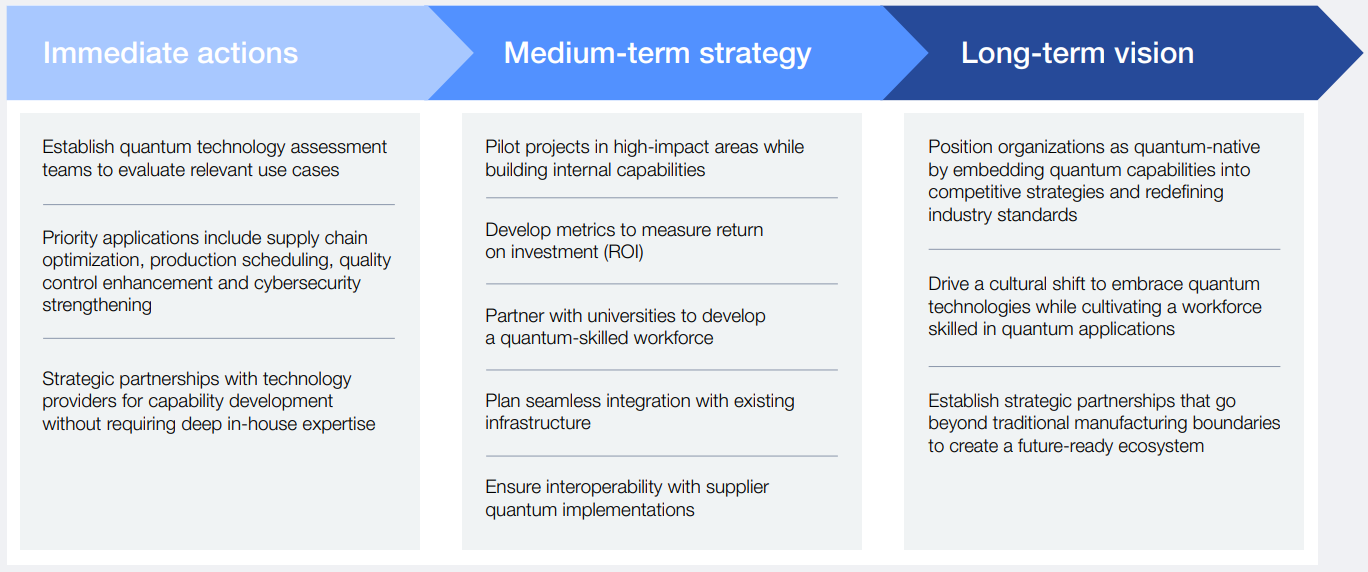
- Invest in talent and awareness: Build quantum-literate teams. Run upskilling programmes for existing professionals and foster a “quantum-aware” culture to ensure a broader understanding and adoption of quantum technologies.
- Run pilot projects: Start with cloud-based quantum platforms for experiments – these require minimal upfront investment, enable low-risk pilot projects and provide a fast track to identification of value.
- Align pilots to business outcomes: Prioritize projects that directly enhance efficiency, resilience or agility, linking quantum investments to strategic objectives.
- Collaborate for standards: Join consortia and industry bodies establishing common standards, sharing pre-competitive best practices and advocating for quantum-friendly regulatory environments.
- Balance hype with realism: Avoid exaggerating current capabilities – learn from AI, machine learning adoption curves. Recognize that meaningful returns are already emerging, but widespread transformation will take several years of iteration and scaling.
- Assess and mitigate risk: Regularly scan for supply chain choke points, track industry maturity and partner with best-in-class vendors to avoid costly missteps as the ecosystem evolves.
Building quantum fluency and platform competence today will define market leaders tomorrow. The quantum era isn’t years away. It is here, now, and manufacturing and supply chain leaders prepared to seize quantum’s potential stand to chart the future of their industries.
License and Republishing
World Economic Forum articles may be republished in accordance with the Creative Commons Attribution-NonCommercial-NoDerivatives 4.0 International Public License, and in accordance with our Terms of Use.
The views expressed in this article are those of the author alone and not the World Economic Forum.
Related topics:

Forum Stories newsletter
Bringing you weekly curated insights and analysis on the global issues that matter.
More on Emerging TechnologiesSee all

Jacob Nathan
September 25, 2026


