Why space technology convergence matters now
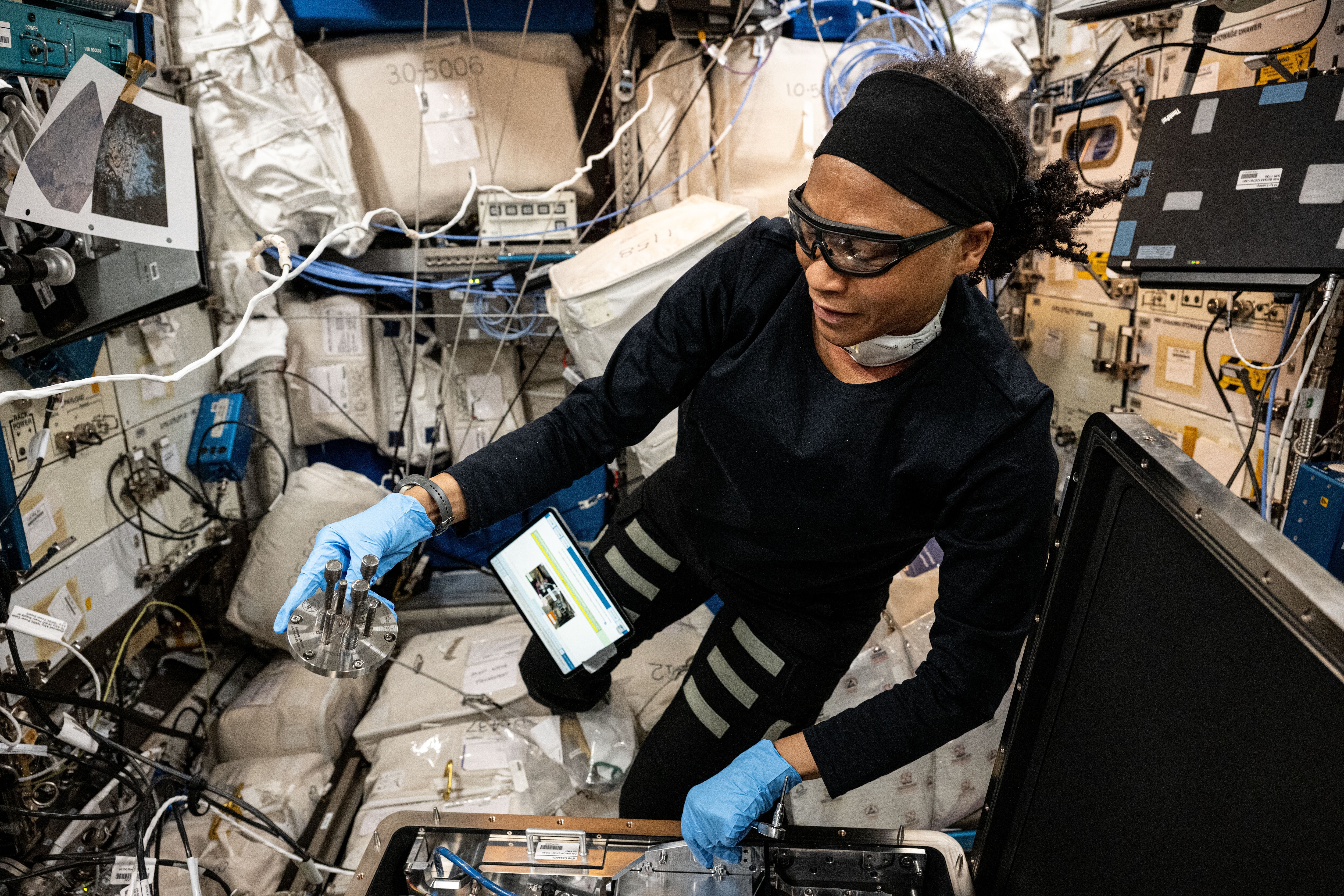
Space technology convergence is a new phase of innovation. Image: NASA
- Space technology applications are already embedded into our daily lives in everything from navigation to climate monitoring and financial transactions.
- Space technology convergence is a new phase of innovation, reshaping how we operate in space, as well as how we manage complex systems on Earth.
- Decisions taken now about how we develop, share and govern space technologies will reverberate across economies and societies for years to come.
From navigation and financial transactions to climate monitoring and emergency response, applications of space technology are already deeply woven into daily life on Earth.
But what is changing now is not just the scale of space activities, it is the speed and depth of new space technologies and applications, and the convergence between space and other breakthrough technologies.
Advances in artificial intelligence (AI), energy systems, climate technologies and quantum technologies are no longer evolving in isolation. Instead, they are reinforcing one another, with space acting as both a platform and accelerator.
This convergence is creating a new phase of innovation, one that is reshaping not only how we operate in space, but how we manage complex systems on Earth.
Space data intelligence enables insight and innovation across systems
Space is increasingly about understanding and acting on observations and information in real time. Advances in AI, edge computing and digital twins are transforming satellites into intelligent systems capable of processing data in orbit, detecting anomalies and adapting operations autonomously.
Recent space missions already demonstrate this shift. For example, the European Space Agency’s Φ-sat-1 (‘phisat-1) mission uses onboard AI to filter satellite imagery in orbit, reducing the need to transmit unusable data back to Earth and enabling faster decision-making.
Advances in space-based observations, combined with climate science, advanced modelling and data assimilation techniques, are turning raw measurements into actionable climate intelligence, from tracking emissions to forecasting extreme events.
This shift is reinforced by progress in quantum technologies, where integrated into existing satellite systems, quantum sensing and timing improve navigation and measurement precision.
Demonstrations of satellite-based quantum communication, such as China’s Micius mission, have already shown the feasibility of ultra-secure data transmission over global distances. In parallel, advanced materials and in-space manufacturing are enabling more capable and efficient satellites, while also unlocking new possibilities for future production of complex tissues and organs in space that cannot be produced on Earth, such as 3D printing muscle tissue in microgravity.
While biotechnologies and closed loop life-support systems developed for long-duration missions are expanding the boundaries of microgravity experimentation, they are also generating new insights into health therapies, agriculture and resource efficiency.
Together, these developments are creating a new layer of integrated, data-driven infrastructure, where space systems continuously generate, process and refine knowledge. The result is not just better information, but fundamentally new ways to innovate across sectors from climate modelling and logistics to healthcare and industrial systems.
Space as a critical domain for resilience and security
As space becomes more deeply embedded in economic and societal systems, it is also becoming a critical domain for resilience and security. Satellites underpin essential services, from communications and financial systems to navigation, emergency response, and energy networks. As reliance grows, so do vulnerabilities.
Recent disruptions to satellite services in conflict zones and increasing reports of jamming and cyber interference have underscored the fragility of space-dependent systems. Rising orbital congestion, debris, and increasingly sophisticated cyber and physical threats are driving a shift toward distributed, redundant, multi-layered architectures and more autonomous operations.
Here, convergence again plays a central role. Autonomous systems and robotics enable in-space servicing, debris removal, and infrastructure maintenance, reducing reliance on single points of failure. AI-driven autonomy enhances system resilience by enabling spacecraft to respond rapidly to disruptions and potentially also to self-repair without ground intervention.
At the same time, energy and power innovations, including space-based solar power, advanced batteries, and compact nuclear systems, are enabling sustained operations in space while offering pathways to more resilient and low-carbon energy systems on Earth. Quantum communication technologies introduce new approaches to secure data transmission, strengthening cybersecurity in both space and terrestrial networks.
Meanwhile, advances in manufacturing and materials support the development of more robust and adaptable infrastructure, and life-support and regenerative systems provide models for operating in constrained, high-risk environments, insights that are increasingly relevant for critical infrastructure resilience on Earth.
Why space technology convergence matters
Across both themes, the same pattern emerges and the implication is clear. Space is evolving into a connected system of systems, where advances in AI, quantum technologies, climate science, energy, manufacturing, biotechnology and robotics reinforce one another.
This shift is already visible in how governments, investors and industries are repositioning space as a strategic domain rather than a niche sector. Space is becoming a foundational layer of global infrastructure, shaping how societies generate knowledge, manage risk and build resilience.
The Space Technology Convergence Transformation Map, created by the Global Future Council on Space Technologies, places Space Technology as a central hub, and offers a systems-level view of interaction between eight converging technology domains, which are themselves intertwined with more than 200 defining topics.
Understanding how developments in a given domain (e.g., space, quantum, or AI) are likely to affect space investments visualizes interdependencies, supports structured foresight under uncertainty and highlights where cross-sector collaboration is essential.
For example, collaborations are emerging between space agencies and the energy sector on space-based solar power, and between health systems and space medicine and bioastronautics communities on life-support systems and biotechnology.
Innovations from space technologies can accelerate terrestrial adoption and resilience. By linking space technologies to priorities such as the climate crisis, food security and global health, this approach helps ensure that the emerging space economy – projected to reach $1.8 trillion by 2035 and growing at 9% per year – supports the United Nations Sustainable Development Goals both directly and indirectly, including by monitoring progress, rather than diverging from them. International coordination is highlighted as essential.
Space will have impact for decades to come
Space technology convergence marks a shift from exploration as aspiration to future infrastructure as necessity.
Governments can guide national space strategies that integrate industrial policy, climate action, digital infrastructure and security. Meanwhile, businesses can shape portfolio choices and partnerships, highlighting where investments in, say, advanced materials or green energy may benefit from space-enabled capabilities, as well as clarify where gaps are emerging, from orbital traffic management governance to jurisdictional and enforcement challenges in climate accountability, where space-based data can support the monitoring of emissions and environmental non-compliance.
Importantly, thinking about the convergence of space and other technologies reminds us that space is not a distant frontier, but a shared domain hosting critical infrastructure that supports our lives here on Earth. Decisions taken now about how we develop, share and govern space technologies will reverberate across economies and societies for decades to come.
Don't miss any update on this topic
Create a free account and access your personalized content collection with our latest publications and analyses.
License and Republishing
World Economic Forum articles may be republished in accordance with the Creative Commons Attribution-NonCommercial-NoDerivatives 4.0 International Public License, and in accordance with our Terms of Use.
The views expressed in this article are those of the author alone and not the World Economic Forum.
Stay up to date:
Space Technology Convergence
Related topics:


Forum Stories newsletter
Bringing you weekly curated insights and analysis on the global issues that matter.