How Arctic drones can redefine disaster response
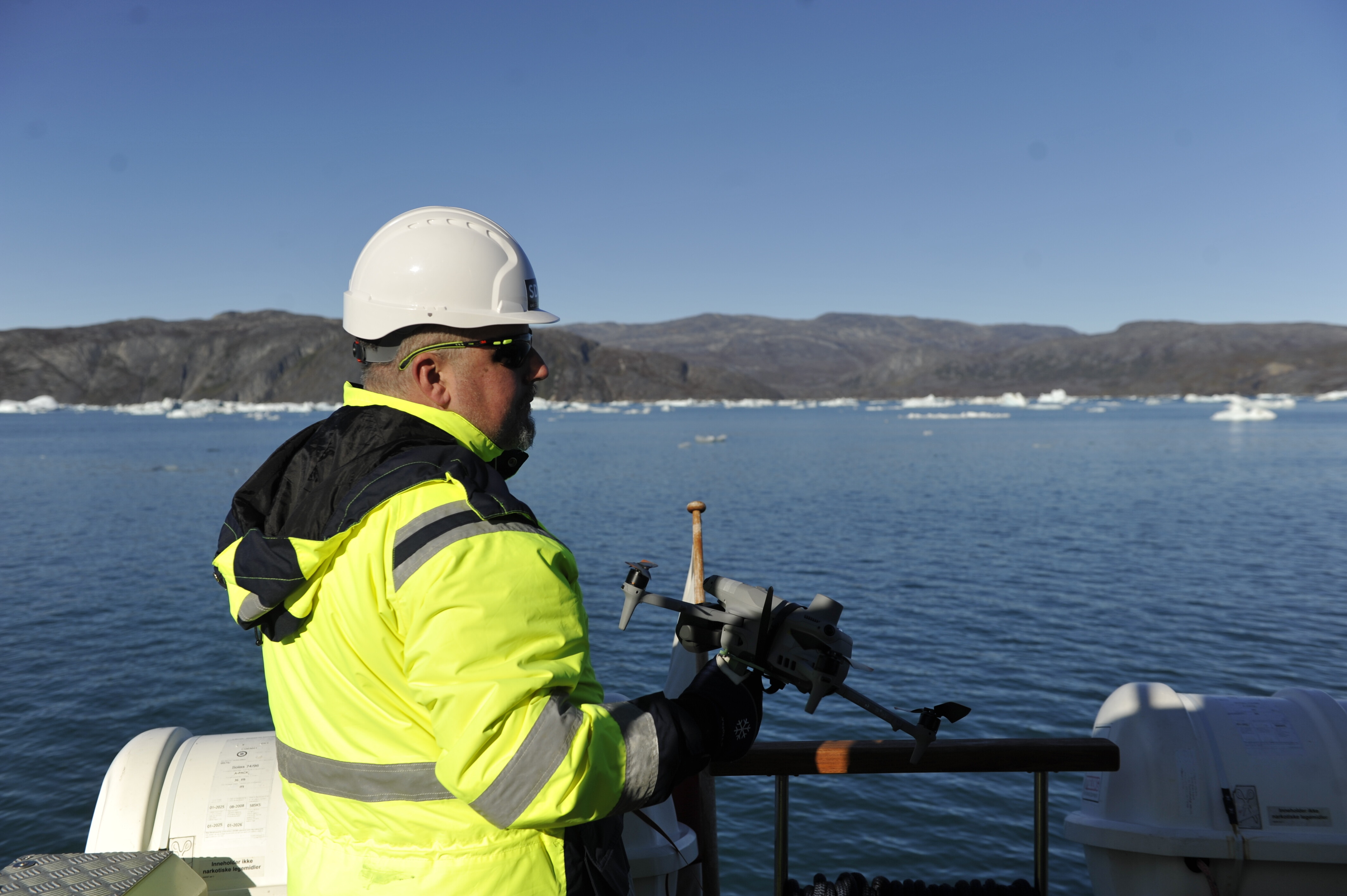
Testing drones in the Arctic. Image: University of Southern Denmark
- Across the Arctic, shipping, tourism and resource exploration are expanding rapidly as sea ice retreats, with maritime traffic growing by about 7% a year.
- Vast distances, freezing weather and fragile infrastructure make Arctic search and rescue one of the toughest operational challenges in the world.
- New drone technologies tested in Greenland could transform how the world responds to emergencies in remote and extreme environments.
In Greenland’s capital Nuuk, calm skies can turn perilous within minutes. For anyone stranded on sea ice or lost in fog, rescue time can mean the difference between life and death, and helicopters can’t always keep up.
Across the Arctic, shipping, tourism and resource exploration are expanding rapidly as sea ice retreats. Since 2013, the number of vessels entering Arctic waters has increased by over 37%, while total sailing distance has more than doubled. Maritime traffic grows by around 7% annually, and winter sailing time has tripled over the past decade.
Vast distances, freezing weather and fragile infrastructure make Arctic search and rescue one of the world’s toughest operational challenges. Here, every extra minute matters, and new technology is needed to extend visibility, speed and safety.
Testing drones in Greenland’s Arctic waters
A pilot study, conducted in Nuuk in September 2025, marks the first step in a broader Arctic search and rescue innovation effort. Researchers from the University of Southern Denmark and the Alexandra Institute, together with the Joint Arctic Command, carried out drone-based search and rescue (SAR) operations in the waters and fjords surrounding the city.
Funded by Denmark’s National Defence Technology Centre (NFC), the pilot is the first important step towards developing fully integrated drone-helicopter systems for extreme conditions.
Rather than testing whether drones can work in Arctic rescues – that’s already proven – the goal was to see how well standard, off-the-shelf technologies perform amid cold, wind and limited GPS coverage. The team aimed to identify both strengths and breaking points under real operational pressure.
Two drones were launched: one from a coastal headland known locally as “the world’s end”, the other from a small vessel in the icefjord. Researchers alternated between piloting and serving as “targets”, simulating missing persons by walking, lying down or hiding behind cliffs. The aim was to create a dataset that trains AI and machine learning systems to identify objects of interest in real time, providing critical insights to search and rescue helicopter crews.
“We wanted to know when our sensors work best, and when they fail,” says Jussi Hermansen, Senior Specialist at the Faculty of Engineering, University of Southern Denmark. “Thermal cameras can miss someone if cliffs are warm or water reflects light. You only learn that by testing in the real environment.”
Across 32 flights, the team confirmed that thermal imaging performs best during early morning or late evening, when the landscape cools, while strong sunlight can obscure objects entirely. The mission generated 250 GB of data, now used to train AI models to automatically detect points of interest in future operations.
Engineering against the elements with Arctic drones
The lessons from the Nuuk pilot go far beyond data collection; they mark the first step towards engineering drones capable of mastering Arctic conditions.
Flying drones in Greenland is a constant battle against extreme cold, ice and unreliable GPS. Batteries drain faster below zero, ice forms on rotors and communication links often fail near the poles.
The Nuuk flights served as a crucial data-gathering phase for developing the next generation of Arctic-ready systems. By observing how off-the-shelf technologies perform in real conditions, researchers can now refine hardware, sensors and AI for future rescue missions.
The broader goal is to move from experimental flights to operational systems that actively guide helicopter missions. This involves semi-autonomous drones that scan the terrain, mark potential targets, and stream live thermal and visual data to the helicopter crew, enabling faster, more precise searches.
Next, the team aims to develop a fixed-wing SAR drone that can be launched and recovered directly from a helicopter in mid-air. Inspired by Switchblade drones used in defense operations, the system is designed to unfold in flight, scan the terrain and return safely via a net or cable.
Such systems could extend helicopter search ranges by 20% or more – a critical advantage in Greenland, where the number of rescue helicopters is limited.
In this way, the Nuuk trial serves both as proof of concept and a springboard, transforming field data into design blueprints for the next Arctic SAR platform. Beyond search and rescue, these emerging drone technologies may also support defence, environmental monitoring and logistics, demonstrating the wider strategic and operational relevance of Arctic innovation.
A testbed for Arctic-ready technologies
Building on early lessons from Nuuk, the momentum is clear. Around the world, unmanned aerial systems (UAS) are emerging as key enablers for both emergency response and sustainable Arctic operations. The European Union’s integrated Arctic policy highlights unmanned aerial systems as essential for safety, climate monitoring, infrastructure inspection, wildlife conservation and resource management.
The International Maritime Organization’s Polar Code also flags the urgent need for stronger search and rescue capacity in polar waters. Meanwhile, Canada, the US and Russia are investing heavily in Arctic drone capabilities.
The European Commission estimates that by 2035, the drone sector could represent up to 10% of the EU aviation market, creating more than 150,000 jobs, underscoring both scientific and societal importance.
At the same time, the Arctic is warming nearly four times faster than the global average, reshaping coastlines, weather patterns and human activity. As new sea routes open and tourism expands, pressure on rescue infrastructure will only grow.
Greenland is rapidly becoming a testbed for Arctic-ready technologies, and the Nuuk pilot has positioned it at the forefront of this emerging field, watched closely by international researchers and governments.
From Arctic innovation to global resilience
What began as a small-scale pilot in Nuuk is now shaping a broader vision: technologies proven in the Arctic could transform disaster response in remote or damaged regions around the world.
Systems that fly stably without GPS and stream live data over long distances are equally valuable in earthquake zones, mountain rescues, wildfires and anywhere infrastructure has collapsed.
The Nuuk pilot was more than a research exercise; it was the first building block in a model of cross-sector innovation. It also helps SAR teams in data analysis, drone operations and real-time AI systems – building both digital and operational capacity for future emergencies.
“Standing on a boat in the fog outside Nuuk, launching a drone in the morning mist, that’s when it feels real,” says Hermansen. “We’re not just testing machines. We’re testing how to save lives in the toughest environment on Earth.”
Arctic drone tests could help redefine disaster response
As the Arctic becomes busier, the technologies first piloted in Greenland will have global implications. Drones that function where humans and helicopters struggle could redefine not only disaster response but also how we build more resilient, data-driven systems across industries.
Lessons learned in Greenland’s ice fjords can be applied in deserts, high mountains, or post-disaster zones, providing a blueprint for extreme-environment operations worldwide.
Ultimately, the Arctic is not just a frontier of risk; it is a laboratory of solutions, showing that innovation born in the cold can protect lives everywhere.
Don't miss any update on this topic
Create a free account and access your personalized content collection with our latest publications and analyses.
License and Republishing
World Economic Forum articles may be republished in accordance with the Creative Commons Attribution-NonCommercial-NoDerivatives 4.0 International Public License, and in accordance with our Terms of Use.
The views expressed in this article are those of the author alone and not the World Economic Forum.
Stay up to date:
Drones
Related topics:


Forum Stories newsletter
Bringing you weekly curated insights and analysis on the global issues that matter.
More on Climate Action and Waste Reduction See all

Syeda Hamna Shujat
March 24, 2026


