How caring companies are redefining capitalism

Businesses with care at their core could enhance capitalism . Image: Suraj Tomer/Unsplash
- For decades, classical economics has taught us that rational actors seek to maximize self-interest.
- This idea helped to create a free market economy, replacing domination-based feudal exchanges with voluntary trade among free individuals.
- Yet, true wealth comes not just from market exchange, but from care, trust and human connection with the members of one’s business ecosystem.
On an ordinary April morning, The FruitGuys, a California-based fruit delivery company, received a message from a client:
“When Jasmine found out my fruit hadn’t arrived, she arranged for someone to drive it — from San Francisco all the way to Bakersfield — and deliver it in person! I was stunned… and so happy to see his smiling face at my door. I love The FruitGuys and will be a customer as long as I live in your service area.”
Most companies would celebrate a review like that. But for The FruitGuys, stories like these don’t happen by chance; they’re the result of a deliberate business philosophy built around care.
Two details make this story remarkable. First, the client wasn’t a major corporate account — just an individual customer. Losing her wouldn't have had any significant financial impact on the business. Second, the person who made the six-hour round trip wasn’t a delivery driver; it was the director of operations, personally ensuring the good quality of delivered fruits.
Six hours on the road — for one box of fruit. For companies fixated on short-term profit, that sounds irrational. But for The FruitGuys, it made perfect sense.
Rethinking what value means
For decades, classical economics has taught us that rational actors seek to maximize self-interest — that each transaction should generate as much financial value as possible for each of the involved parties. This idea helped to create a free market economy, replacing domination-based feudal exchanges with voluntary trade among free individuals. Commerce, in many ways, was liberation.
Yet, freedom without connection can lead to isolation. A purely transactional approach to business can erode the social fabric that free markets depend on. Two facts will suffice to illustrate this point. Studies show that levels of trust in governments or large corporations have never been so low and the feelings of loneliness have never been so high, particularly among young people. Thus, value should not be measured only through the lens of short-term transaction efficiency; it should include the cost of negative externalities or, in simpler terms, of damage caused by business to society and the environment.
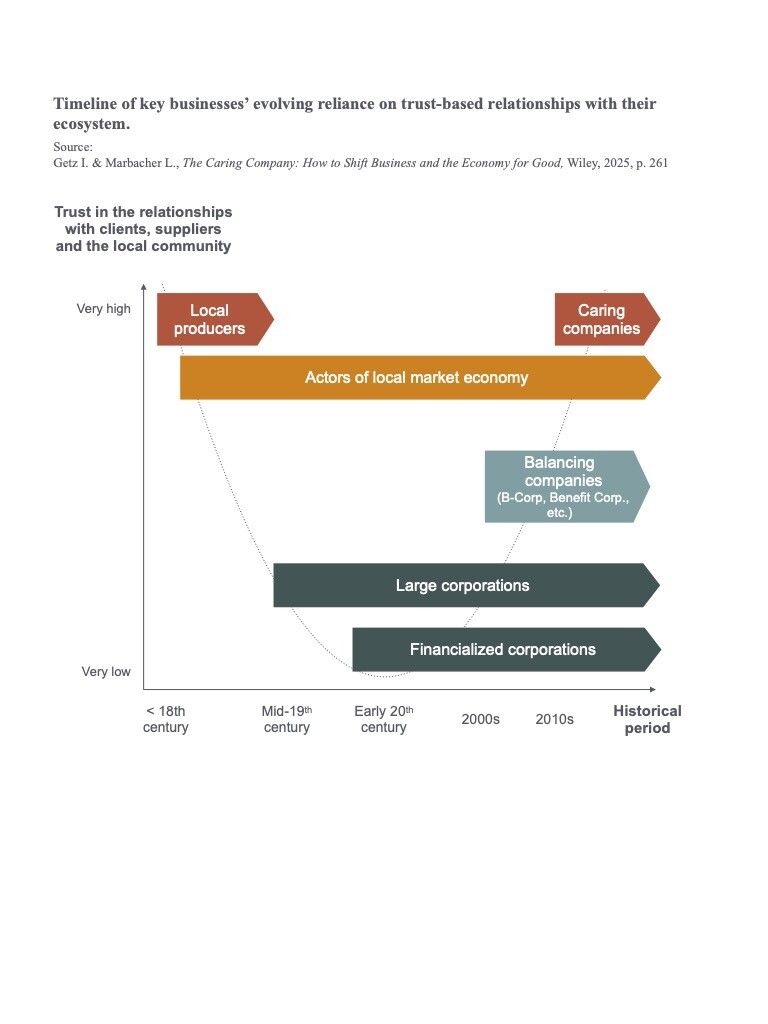
The rise of caring companies
Businesses, like The FruitGuys and many others we have studied, show an even more powerful way: they measure success not so much by revenue or profit but by the strength of their relationships and bet that economic results will follow. Their organizing principle isn’t 'maximize every transaction', but 'care, unconditionally.'
This applies to customers, but also to other members of the company’s ecosystem – clients, suppliers and local communities. At first glance, the logic of caring companies might look like stakeholder capitalism. But a deeper look reveals that the caring company concept is rather novel. First, unlike stakeholder capitalism, which tries to balance the shareholders’ interest with those of other stakeholders, the caring company focuses only on the social and environmental value for the members of its business ecosystem and bets that the value for shareholders will follow. Second, unlike stakeholder capitalism, which often views stakeholders as abstract entities, the caring company builds relationships with each concrete member of its business ecosystem — it cares for people that its employees can talk to face-to-face.
Take, for example, LSDH, a family-owned French industrial dairy with more than 2,000 employees. It welcomes truck drivers who arrive at its premises with a dedicated lodge with free food and drinks, showers and rest areas. Or look at Eisai, a listed Japanese pharmaceutical, which has transformed its focus from developing and selling drugs to alleviating the suffering of patients and their families.
Both of these companies don’t ignore profit. But profit for them is the consequence, not the purpose, of authentic care. By acting out of such care — even when it costs time or money — these companies deepen trust, build loyalty and strengthen their entire business ecosystem.
Their behaviour might look counterintuitive to traditional economists, but it’s profoundly rational over time. Authentic care compounds. Trust lowers transaction costs, increases resilience during crises, transforms customers into advocates, creates dedication of suppliers and builds the support of local communities.
From transactional to relational systems
To make care operational, companies must redesign their core business processes — customer service, supply chains, HR practices and more — around authentic relationships, rather than self-interested transactions. This is what Handelsbanken, a leading Swedish retail bank, did in the early 1970s. By giving decision-making power to its branches, instead of concentrating it in its headquarters, the bank allowed each advisor to maintain a close relationship with their clients. As a consequence, and not as a primary goal, Handelsbanken has outperformed its competitors year after year for more than five decades.
Such a transformation begins with leadership. It demands that executives replace a mindset of command and control with one of higher purpose, coupled with commitment to employee freedom and responsibility. They also understand that their leadership role is to eliminate the obstacles to providing unconditional care by employees, rather than to tell them what to do.
The future of capitalism
Revitalizing capitalism requires resetting some of its fundamental assumptions. For centuries, it has revolved around maximizing the value of each transaction. In the 21st century, the competitive edge belongs to organizations that focus on the quality of relationships instead.
True wealth comes not just from market exchange, but from care, trust and human connection with the members of one’s business ecosystem. Caring companies prove that acting this way may be the smartest business decision of all.
Isaac Getz and Laurent Marbacher are co-authors of The Caring Company: How to Shift Business and the Economy for Good.
Don't miss any update on this topic
Create a free account and access your personalized content collection with our latest publications and analyses.
License and Republishing
World Economic Forum articles may be republished in accordance with the Creative Commons Attribution-NonCommercial-NoDerivatives 4.0 International Public License, and in accordance with our Terms of Use.
The views expressed in this article are those of the author alone and not the World Economic Forum.
Stay up to date:
Redefining Prosperity
Related topics:

Forum Stories newsletter
Bringing you weekly curated insights and analysis on the global issues that matter.