How to make the green transition work for people and economies
Image: REUTERS/Jana Rodenbuschâ
- The shift to greater sustainability can be made more effective by paying heed to the needs of people and individual economies, according to a new report published by the World Economic Forum and McKinsey & Company.
- The report, Making the Green Transition Work for People and the Economy, offers ways to be more alert to these changing needs amid geopolitical disruption, persistent inflation and inequality.
- The report draws on insights from more than 11,000 executives based in 126 different countries.
The world is undergoing a period of economic and geopolitical realignment. Global trade and supply chains are being reshaped, with renewed domestic industrial incentives in the European Union, the US, and China changing the playing field.
Meanwhile global inflation remains above pre-pandemic norms, straining fiscal resources, especially in developing economies. Within countries, income inequality is widening, posing challenges for access, affordability, and social cohesion.
These shifts have far-reaching implications for competitiveness, living standards, and economic opportunity. So as governments and businesses pursue climate goals, support for the transition could fluctuate – depending on how well climate action aligns with people’s daily realities and economic prospects.
As outlined in a new report published by the World Economic Forum and McKinsey & Company, the need to ensure that the green transition works for both people and the economy has therefore never been more urgent.
Overcoming socioeconomic risks and maintaining competitiveness
While confidence remains high about the long-term benefits of climate action, many leaders are concerned about rising costs, uneven access to capital, and gaps in capacity that could slow or skew related progress.
Drawing on insights from over 11,000 executives across 126 countries in the World Economic Forum’s Executive Opinion Survey, the new report identifies three key barriers to competitiveness in the green transition:
Rising energy and commodity costs: 37% of executives report this as a constraint to competitiveness, rising to nearly 50% in low-income economies.
Regulatory uncertainty and compliance: 36% cite unclear or evolving regulation as a barrier, with concerns highest in high-income countries.
Slow returns on investment: 32% point to long payback periods and limited bankability of projects.
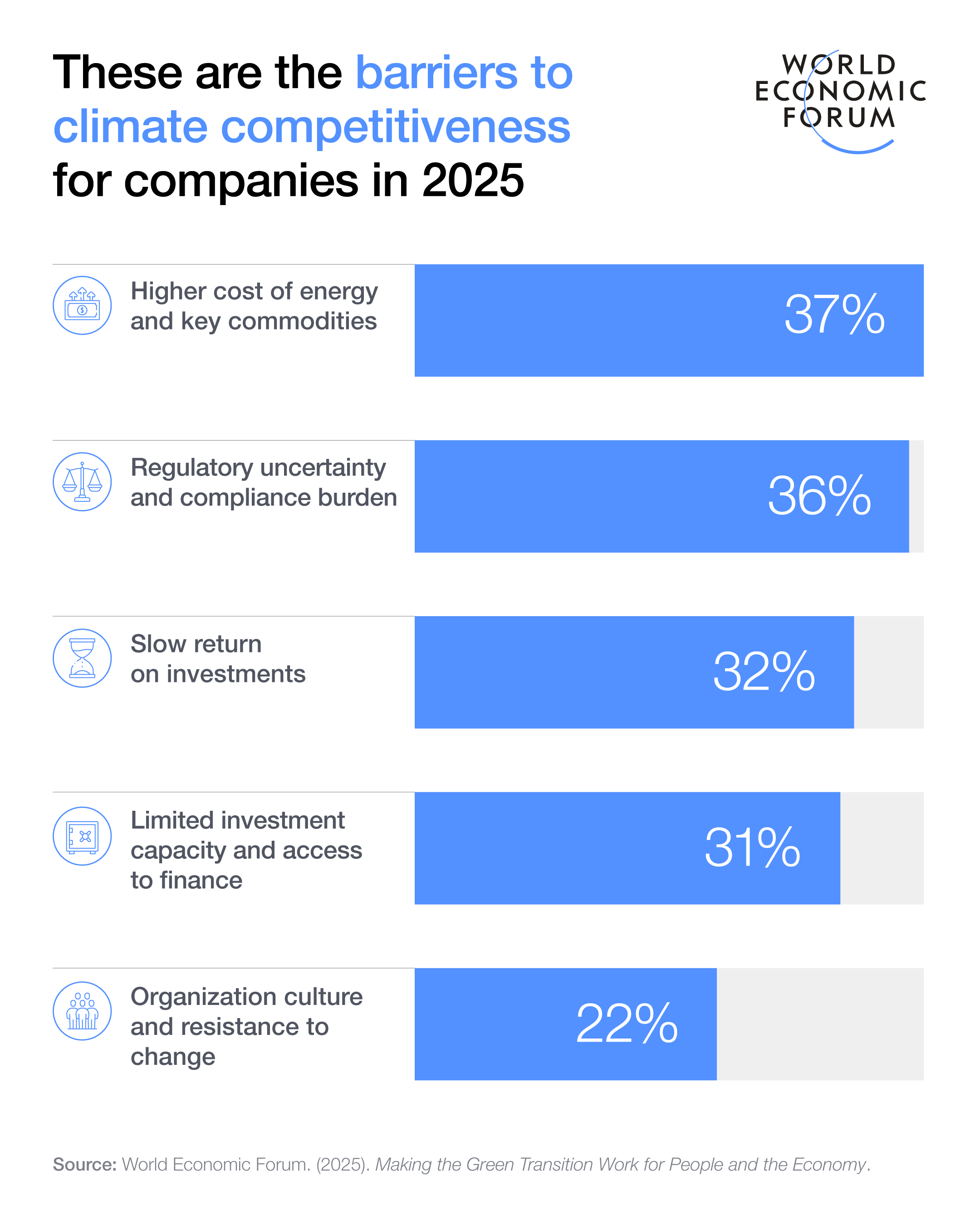
The issues of access to finance illustrates a particularly sharp divide: 49% of executives in low-income economies view limited green finance as a major barrier, more than double the 23% in high-income economies.
Cost pressures and divides in terms of access to capital and technology risk deepening further.
- 80% of executives say unequal access to financing poses a significant risk to competitiveness in at least one industry in their country.
- 71% highlight divides in access to technology and know-how as a similar concern.
- 51% worry about price hikes in key industries as the transition advances, while 66% anticipate knock-on effects to accessibility of goods and services for consumers.
Our research also shows that stronger social protection systems and more equal access to resources and services correlate with lower concern about the transition’s impacts on workers and consumers.
This underscores the diverse regional needs for long-term investment in social and economic foundations. To that end, the report presents a new iteration of a framing of countries into Equitable Transition Country Archetypes, from “Fossil Fuel Exporters” to “Green Developers.”
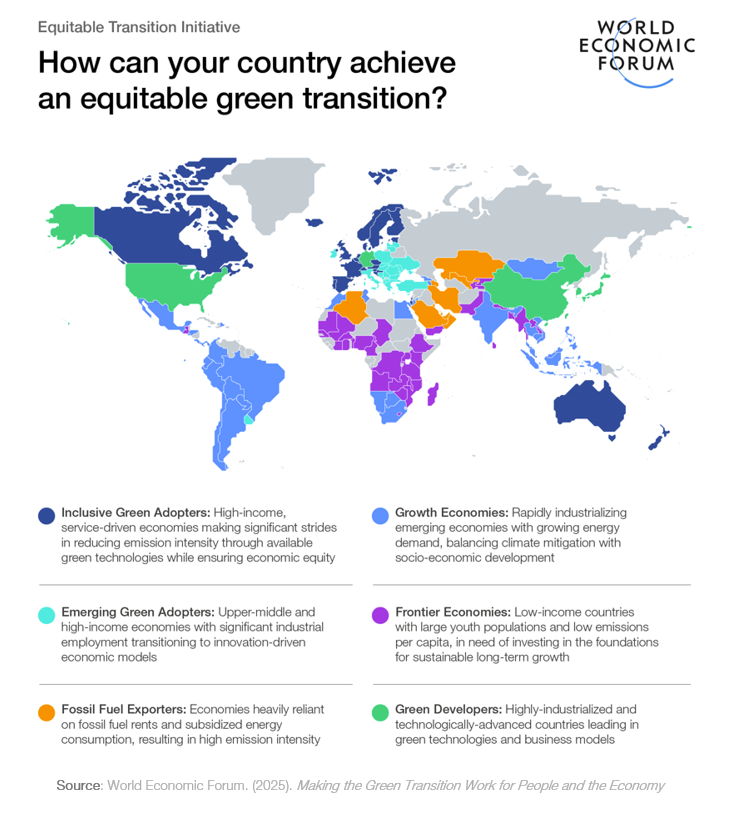
Each archetype has a different starting point for the transition; local socioeconomic risks and competitiveness challenges related to the green transition vary accordingly.
Takeaways for companies and their climate plans
For corporate leaders, the stakes are clear. To remain competitive and credible, climate ambition must go hand in hand with social and economic priorities.
The report offers a framework to help decision-makers:
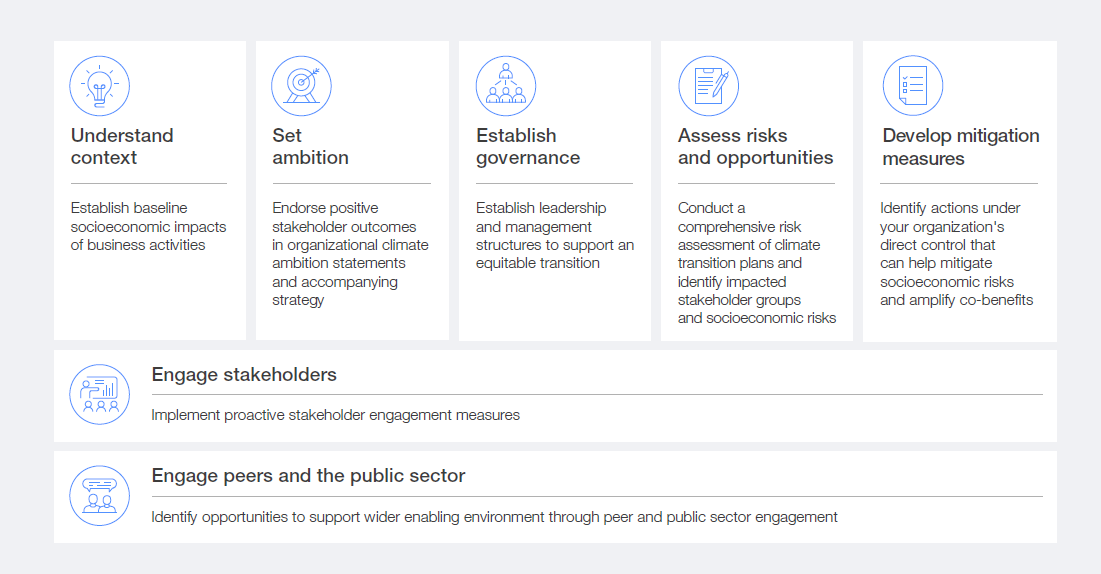
Effective action depends on collaboration and dialogue – within industries, across value chains, and with the public sector. The report’s guiding questions are designed to help leaders think systematically about which stakeholders and partners to engage, and where collaboration can achieve shared objectives.
Looking ahead
The green transition is not only a technological or environmental challenge; it is a socioeconomic transformation. The report’s core message is simple: only by making the green transition truly work for people and economies, and by tailoring solutions to context, investing in capacity, and driving shared economic value, can we maintain momentum on climate.
Everyone is invited to explore the report’s frameworks, data insights, and practical considerations that can turn this vision into reality – and join a growing coalition striving for inclusive climate progress.




License and Republishing
World Economic Forum articles may be republished in accordance with the Creative Commons Attribution-NonCommercial-NoDerivatives 4.0 International Public License, and in accordance with our Terms of Use.
The views expressed in this article are those of the author alone and not the World Economic Forum.
Related topics:

Forum Stories newsletter
Bringing you weekly curated insights and analysis on the global issues that matter.
More on Economic GrowthSee all

Robert Muggah
March 12, 2026


