China's renewable energy boom has its own challenges. Here's what we can learn
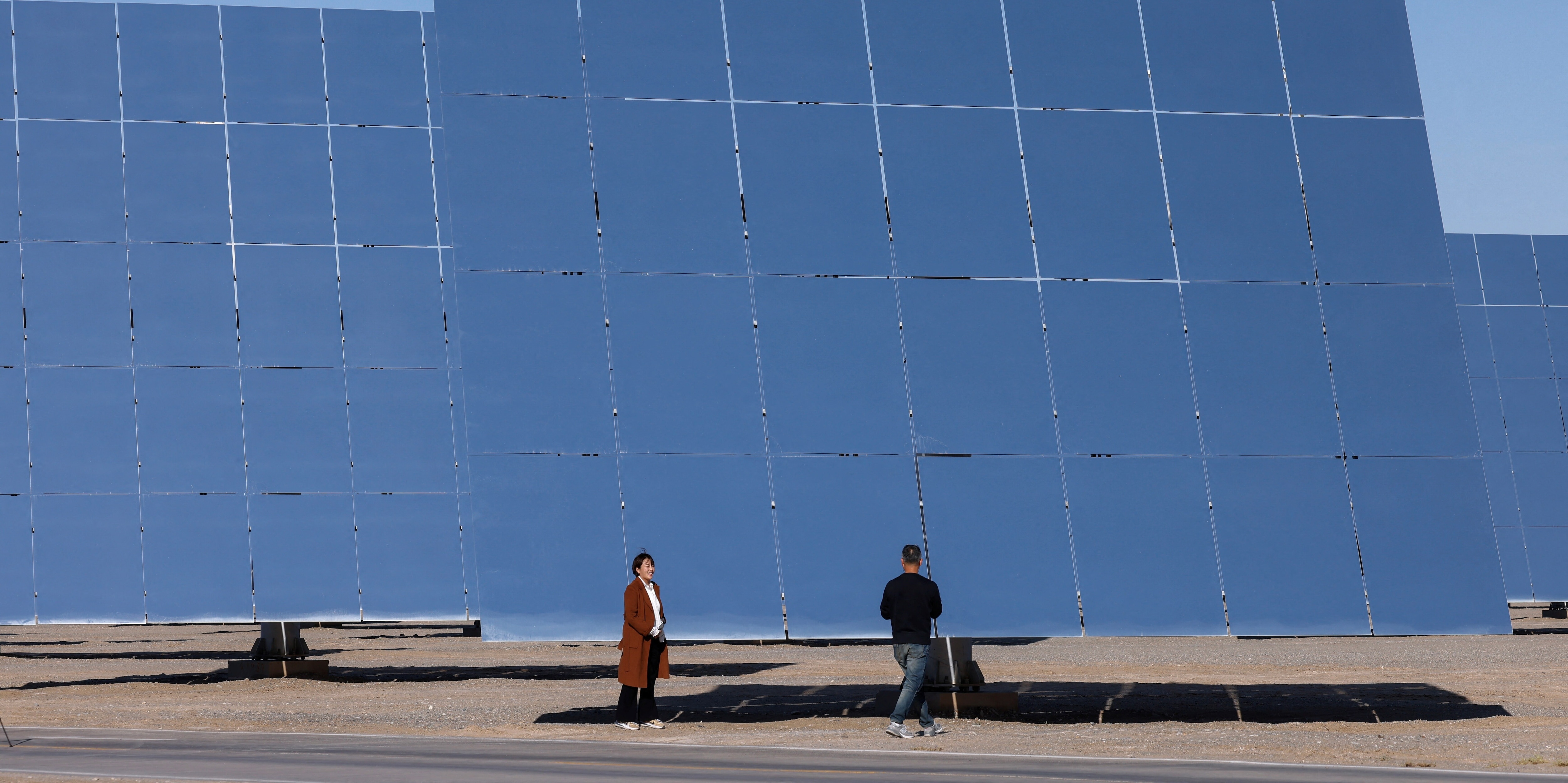
China's renewable energy buildout is unrivalled – but that does not mean it is without challenges. Image: REUTERS/Tingshu Wang
- China’s approach to renewable energy buildout combines large-scale investment, technological innovation and market reform.
- China is installing more renewables than any other economy, but that rollout is not without its challenges.
- How China overcomes market, financing and systemic challenges holds lessons for other economies investing in renewables.
China is the world’s largest energy consumer and greenhouse gas emitter – it is also undergoing one of the most ambitious energy transitions in history. Guided by its goals of peaking carbon emissions before 2030 and achieving carbon neutrality by 2060, the country is rapidly reshaping its power system to accommodate a new generation of clean energy.
In 2024 alone, China installed 360 gigawatts (GW) of wind and solar capacity. That’s more than half of global additions that year, and it brings total installed capacity to 1.4 terawatts (TW) – that’s roughly a third of the entire world’s 4.5 TW. Chinese renewable generation reached 366 terawatt-hours (TWh), making wind and solar the country’s largest sources of new power. This transformation has also driven the rise of new technologies and business models, from battery storage and virtual power plants to electric vehicles and “zero-carbon" industrial parks.
Integrating renewable energy at such speed and scale, however, poses formidable challenges. China’s experience offers valuable insights into how countries can manage the technical, economic and market complexities of the clean energy transition while maintaining grid stability and affordability.
The challenges of energy transformation in China
System operation
Power systems must stay in constant balance: generation must equal consumption at all times. With wind and solar, output fluctuates sharply with weather and daylight. The growth of renewable capacity has outpaced the development of resources, like storage and flexible generation, that can stabilize the system.
Transmission networks also face pressure. Most of China’s renewable potential lies in northwest China’s “Shagehuang” areas, while major demand centres are along the eastern coast. This requires long-distance transmission and stronger interregional connections. Local distribution grids must likewise evolve from one-way delivery systems into two-way interactive platforms that integrate rooftop solar, electric vehicles and flexible loads.
In this new model, electricity supply no longer simply follows demand; instead, generation, grid, demand and storage must operate in coordination to maintain reliability.
Economic challenges
Integrating large amounts of renewable power also adds cost. While the price of generating solar and wind electricity continues to fall, additional investment is required for grids, storage and backup capacity. Even facilities with on-site generation depend on the wider grid for voltage and frequency control, meaning cost-sharing mechanisms are needed to distribute system expenses fairly.
The central challenge is ensuring that renewable energy’s low generation costs lowers total system costs and consumer prices rather than increasing them.
Market mechanisms
Electricity depends on multiple markets, covering not only energy itself but also capacity, flexibility and environmental value. Incomplete or misaligned mechanisms can discourage investment or fail to reward clean energy properly.
China is refining its market design to address this. It is developing capacity and ancillary service markets to ensure adequate flexibility, expanding green power and certificate trading to recognise environmental value, and clarifying the roles of new participants such as distributed generators, storage operators and aggregators.
How the Forum helps leaders navigate the transition of energy and materials systems
How China is addressing these challenges
China’s approach combines large-scale investment, technological innovation and market reform to create a cleaner, more resilient power system.
System transformation and upgrading
The country is expanding renewable generation while strengthening its grid. Gigawatt-scale wind and solar bases are being built in resource-rich regions, alongside distributed generation in cities and industrial parks. In 2024 alone, more than $80 billion was invested in power grid infrastructure, including ultra-high-voltage (UHV) lines that connect remote generation with coastal demand centres.
Flexibility has become a key priority. Coal plants are being retrofitted for flexible operation, new gas and pumped-storage facilities are being developed, and artificial intelligence tools, such as the “Guangming Power” model, support grid forecasting and dispatch. Together, these steps enhance the system’s capacity to absorb fluctuating renewable output.
Building a unified national power market
China is aiming to facilitate the cross-provincial consumption of new, renewable energy and break down inter-provincial barriers. Today, it is advancing a unified national market that enables cross-regional trading and better integrates renewable resources. The framework includes long-term contracts, spot markets and ancillary service trading, establishing a more complete price formation system.
Renewables now participate fully in market-based transactions, while green power and certificate trading are expanding to attract investment in clean energy. These reforms are aiming to create a transparent, efficient and flexible market that values both reliability and sustainability.
Strengthening policy and business mechanisms
China has introduced policies to guide emerging business models such as virtual power plants and integrated generation–grid–demand–storage projects. These frameworks define the roles and responsibilities of market participants, ensuring that new entities contribute fairly to system stability.
At the same time, the country is setting up complementary markets, such as a capacity market, and is refining the auxiliary service markets, including those for peak regulation, frequency regulation and spinning reserve, where diverse participants – storage, demand response and flexible generation – can trade services that support reliability.
What the world can learn from China on energy
China’s experience shows that large-scale renewable integration requires alignment across policy, planning, markets and innovation. Four lessons stand out:
1. Set clear, connected goals. China’s “dual carbon” framework links national targets to implementation at local and sectoral levels, ensuring coordinated progress.
2. Plan grids for the long term. Large power grids remain the backbone of clean energy systems. Strategic grid planning and investment in transmission are essential to move renewable electricity from where it’s produced to where it’s needed.
3. Design markets that reflect real value. Effective markets must reward flexibility, capacity and environmental performance – not just kilowatt-hours. Instruments like renewable quotas, certificate trading and price reform can align incentives for all participants.
4. Invest in innovation. Technology underpins the balance between economic efficiency, system security and environmental sustainability – the “energy trilemma” every country faces.
A global pathway forward
China’s approach combines the scale of massive renewable deployment with the depth of systemic reform. The concept of integrated generation–grid–demand–storage – which links clean generation, flexible grids, active demand and storage – illustrates how next-generation power systems can function as coordinated ecosystems rather than linear supply chains.
As technologies evolve and markets mature, China’s evolving model offers a valuable reference for other countries seeking to integrate renewables quickly and reliably. Global collaboration through shared lessons, harmonized standards and joint innovation will be crucial to accelerating the clean energy transition worldwide.
Don't miss any update on this topic
Create a free account and access your personalized content collection with our latest publications and analyses.
License and Republishing
World Economic Forum articles may be republished in accordance with the Creative Commons Attribution-NonCommercial-NoDerivatives 4.0 International Public License, and in accordance with our Terms of Use.
The views expressed in this article are those of the author alone and not the World Economic Forum.
Stay up to date:
China
Related topics:


Forum Stories newsletter
Bringing you weekly curated insights and analysis on the global issues that matter.
More on Energy TransitionSee all

Arslan Khalid and Rabia Ferroukhi
March 11, 2026


