To go fast and far, go together: Why leaders are collaborating to compete

In today’s turbulent world, it is isolation that can break companies. Image: Getty Images
- In a fragmenting economy, creating collaborative ecosystems may now be the key to successful competition.
- What began as a handful of one-offs has become a systemic shift toward an "ecosystem economy".
- The question for today’s leaders is no longer simply "What can I bring to market?" but "What can we build together?"
In a business environment where the rules keep changing, the path forward for business leaders often feels more like a maze than a racetrack.
For years, organizations operated on reliable assumptions: trade flowed freely, borders were stable, and geopolitics – while imperfect – were predictable enough to plan around. That world is a distant memory.
Economic uncertainty, a shifting trade environment, inflation, geopolitical turbulence and tech transformation are combining to create an ever-shifting ground or a feeling of “permacrisis.” There is no expectation that the current turbulence will subside, and we are now operating in a world in which change is nonlinear, accelerated, volatile and interconnected (NAVI). This is fundamentally stressing business models and shattering former certainties.
In today’s turbulent world, it’s not disruption that breaks companies – it’s isolation.
The past decade shows that carefully chosen collaboration, even with competitors, can unlock growth and adaptability. However, in a fragmenting economy, collaboration is evolving from “nice to have” to “must have.” Paradoxically, creating collaborative ecosystems may now be the key to successful competition.
Collaboration as competitive advantage?
Technological change demands the need for speed, adaptation and innovation at scale. Organizations using the “run fast alone” model may struggle to respond here. For example, in AI, even with near-unlimited investment, it would be a fool’s errand to attempt to solely develop the data infrastructure, in-house expertise or strategy that can deliver immediate impact. Today, organizations are proving that the right alliances can create a whole that is bigger than the sum of the parts, with complementary capabilities on demand, and aligned from day one.
From large chipmakers collaborating to launch next-generation data processing, to global shipping companies sharing logistics infrastructure, to carmakers joining forces in fuel cell R&D – even rivals are collaborating for mutual benefit. These organizations still compete, but also selectively choose where to collaborate for results to become faster, better and meet the evolving demands of their customer base.
What began as a handful of one-offs has become a movement, a systemic solution – a systemic shift toward an “ecosystem economy.” Most organizations (64% of those EY surveyed in 2024) are now investing in delivery ecosystems, and recent research from Forrester reflects the expectation that alliances will increasingly be a primary driver of revenue growth. The experience of EY, with more than 100 ecosystem collaborators, reflects this: 55% of EY FY25 revenue growth was supported by ecosystem alliances.
Success used to be about what you could control, but today it is increasingly about what and to whom you are connected.
Over time, ecosystems will become increasingly more critical, forming a core part of future superfluid enterprises that operate through extensive, tightly connected networks. Operating models that work in times of rapid technological change are also better suited to times of geopolitical and economic uncertainty. Alliances that reduce friction, increase trust and catalyze adaptation are fit for purpose in a NAVI world.
Managing creative coalitions will be a next-gen skill
While the upside is undeniable, managing diverse alliances is not easy.
Collaborating across highly competitive environments, geographies, sector and size does not come naturally to most businesses, with many ecosystem leaders struggling to keep all parties consistently aligned and responsive.
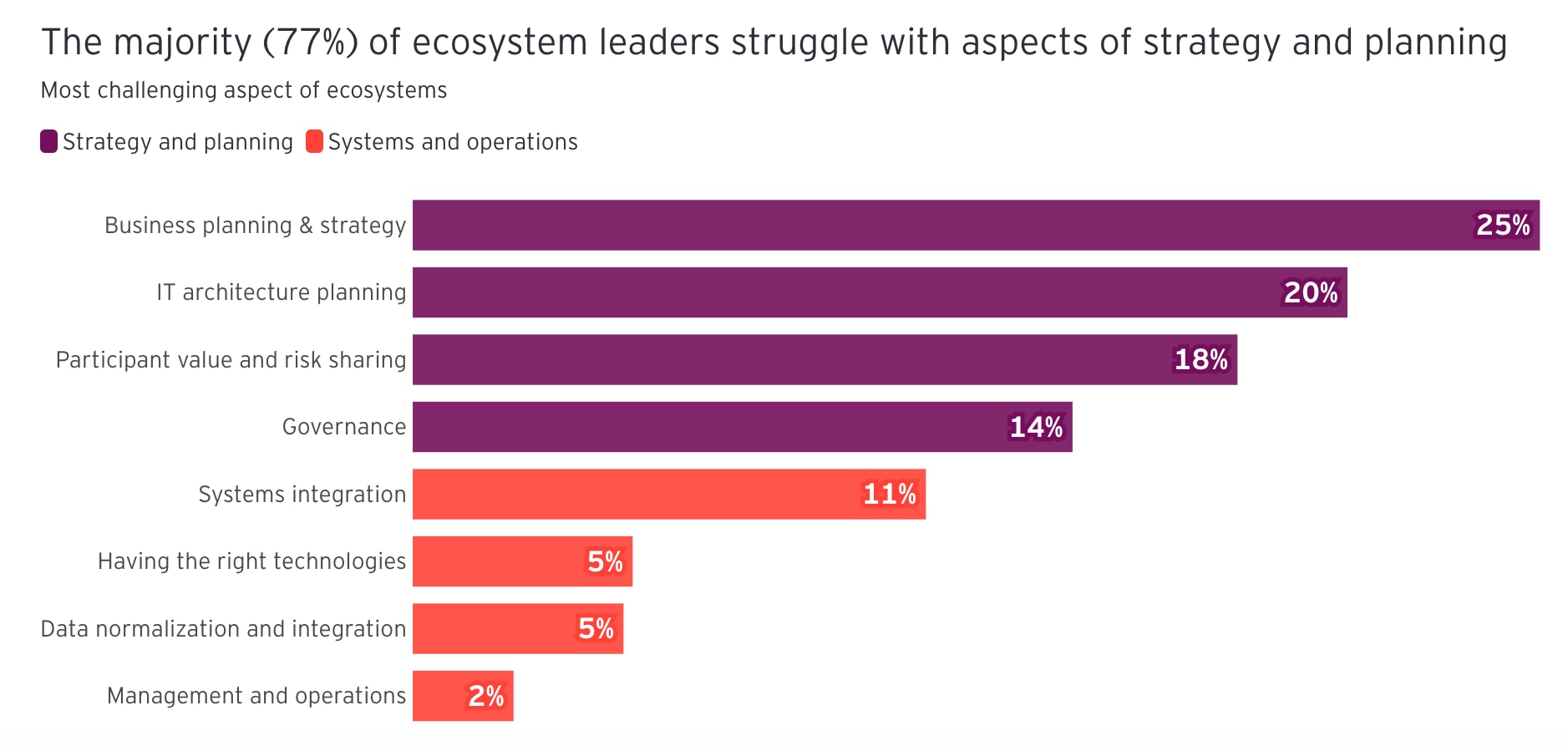
The billion-dollar question is: how do we get this right?
1. Trust is earned through transparency
Trust is the currency of collaboration – but it only holds value with the right processes in place to ensure transparency and repeatability. Strong ecosystems start and thrive with clear conversations: objectives, constraints, competitive boundaries and success metrics:
- Decision rights: who can commit resources and what requires escalation.
- Communication rhythms: regular, predictable touchpoints.
- Conflict resolution: pre-agreed mechanisms before they’re needed.
- Metrics: tracking ecosystem health – from satisfaction, speed of execution and innovation created.
Start with small pilots to prove value. Use shared wins to build confidence and scale. The focus needs to be on progression, not perfection, and building a culture of experimentation.
2. Collaborate where it counts
Not all partnerships are equal and timing matters. The right question isn’t “Who wants to work with us?” but “What critical capability does this partner bring that we cannot efficiently build ourselves?” Key questions for any partnership include:
- Does this partner align on pace and risk appetite?
- Does it close a critical capability gap?
- Is this the right moment in our growth cycle for this type of collaboration?
- Does it open access to new markets, faster?
The goal isn’t to control every variable; it’s to stay connected to the right capabilities and activate them as conditions demand. Major ocean carriers are fierce rivals, but they can activate alliances to reroute cargo and share vessels when certain ports are inaccessible.
The long-term shared outcomes are better than any short-term individual gains.
3. Build networks that flex, not just scale
Designing robust ecosystems requires networks that can be adapted and reconfigured as conditions change.
Efficiency alone won’t survive today’s shocks. Resilient networks reconfigure rapidly around emerging opportunities and threats. Some partners leave and others join as conditions change – the ecosystem needs to be considered as a dynamic, evolving system.
These superfluid arrangements shift focus and resources without starting from scratch. The 2021–22 semiconductor shortage proved the point: companies with diversified supplier ecosystems pivoted within weeks. Others were frozen.
The competition paradox
It’s been said countless times: If you want to go fast, go alone. If you want to go far, go together.
The question for today’s leaders is no longer simply “What can I bring to market?” but “What can we build together?” Those that find themselves in the centre of valuable networks, attracting top ecosystem partners, suppliers and talent, will be able to run and pivot. They will compete on the power and flow of their ecosystem, not just the placement of their product.
In an age defined by AI and disruption, the leaders who thrive will be those who embrace the competition paradox: compete fiercely, collaborate wisely and watch long-term value beat short-term gains.
The views reflected in this article are the views of the author and do not necessarily reflect the views of the global EY organization or its member firms.
Don't miss any update on this topic
Create a free account and access your personalized content collection with our latest publications and analyses.
License and Republishing
World Economic Forum articles may be republished in accordance with the Creative Commons Attribution-NonCommercial-NoDerivatives 4.0 International Public License, and in accordance with our Terms of Use.
The views expressed in this article are those of the author alone and not the World Economic Forum.
Stay up to date:
Future of Leadership
Related topics:


Forum Stories newsletter
Bringing you weekly curated insights and analysis on the global issues that matter.
More on Trade and InvestmentSee all

Rumaitha Al Busaidi and Sarah Mostafa-Kamel
March 20, 2026


