Five ways to push progress on the industrial energy transition
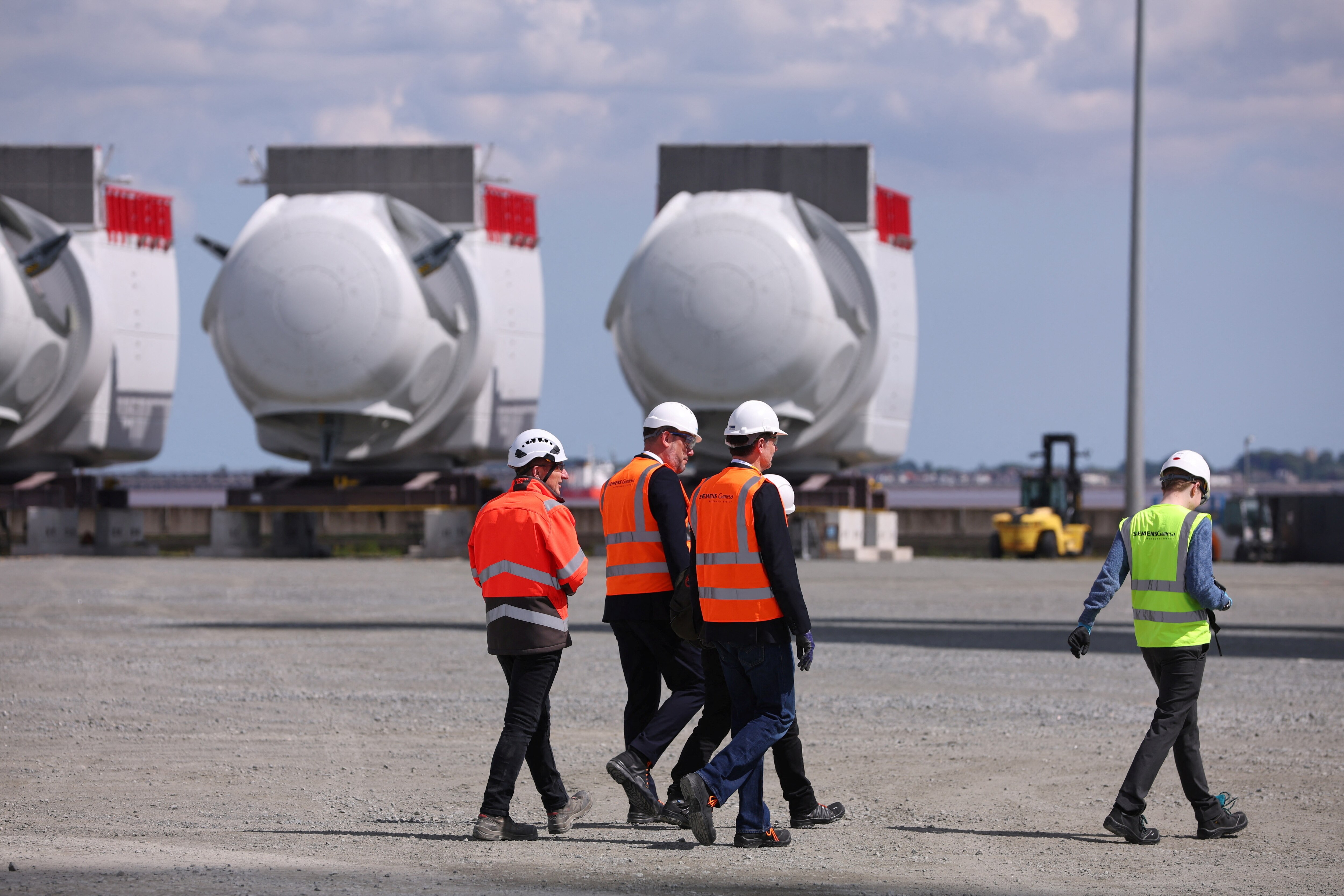
The next ten years will determine whether industry can deliver an energy transition at the scale required. Image: REUTERS/Craig Brough
Nicholas Wagner
Manager, Energy and Industry Transition Intelligence – Energy and Materials, World Economic Forum- AI and digitalization are projected to drive nearly 10% of global electricity growth by 2030, forcing industries to secure low-carbon power.
- The energy transition in industrial sectors is nonetheless continuing, with some areas progressing faster than others.
- Below are five ways to turn momentum into measurable progress on the industrial energy transition.
Hard-to-abate sectors – steel, cement, chemicals, aluminium, shipping, aviation, trucking, and oil & gas – account for almost 40% of global emissions. These sectors also form the backbone of global infrastructure, manufacturing and trade, and face a rapidly shifting landscape.
Overall, global emissions reached a record high in 2024, rising by 0.9% to about 38 gigatonnes. AI and digitalization are projected to drive nearly 10% of global electricity growth by 2030, forcing industries to secure low-carbon power. Meanwhile, non-electricity energy demand – still the largest share of energy use in most hard-to-abate sectors – relies heavily on carbon-intensive fuels.
The World Economic Forum’s Scaling the Industrial Transition: Hard-to-Abate Sectors and Net-Zero Progress in 2025 report, based on the Net-Zero Industry Tracker framework, shows that the foundations for decarbonizing these sectors are now largely in place. Technologies required for deep emissions reductions already exist or are emerging: the Net-Zero Industry Tracker 2024 shows that roughly half of industrial emissions can be abated with mature solutions, while the remainder requires further innovation, stronger policy support and enabling infrastructure.
Corporate net-zero strategies are also expanding. According to Accenture’s Destination Net Zero 2025 report, 41% of the largest 2,000 companies have net-zero targets, but near-term procurement of low-carbon materials remains insufficient – leaving many producers without reliable demand signals. Across markets, rising energy costs, tighter financing and policy uncertainty continue to slow progress, underscoring the need for coordinated action across supply chains, governments, financial institutions and consumers.
5 ways to deliver progress on the industrial transition
Five priorities are central to converting momentum into measurable progress in the hard-to-abate sectors.
1. Creating demand for low-carbon fuels and materials
Many of the technologies necessary for industrial transition are technically viable, yet companies remain hesitant to invest in large-scale projects without clear demand signals. Today, demand for low-carbon fuels and materials remains thin and fragmented; fewer than 1 in 10 announced clean-hydrogen or CCUS projects have reached final investment decision (FID), reflecting weak offtake and policy fragmentation.
Several countries are expanding carbon-pricing systems or linking market access to verified carbon intensity through instruments such as carbon border adjustments and sector-specific compliance rules like the EU’s ETS2 or Brazil’s ETS. As these mechanisms evolve, carbon transparency is becoming a central feature of competitiveness. Verified emissions data increasingly determines whether products meet market requirements, influencing both trade flows and investment decisions.
To build confidence for buyers and mobilize investment, stronger demand signals are essential, including clearer standards, consistent certification and coordinated procurement models.
2. Building the infrastructure required for scale
Industrial transition cannot succeed without the infrastructure that underpins it. Grid congestion, limited CO₂ transport and storage capacity, insufficient hydrogen pipelines and slow permitting processes all contribute to delays and rising project costs.
In many regions, the enabling systems for industrial transformation are still in early development. Projects require reliable clean-power access, storage solutions, modernized ports and integrated industrial hubs. Without these shared assets, facilities that rely on hydrogen supply, carbon capture, utilization and storage (CCUS) networks, or large volumes of renewable electricity face significant barriers to scaling.
These constraints reflect the need for long-term planning, coordinated policy and substantial public-private investment. Global grid investment currently stands at around $400 billion per year, but needs to rise to more than $800 billion annually by 2030 under BNEF’s Net-Zero scenario. Infrastructure development, rather than technology readiness, is increasingly the determining factor in whether industrial decarbonization moves forward.
3. Lowering the cost of capital for clean industrial projects
Economic viability is one of the biggest obstacles to industrial transformation. High interest rates, volatile energy prices and policy uncertainty have raised financing costs for clean-technology projects – especially capital-intensive solutions such as hydrogen-based steelmaking, sustainable aviation fuels, low-carbon ammonia and methanol, and carbon-capture systems. In many markets, financing conditions are now a primary reason projects fail to reach final investment decision, as even committed companies face internal competition for capital.
Lowering the cost of capital – and reducing risk for investors – will determine which regions and sectors move forward. Policy stability, blended-finance models, carbon contracts for difference and long-term offtake agreements can all improve project bankability. Clean-energy investment, expected to reach 2.2 trillion in 2025, remains concentrated in advanced economies and China, leaving emerging markets behind despite their central role in future industrial demand. Creating financial conditions that support large-scale deployment across regions will be essential for a global transition.
4. Prioritizing market-ready solutions while enabling innovation
The transition requires a combination of immediate action and long-term innovation. Market-ready solutions such as electrification, energy efficiency, materials recycling and renewable integration can deliver meaningful emissions reductions today.
At the same time, next-generation technologies like clean hydrogen, sustainable fuels, process-innovation in steel and cement, and advanced carbon-capture systems require ongoing investment and policy support to reach commercial maturity.
Balancing proven and emerging technologies is essential: over-reliance on future solutions risks delay, while underinvestment in innovation limits long-term progress. A coordinated, dual-track approach is needed.
5. Aligning policies and standards across regions
This year marked a shift toward hybrid policy models, in which voluntary initiatives and incentives increasingly converge with compliance-based regulation — yet progress remains uneven. Regions are moving at different speeds and with different approaches. Europe is expanding mandatory emissions-pricing frameworks and sector-specific rules such as the EU ETS expansion, CBAM, ReFuelEU and FuelEU; the United States remains largely incentive-led through the Inflation Reduction Act alongside state programmes like California’s Cap-and-Trade and Clean Fuel Standard; and parts of Asia, the Middle East and Latin America are establishing early-stage carbon markets and disclosure systems, including the UAE’s MRV system and Saudi Arabia’s voluntary carbon market.
This diversity creates a complex landscape for global companies. Fragmentation complicates compliance, increases costs and limits the visibility needed for long-term investment. Greater convergence – around measurement frameworks, reporting standards and long-term policy trajectories – will enable companies to plan and invest with greater confidence.
A decisive decade for the industrial energy transition
With around $30 trillion in additional investment needed to achieve net-zero alignment across hard-to-abate sectors by 2050, the next 10 years will determine whether industry can deliver at the scale required.
The transition is no longer a question of technological feasibility: the tools exist and ambition is rising. What’s needed now is system alignment: markets that reward low-carbon production, infrastructure that supports deployment, financing that enables scale and policy frameworks that provide clarity.
The next decade will be decisive for moving heavy industry from incremental improvements to real transformation, guided by five priorities that can position the sector to lead in a net zero economy.
Don't miss any update on this topic
Create a free account and access your personalized content collection with our latest publications and analyses.
License and Republishing
World Economic Forum articles may be republished in accordance with the Creative Commons Attribution-NonCommercial-NoDerivatives 4.0 International Public License, and in accordance with our Terms of Use.
The views expressed in this article are those of the author alone and not the World Economic Forum.
Stay up to date:
Energy Transition


Forum Stories newsletter
Bringing you weekly curated insights and analysis on the global issues that matter.
More on Energy TransitionSee all

Ginelle Greene-Dewasmes, Michael Higgins and Karolina Oleszczuk
January 26, 2026


