Navigating the new economy: 6 decision-makers reveal their strategies for growth and resilience

The interplay of geoeconomics and advanced technologies like AI is reshaping the global economy. Image: Reuters/Stephanie Lecocq
- The World Economic Forum’s Scenarios for the Global Economy Dialogue Series leverages foresight and cross-industry dialogue to help decision-makers understand and navigate uncertainty.
- The first edition explores four futures for the new economy in 2030 at the intersection of geoeconomic and technology trends.
- Decision-makers from different sectors offer their thoughts on the
transformative trends impacting their industries and related strategy responses.
Uncertainty and complexity are increasingly shaping the outlook for the global economy.
Geopolitical rifts are widening, fast-changing technologies are reshaping industries and labour markets, and decision-makers are grappling with mounting trade-offs.
Strategic decisions in this context require greater agility and foresight. The World Economic Forum’s Dialogue Series on Scenarios for the Global Economy aims to help decision-makers navigate uncertainty by exploring scenarios for the global economy and their implications for businesses.
The Forum just released a first set of scenarios developed through this initiative, delving into Four Futures for the New Economy: Geoeconomics and Technology in 2030. Each scenario holds risks and opportunities that can reshape sectors and individual businesses – but informed, creative and anticipatory strategies can help businesses navigate the new economy.
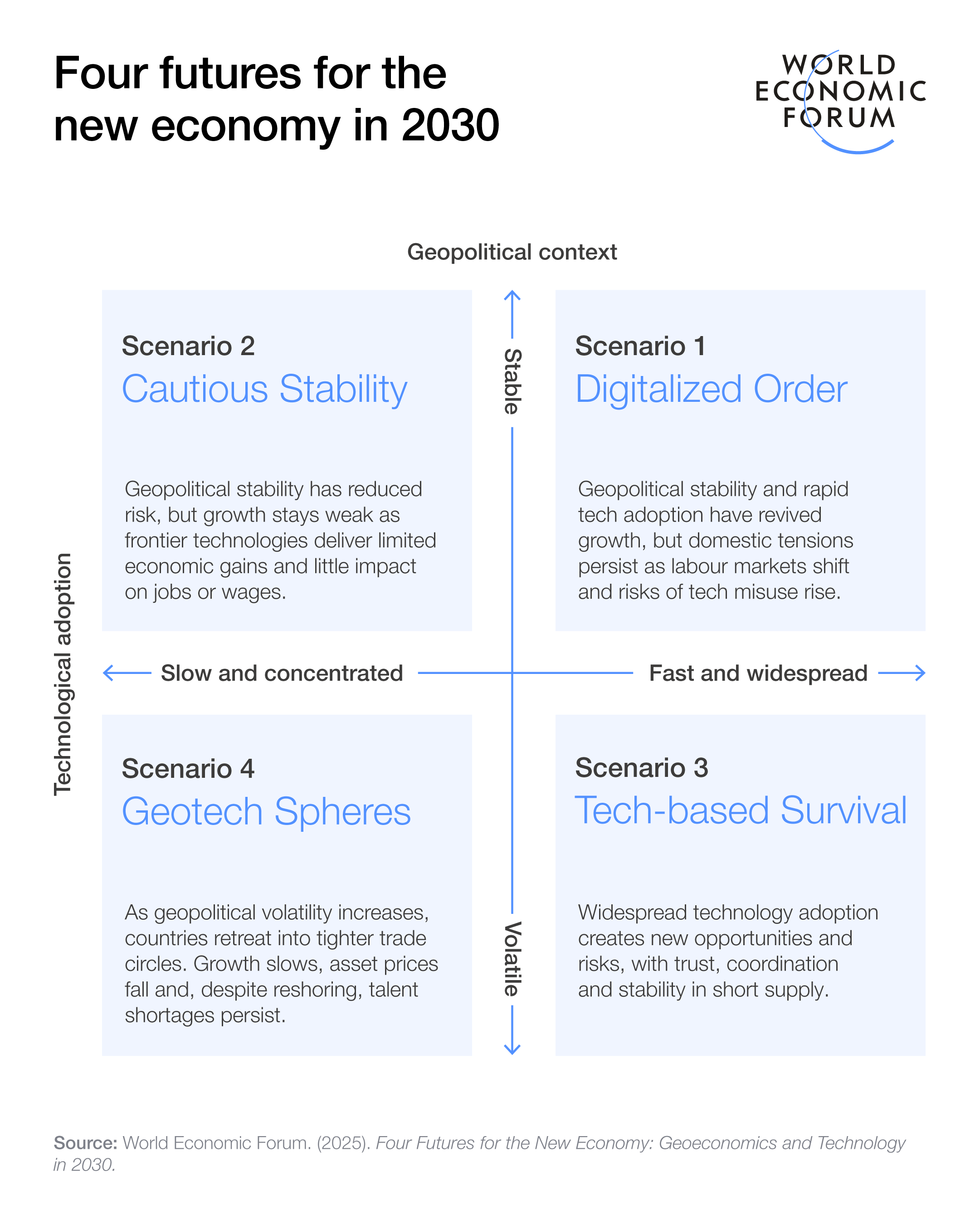
We asked top executives which global trends will have the most significant impact on strategies in their industries over the next five years. And what will be the key sources of growth and resilience in an era of heightened technological and geoeconomic uncertainty. Here's what they said:
Michael Combach, Head of Strategy, Siemens Smart Infrastructure
"The coming years will undeniably redefine corporate strategies, driven by a confluence of powerful, interlinked megatrends creating increased complexity at an accelerated pace. First, digitalization and AI will supercharge industrial transformation and revolutionize how we innovate and create value. It necessitates prioritizing data to unlock value at scale, enhance productivity and deliver unprecedented insights – which are essential to solving some of the biggest challenges we face, climate change being one of them. Simultaneously, the imperative for decarbonization and resource efficiency will intensify to shape strategies and demands leveraging rapid technological advancements that lead to both greater environmental and economic benefits.
“Furthermore, geopolitical shifts and intensifying glocalization are adding to the complexity by driving volatility, necessitating focused regional strategies and robust scenario-planning to ensure business success. Overall, in this era of transformative forces, growth and resilience will be profoundly shaped by leveraging the power of trust-based networks. Strategies will place customer and partnership value and intimacy even more firmly at the core, and aim to collectively leverage data-driven insights to scale effectively and navigate the complexity.”
Bart Brouwer, Head, Corporate Development; Senior Corporate Strategist, ING
“The commercialization of AI will be the most transformative trend for banking strategy in the next five years. AI is in my opinion no longer just an efficiency tool, but a growth engine that has the potential to reshape the entire operating model of banks. Banks can achieve significant productivity gains, faster cycle times and improved risk outcomes if they are able to successfully scale AI across risk management, operations and customer engagement. Beyond cost reduction, AI will enable banks to make more and better personalized offerings, faster (real-time) credit decisions and predictive analytics, creating new revenue opportunities and enhancing the customer experience.
“This shift demands strategic repositioning. Banks will need to move from product-centric models to more platform and ecosystem-focused strategies, embedding AI into every layer of decision-making and service delivery. It will also introduce new governance challenges, such as the ethical use of AI, regulatory compliance and cybersecurity. This will require robust frameworks as guardrails to maintain the essential trust of customers. Very much linked to this trend is AI-driven workforce transformation. The skills needed at banks will shift from (repeatable) branch and administrative roles to data, engineering and product expertise.
“Growth for banks will primarily be driven by AI-enabled productivity, reducing operating costs through automation in areas such as software coding, fraud detection, underwriting and customer interaction. This will improve, for example, risk outcomes (lower cost) and conversion rates (more revenue). These savings can be reinvested into revenue-generating activities, such as product innovation and new income streams. Resilience will come from further integration of the bank’s own financial services into third-party financial ecosystems, embedding services into external platforms to broaden access and create new distribution channels. In addition, AI will support better risk and balance sheet management through advanced stress testing and scenario planning. This will help banks navigate volatility.
“Finally, I believe that geoeconomic uncertainty requires more regional diversification, up-to-date liquidity strategies and operating models adaptive enough to mitigate the geopolitical fragmentation risks.”
Arne Cartridge, Senior Adviser to the CEO, Yara International
“For the global nitrogen industry, two intersecting trends will shape corporate strategy in the coming year and beyond: rapid decarbonization and accelerating geoeconomic fragmentation.
“Decarbonization is no longer a long-term ambition; it is becoming a market-shaping force. Regulation, carbon pricing, customer demand and emerging green value chains are converging to differentiate low-emission products from conventional ones. For nitrogen producers, this transforms ammonia from a commodity into a strategic platform; enabling low-carbon food production, supporting renewable energy systems and creating new markets for clean ammonia in shipping, power and energy storage. Companies that can scale credible, traceable low-carbon solutions will gain both premium markets and long-term relevance.
“At the same time, geoeconomic fragmentation is reshaping supply chains, trade flows and energy access. In a multipolar world, resilience depends on diversified production, secure access to energy and feedstocks, and strong local partnerships. This creates opportunities for globally integrated players to act as stabilizing partners – supporting food security, regional self-sufficiency and industrial transition.
“Growth and resilience will come from combining industrial decarbonization with digital infrastructure, trusted partnerships and the ability to operate across fragmented markets while enabling global food and energy security.”
Gokalp Kahraman, Regional Director, UK and Western Europe, Limak Holding
“Over the next five years, the most critical trends that can be predicted are the intersection of geoeconomic fragmentation, accelerated technology adoption and workforce transformation. Technology is crucial because it may offer a primary solution to our industry's major challenge: a lack of interest and new talent entering construction professions. Technical developments need to focus on scaling site automation and adopting off-site production as a reply to this critical human resources gap. Advances in technology may also reshape traditional procurement rules. Geopolitics is equally impactful, forcing companies to address heightened volatility through flexible supply chains and diversified operations.
“The path to resilience lies in implementing the agreed-upon 'no-regret' strategies. This means viewing technology investment (in construction, AI, digital twins, advanced data analytics and automation) not just as optimization, but as a requirement for survival and a competitive advantage. We must also achieve geoeconomic resilience through geographic diversification across different markets, to balance risk.
“Furthermore, resilience demands a contractual shift; abandoning outdated contract models in favour of more collaborative, risk-sharing contracts like alliance-type or open-book agreements. Finally, sustained growth will require leveraging public-private partnerships to address significant accumulated infrastructure gaps, while embedding sustainability as a non-negotiable constant throughout planning, design and construction.”
Renato Lulia Jacob, Partner, Group Head of Corporate Strategy, Corporate Development & Investor Relations, Itaú Unibanco
“Over the next five years, financial institutions will be shaped above all by geoeconomic fragmentation and the rapid commercialization of AI. Heightened geopolitical tensions are already contributing to greater volatility in capital flows, currencies and commodity markets – variables of particular importance to Brazil. This environment calls for more sophisticated scenario analysis, enhanced risk-management capabilities and closer engagement with clients as they navigate a less predictable global context.
“Concurrently, AI is redefining the economics and expectations of financial services. It is transforming how institutions acquire, advise and support clients, while lowering operational costs and enabling new entrants to compete with unprecedented agility. Established banks therefore face a dual imperative: to deploy AI at scale, and to do so with rigorous attention to data governance, security and responsible use.
“Alongside these shifts, workforce transformation is becoming critical. The sector must recruit and develop talent capable of working alongside advanced technologies, while reskilling teams to adopt more adaptive and digitally enabled ways of operating. Together, these trends will require strategies that are markedly more agile, technology-driven and resilient in the face of global uncertainty.
“Growth and resilience in the financial sector will depend on a judicious combination of innovation, institutional trust and diversified business models. Foremost among these is AI-enabled innovation, which will underpin productivity gains across credit processes, risk assessment, fraud prevention and client engagement. Integrating AI throughout the organization will allow us to serve clients with greater precision and efficiency, while opening avenues for new products and services suited to a more digital economy.
“Equally, trust and institutional solidity will remain essential. As geopolitical uncertainty increases systemic risk, clients will place an even higher premium on balance-sheet strength, cybersecurity, regulatory compliance and transparent governance. These attributes will differentiate those institutions capable of withstanding external shocks and supporting their clients through periods of volatility.
“Finally, diversification – in products, funding sources and distribution channels – will help mitigate uncertainty. In Brazil, opportunities lie in digital payments, SME financing, investment and wealth management solutions, and deeper integration of financial services into digital ecosystems.
“By combining technological leadership with prudent risk management and strong governance, the sector can continue to act as a stabilizing force while sustaining long-term growth, even in a more unsettled global environment.”
Lu Bo, Corporate Vice-President, Corporate Strategy, Business Development, Market Intelligence, Incubation Office, Lenovo
“Artificial intelligence – powered increasingly by hybrid AI that blends on-device, edge and cloud intelligence to create a more responsive, private and scalable model for adoption – will be the defining force reshaping the ICT (information and communication technology) industry over the next five years.
“Hybrid AI will determine how intelligence is delivered, balancing responsiveness, privacy and scale. It provides the foundation for two major transformations: the rise of personal AI and enterprise AI. Personal AI will change how individuals interact with technology, shifting experiences from device-centric to truly user-centric. Expectations for contextual assistance, seamless continuity and intuitive interactions will rise accordingly.
“At the same time, enterprise AI will reshape how organizations operate, enabling new forms of automation, decision support and knowledge management that extend far beyond traditional analytics. These shifts mark a transition from digital workflows to intelligent ecosystems. They will influence product design, service models and workforce capabilities, while elevating the importance of trust, governance and responsible use as AI becomes embedded in everyday and mission-critical activities.
How the Forum helps leaders understand change in global financial systems
“Building on this transformation, the same forces will become primary drivers of growth and resilience. Personal AI will unlock opportunities in devices and differentiated services. Enterprise AI will fuel demand for integrated solutions that deliver measurable productivity gains. Organizations able to orchestrate hybrid AI across both domains – at scale and with responsibility – will be best positioned to lead the next era of the ICT industry.”




License and Republishing
World Economic Forum articles may be republished in accordance with the Creative Commons Attribution-NonCommercial-NoDerivatives 4.0 International Public License, and in accordance with our Terms of Use.
The views expressed in this article are those of the author alone and not the World Economic Forum.
Related topics:
Contents
Michael Combach, Head of Strategy, Siemens Smart InfrastructureBart Brouwer, Head, Corporate Development; Senior Corporate Strategist, INGArne Cartridge, Senior Adviser to the CEO, Yara InternationalGokalp Kahraman, Regional Director, UK and Western Europe, Limak HoldingRenato Lulia Jacob, Partner, Group Head of Corporate Strategy, Corporate Development & Investor Relations, Itaú UnibancoLu Bo, Corporate Vice-President, Corporate Strategy, Business Development, Market Intelligence, Incubation Office, Lenovo
Forum Stories newsletter
Bringing you weekly curated insights and analysis on the global issues that matter.
More on Economic GrowthSee all

Francisco Betti
March 20, 2026


