Protecting jobs and boosting productivity when deploying AI in manufacturing
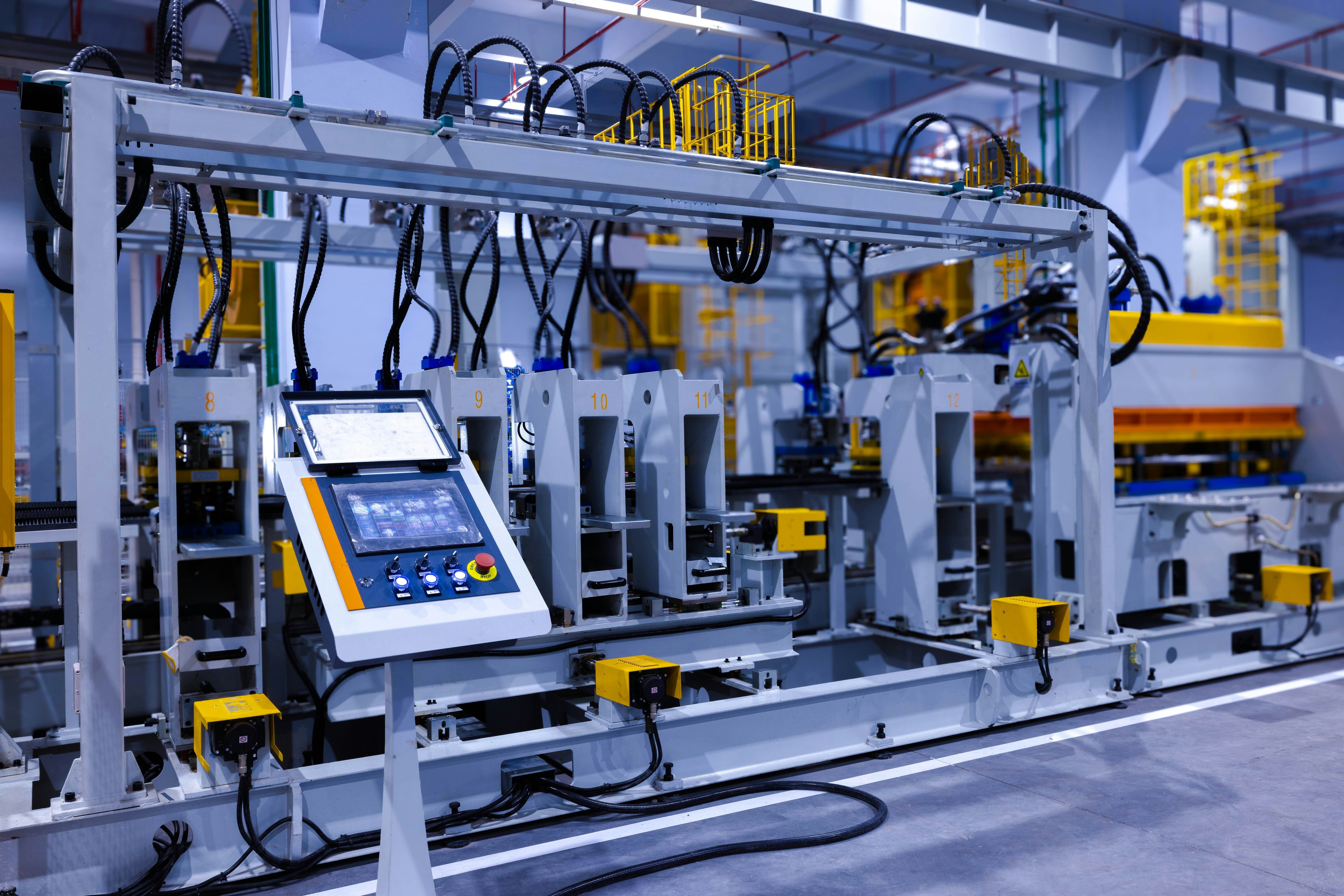
AI poses unique challenges and opportunities for manufacturing Image: Photo by Homa Appliances on Unsplash
- Applying AI across manufacturing industries poses unique challenges and opportunities.
- AI is a powerful tool that has the potential to transform manufacturing and boost productivity while also having a positive impact on society and humanity.
- As this year's Annual Meeting looks at how we can responsibly deploy innovation at scale, this article considers how AI, like any tool, must be wielded by thoughtful and responsible hands.
Artificial intelligence (AI) is reshaping how industries operate. It touches virtually every company worldwide. Most of today’s discussions, however, focus on large language models (LLMs) and their impact on white-collar processes, jobs and organizations.
The outlook for manufacturers is somewhat different: while the potential for productivity gains is equally significant, the application of AI in our type of business poses unique challenges. This includes how much we can trust outcomes when we are building critical infrastructure on which lives depend and how much proprietary knowledge we can safely share with customers and suppliers.
At Mitsubishi Heavy Industries (MHI), we are working on solving these challenges and we believe that it is critical for all large manufacturing and technology companies to do so in a way that will benefit their business and society as a whole.
How the Forum helps leaders make sense of AI and collaborate on responsible innovation
The productivity potential
The first thing to note is that while AI has seized the popular imagination over the past 18 months or so, it is not new to everyone. If by AI we mean collecting large datasets and interrogating them with algorithms to gain insights, then I am sure most large, advanced manufacturers have been deploying it for some years now. We use it to optimize our production and to help customers operate the equipment they buy from us.
In our factories, we also use AI to automate processes and make machine tools and robots more intelligent and to improve the quality and consistency of our product inspections.
And, there is the opportunity to go further. A common technique used for assembling gas turbines, ships, nuclear reactor components and much else, is welding. It sounds simple, but it's a highly skilled process. Trained specialists use their actual five senses and, over time, develop a sixth sense that makes their work better. We are currently filming and recording our welders' working practices to see if we can collect enough data to apply AI to these tasks. That would allow us to merge human skill with machine-like consistency and automate what can be a dangerous job, moving the individuals involved onto safer, cleaner tasks.
At the same time, to improve our inspection processes, we are deliberately adding artificial defects – such as slight bumps, scratches or discolourations – to some product lines to train our AI systems so that they will be smarter at detecting real defects in future.
Meanwhile, we have already developed in-house algorithms for the operational technology control (OT) systems that run the infrastructure we build. Every gas turbine we sell comes with OT systems that can detect the tiniest anomaly in its behaviour, allowing our customers to predict the need to replace a component days or weeks before it fails.
More conventionally, we also use LLMs to support business development. Even our best salespeople cannot quickly or easily assess which of our thousands of products might solve a customer's potential problem. AI makes that connection and humans pursue the lead.
The protection challenges
Ultimately, however, AI is just a tool, a technique - similar to 3D printing, which is used to make certain parts. Like any tool, it has its shortcomings. One is that everyone can use it, so any competitive advantage is likely to erode rapidly – within six months or a year – unless you combine it with other techniques, human skills and experience, so that the overall package becomes hard to replicate. I suspect this is easier for manufacturers to do than, for example, financial services or consulting businesses.
Of greater concern is the fact that sometimes the algorithm’s output cannot be trusted, at least currently. We find that AI models trained with third-party data (including data from other AI models) do not always produce reliable or replicable results. We get better outcomes if we train them entirely on our own information, but sometimes we do not have enough of that.
This raises the broader question of how secure any proprietary data is within an AI system or LLM. At MHI, we want to share as much knowledge and experience as possible with our customers and suppliers, because we are among the companies actively applying AI in our sector, in Japan and internationally.
At the same time, we need to protect our intellectual property and commercial position – and, even more so, those of our partners. I am not sure anyone has solved the challenge of establishing an AI-powered supply chain in which sensitive data is shared in both directions.
That suggests that, despite the vast investments of the hyperscalers in building ever-larger data centres, many companies will want to keep relatively tight control over their proprietary data. This could spur demand for smaller ‘edge’ data centres, potentially even housed on the customer's campus – and these too, will need power, cooling and OT systems. This is a highly competitive market, but one in which MHI is establishing compelling integrated solutions by bundling existing products with new investments.
Maintaining human skills
If I have one final worry, specific to my industry, it is that the current AI and data centre boom is diverting resources from the development of new manufacturing technologies. In every country I visit, I see more and more students learning algorithms and software and fewer courses or apprenticeships that focus on ‘hardware’ and building the skills of what we in Japan call ‘monozukuri’ – the craftsmanship of making things.
AI is a powerful tool that has the potential to transform manufacturing and many other industries, producing productivity gains that promise a significant and positive impact on society and human lives. Like any tool, however, it needs to be wielded by thoughtful and responsible hands.
Don't miss any update on this topic
Create a free account and access your personalized content collection with our latest publications and analyses.
License and Republishing
World Economic Forum articles may be republished in accordance with the Creative Commons Attribution-NonCommercial-NoDerivatives 4.0 International Public License, and in accordance with our Terms of Use.
The views expressed in this article are those of the author alone and not the World Economic Forum.
Stay up to date:
Artificial Intelligence
Related topics:


Forum Stories newsletter
Bringing you weekly curated insights and analysis on the global issues that matter.
More on Manufacturing and Value ChainsSee all

Samaila Zubairu
March 3, 2026


