How can businesses navigate technology risks and opportunities in a competitive age?

Technology related risks have surged in prominence. AI’s rapid advancement has propelled it from a niche concern to one of the top five long-term risks globally. Image: Getty Images For Unsplash+
- The World Economic Forum’s Global Risks Report 2026 highlights technology as both a source of profound risk and unprecedented opportunity.
- Businesses that proactively address the challenges of AI, cybersecurity and digital infrastructure resilience will be better positioned to thrive amid uncertainty.
- In a complex and fragmented world, technology leadership grounded in responsibility and resilience will be a defining factor for success.
At the start of a new year, businesses face an increasingly complex and fragmented global landscape. The World Economic Forum’s Global Risks Report 2026 paints a sobering picture: half of the experts surveyed anticipate a turbulent and stormy environment over the next two years, marked by political, economic and societal fragmentation. Against this backdrop, technology stands out as both a source of profound risk and unprecedented opportunity.
This year’s report highlights deep-dive topics shaping the global risk landscape, with artificial intelligence (AI), cybersecurity and critical infrastructure, including digital infrastructure and the energy sources powering it, at the forefront. Understanding the complex and intertwined challenges and opportunities posed by today’s rapidly advancing technology is essential for businesses aiming to thrive amid uncertainty.
How technology risks manifest in the age of competition
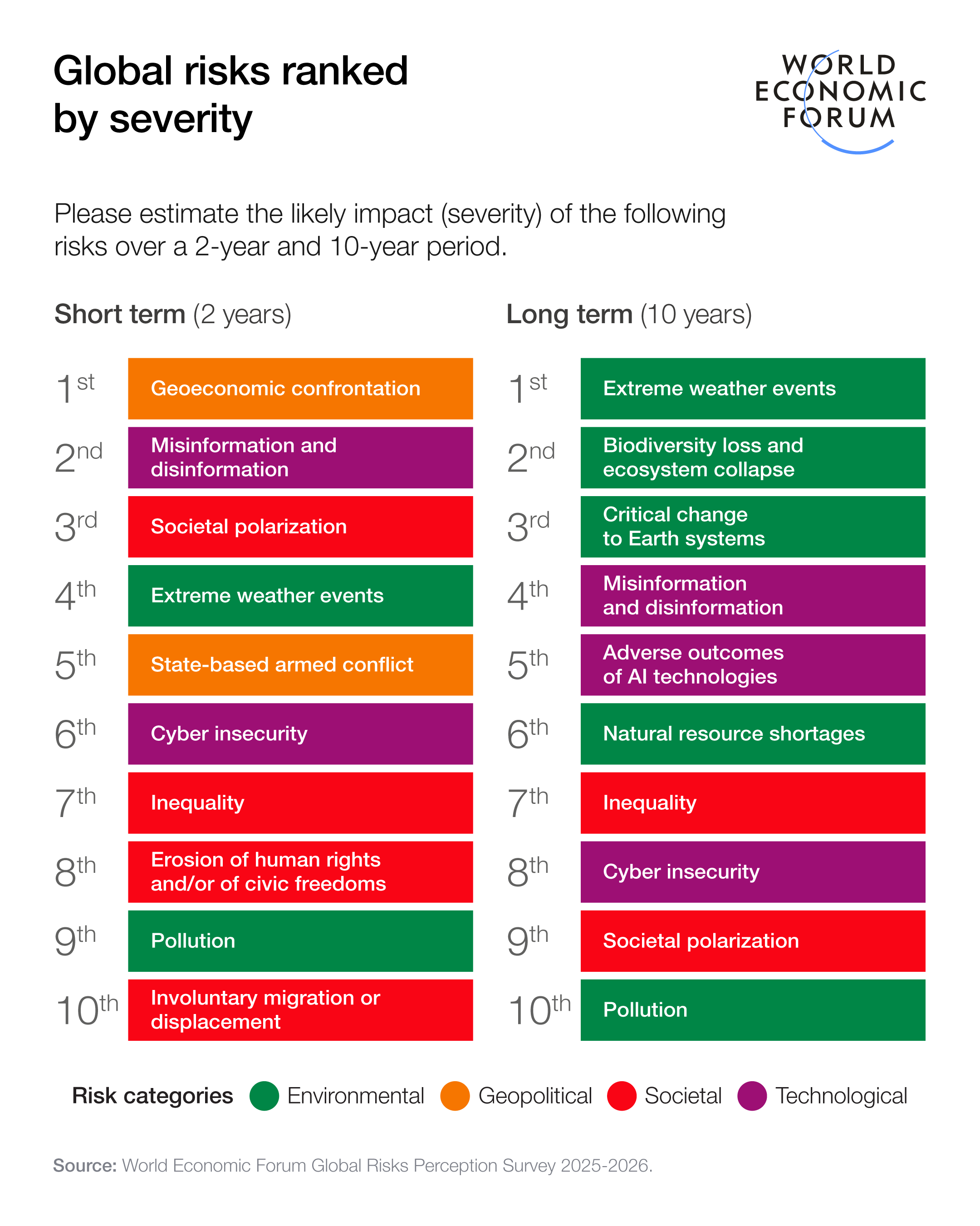
The Global Risks Report 2026 identifies a growing perception of global competitiveness and disorder, driven by geoeconomic confrontation, societal polarization, misinformation and extreme weather events. Multilateralism is under strain and cooperation on shared challenges is increasingly elusive. Economic pressures, including rising debt and inflation concerns, compound these risks.
Technological risks have surged in prominence. AI’s rapid advancement has propelled it from a niche concern to one of the top five long-term risks globally. Cyber insecurity has replaced cyber warfare and espionage as a leading threat, reflecting the evolving nature of digital conflict and crime. Meanwhile, ageing critical infrastructure and new digital infrastructure demands face mounting threats from physical, cyber and climate-related hazards.
Artificial intelligence: A double-edged sword
AI promises transformative productivity gains but also poses significant risks.
The report highlights the potential for AI to exacerbate labour market disruptions, driving “K-shaped” economic outcomes where productivity and unemployment rise simultaneously. This divergence risks deepening inequality and societal fragmentation, especially among youth and white-collar workers.
Similarly, the erosion of shared facts and meaning, fueled by AI-driven misinformation and disinformation, is undermining social cohesion and trust in institutions. Moreover, AI’s expanding military applications raise the specter of rapid, unintended escalation in conflicts.
Investment in AI is growing rapidly, but returns on ambitious projects remain uncertain, creating volatility in investor sentiment. Businesses face the challenge of balancing innovation with ethical considerations and risk management as they seek to reap the rewards of AI’s promise.
Cyber insecurity: A growing and evolving threat
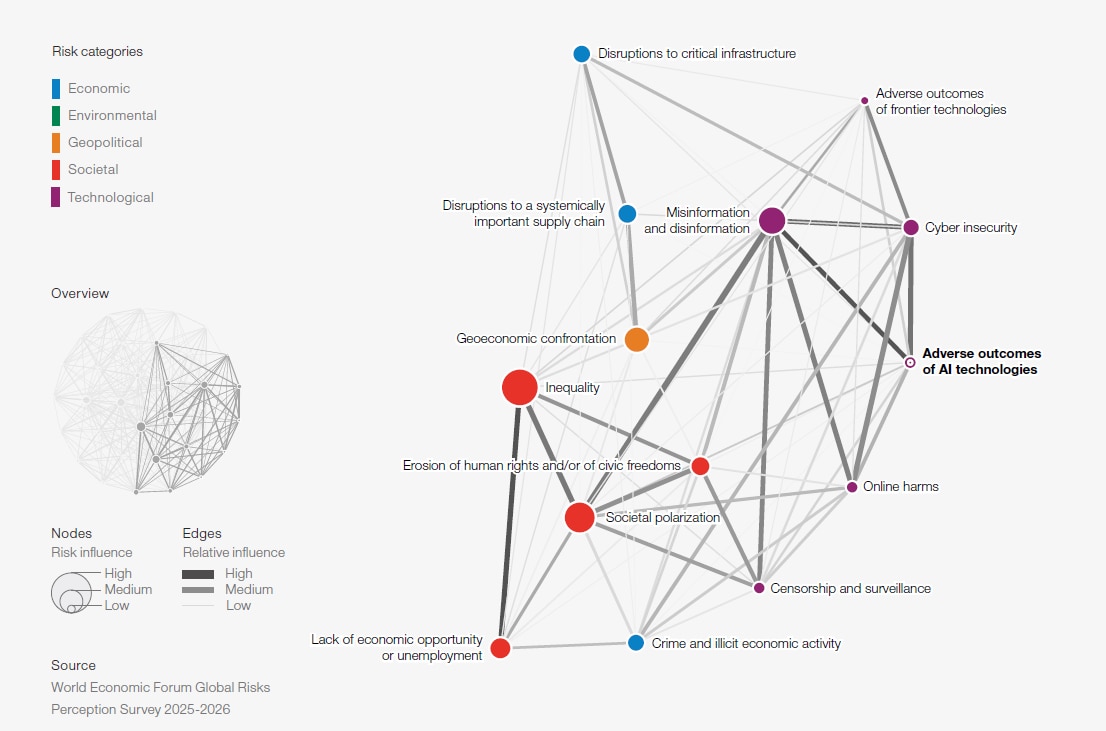
Cyber insecurity has emerged as a top global risk, reflecting the increasing frequency and prevalence of cyberattacks. The report cites examples such as the cyberattack on a Norwegian dam, illustrating how critical infrastructure is vulnerable to physical, cyber and cyber-physical threats.
Geoeconomic confrontation intensifies these risks, as state and non-state actors leverage cyber tools to disrupt adversaries. The convergence of cyber threats with misinformation campaigns and societal polarization creates a complex risk environment that businesses must navigate carefully.
Digital infrastructure: At the crossroads
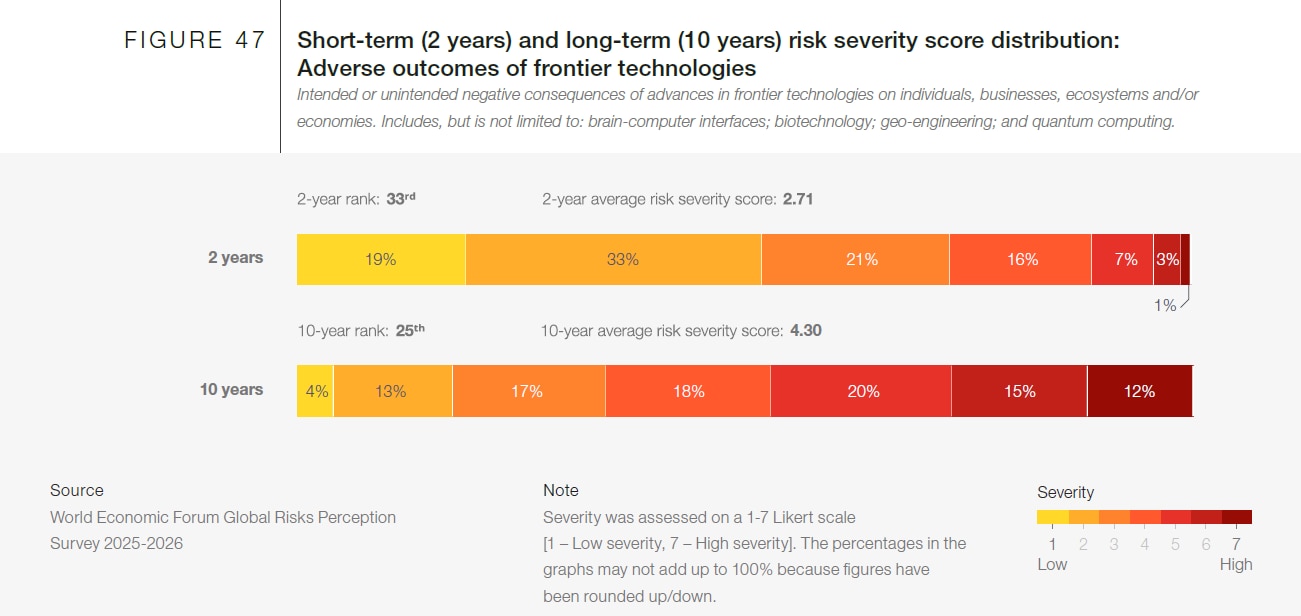
There is currently an unprecedented multi-trillion-dollar expansion of digital infrastructure globally – fueled by rising data consumption, cloud computing, AI and advanced technologies – which presents a complex risk landscape for all parties involved.
Extreme weather events, construction delays, supply chain disruptions, power interconnection uncertainties and cyber vulnerabilities can derail construction and operations, leading to outages, revenue losses, weakened investor confidence, and lasting reputational harm.
Emerging quantum computing risks, which could undermine current cryptographic protections, further expose digital infrastructure to new vulnerabilities.
The opportunities: Harnessing technology for resilience and growth
Despite these risks, technology offers powerful opportunities for businesses willing to adapt and innovate.
- AI as a productivity catalyst: When managed responsibly, AI can drive significant productivity improvements and create new job opportunities. Businesses that invest in upskilling their workforce and fostering inclusive AI adoption can mitigate labour market disruptions and unlock growth.
- Cybersecurity as a strategic priority: Strengthening cyber defenses is no longer optional. Companies that proactively invest in robust cybersecurity frameworks, threat intelligence, and incident response capabilities can build trust with customers and partners, turning security into a competitive advantage. This may even include the implementation of AI tools to counteract AI-enabled risks.
- Modernizing critical infrastructure: Building new and upgrading existing digital infrastructure to be more resilient against climate and cyber threats is essential. Embracing green technologies and distributed architectures can reduce risks and operational costs while supporting sustainability goals.
- Quantum preparedness: Early investment in quantum-resistant cryptography and collaboration with industry and government on quantum risk management can position businesses ahead of emerging threats.
Five actions businesses can take now
To navigate this complex landscape, businesses should consider the following strategic actions:
- Integrate AI ethics and risk management: Develop clear governance frameworks for AI deployment that balance innovation with ethical considerations, transparency, and accountability. Engage stakeholders to build trust and align AI initiatives with societal values.
- Elevate cybersecurity to board-level priority: Embed cybersecurity into the overall business strategy, ensuring adequate resources and leadership attention. Foster a culture of security awareness and continuous improvement across the organization.
- Invest in digital infrastructure resilience: Prioritize digital infrastructure builds and upgrades with a focus on climate resilience, redundancy and cyber-physical security. Collaborate with industry consortia and governments to share best practices and threat intelligence. Success will depend on three core pillars: comprehensive risk management, capital enablement, and resilience-building strategies that span asset lifecycles.
- Prepare for quantum computing disruptions: Monitor advances in quantum computing and begin transitioning to quantum-safe cryptographic standards. Engage in public-private partnerships to shape standards and policies that mitigate quantum risks.
- Foster workforce adaptability: Invest in continuous learning and reskilling programs to prepare employees for evolving technology roles and be sure to harness a broad range of perspectives in technology development and deployment.
Thriving at a time of global complexity and competition
The Global Risks Report 2026 underscores that technology is both a source of profound risk and a critical enabler of opportunity in an age of competition. Businesses that proactively address the challenges of AI, cybersecurity and digital infrastructure resilience will be better positioned to thrive amid uncertainty.
By embracing ethical AI, strengthening cyber defenses, modernizing digital infrastructure, preparing for quantum risks, and investing in the workforce, companies can not only mitigate risks, but also drive innovation and sustainable growth. In a complex and fragmented world, technology leadership grounded in responsibility and resilience will be a defining factor for success.
Don't miss any update on this topic
Create a free account and access your personalized content collection with our latest publications and analyses.
License and Republishing
World Economic Forum articles may be republished in accordance with the Creative Commons Attribution-NonCommercial-NoDerivatives 4.0 International Public License, and in accordance with our Terms of Use.
The views expressed in this article are those of the author alone and not the World Economic Forum.
Stay up to date:
Global Risks
Related topics:


Forum Stories newsletter
Bringing you weekly curated insights and analysis on the global issues that matter.
More on Global RisksSee all

Eric Usher
February 24, 2026


