CEOs are all in on AI but anxieties remain: What leader confidence indicates for 2026

Companies increasingly view AI transformation as a business-led strategy rather than merely IT innovation. Image: ijeab
Jessica Apotheker
Managing Director, Partner and Global Chief Marketing Officer, Boston Consulting Group- Companies are accelerating investments in AI with CEOs increasingly leading this expansion, according to BCG’s annual AI Radar survey.
- For CEOs, the challenge is not determining whether AI is a worthy pursuit; it is figuring out how their companies can succeed with the technology.
- Half of CEO respondents believe their job stability depends on getting AI right in 2026.
A global survey exploring AI acceleration and the mindset of executives suggests that enterprises are doubling their investments year-over-year with no plans to pull back – even if this year’s initiatives fail to pay off.
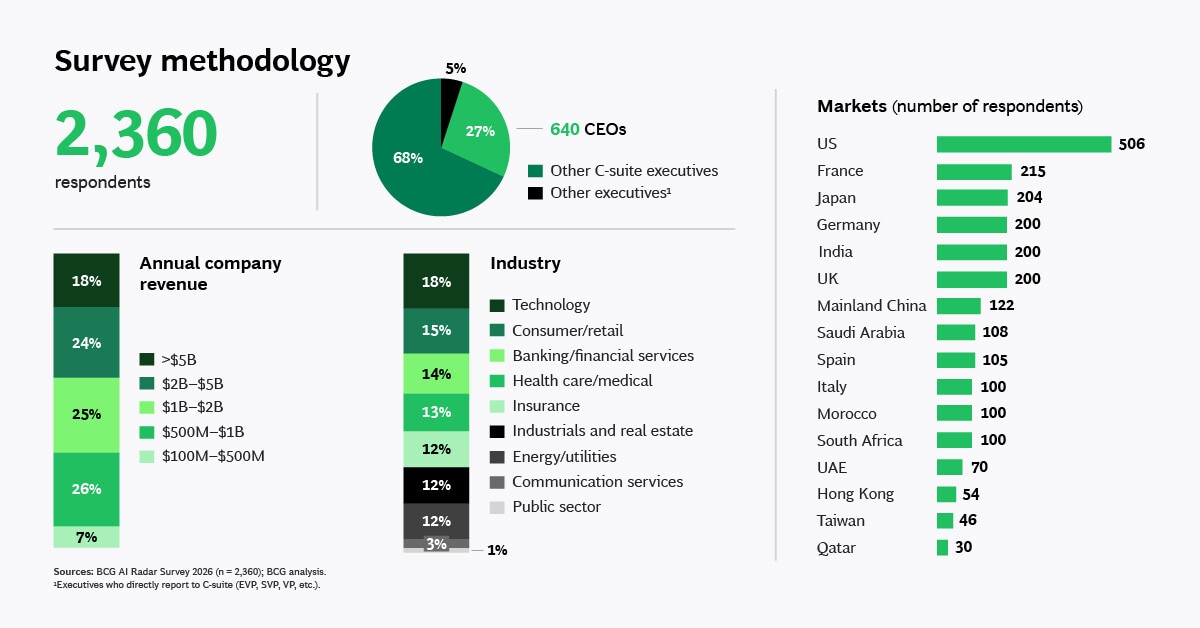
AI innovation has become a top-three strategic priority among two-thirds of CEOs surveyed in BCG’s annual AI Radar report. The survey captures insights from 640 CEOs and 2,360 leaders at companies where the vast majority report $500 million-plus in annual revenue.
Despite reports of AI fatigue and fears of a bursting bubble in 2025, enterprises and their CEOs remain fully committed
AI optimism is a survival instinct for CEOs
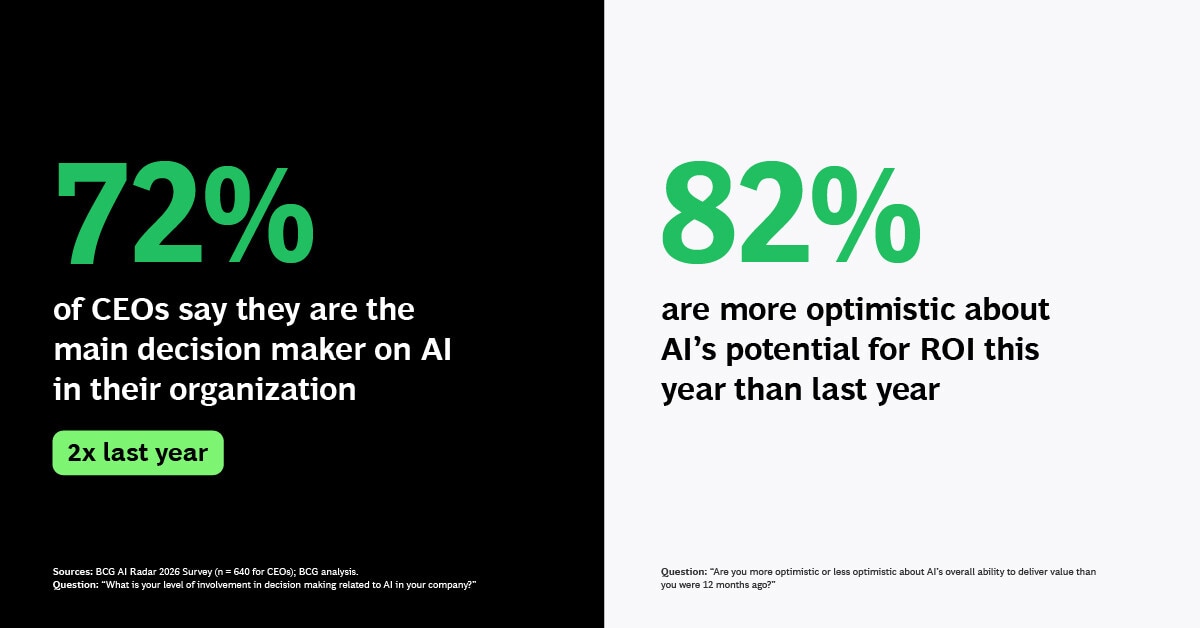
This AI optimism has become a survival instinct for CEOs. Results show that 82% of CEOs are more optimistic about AI than they were a year ago. Of the more than 2,000 senior leaders and C-suite executives in the study, nearly everyone believes to some degree that their organization’s AI investment strategy will pay off. What’s more, only 6% of companies plan to scale back investments if AI fails to deliver in 2026.
Globally, leaders agree that AI’s long-term potential dramatically outweighs near-term ROI goals. The challenge is no longer determining whether AI is a worthy pursuit; it is figuring out how their companies can succeed with the technology.
Of those surveyed, AI excitement increases as leaders "level up". CEOs are generally more optimistic than the rest of the C-suite, and they are substantially more excited than non-C-suite executives. This is a pivotal development because AI strategy has officially become the "CEO’s mandate" – shifting away from being a strictly technical concern for the chief technology officer (CTO).
In fact, half of the CEOs surveyed believe their job stability depends on successfully integrating AI in 2026. This pressure is mirrored across the organization: among non-CEOs, more than half believe the CEO or the board should resign if the company loses market share to competitors due to an inadequate AI strategy.
CEOs are more prepared for large-scale change in 2026
Companies most likely to succeed with AI understand that transformation is a business-led strategy rather than a mere IT initiative.
Nearly all CEOs state they are prepared to lead their organizations through an AI transformation that delivers a positive return on investment. Currently, about one-third of CEOs are allocating at least 20% of their transformation budget to AI, while another third are spending at least 40%.
An end-to-end AI transformation often requires "redrawing the map" of traditional organizational structures. Forward-thinking companies are conceiving new models where core functions, such as sales and marketing, are augmented or replaced by entirely new structures built around agentic AI.
This comprehensive overhaul also indicates a significant technological shift. CEOs increasingly recognize that to optimize AI ROI, they must replace legacy systems with AI-powered platforms. These platforms connect the organization across intricate work processes where AI agents perform complex operations.
Leadership clarity regarding AI’s potential has reached a new peak: 72% of respondents now identify the CEO as the primary decision-maker on AI, a significant jump from one-third last year. Furthermore, nine out of ten CEOs assert they could speak knowledgeably in an impromptu interview regarding the key ways AI directly impacts their industry. The data overwhelmingly implies that leaders are significantly more prepared than last year to navigate this sea change.
AI-enthusiast CEOs become trailblazers by choice
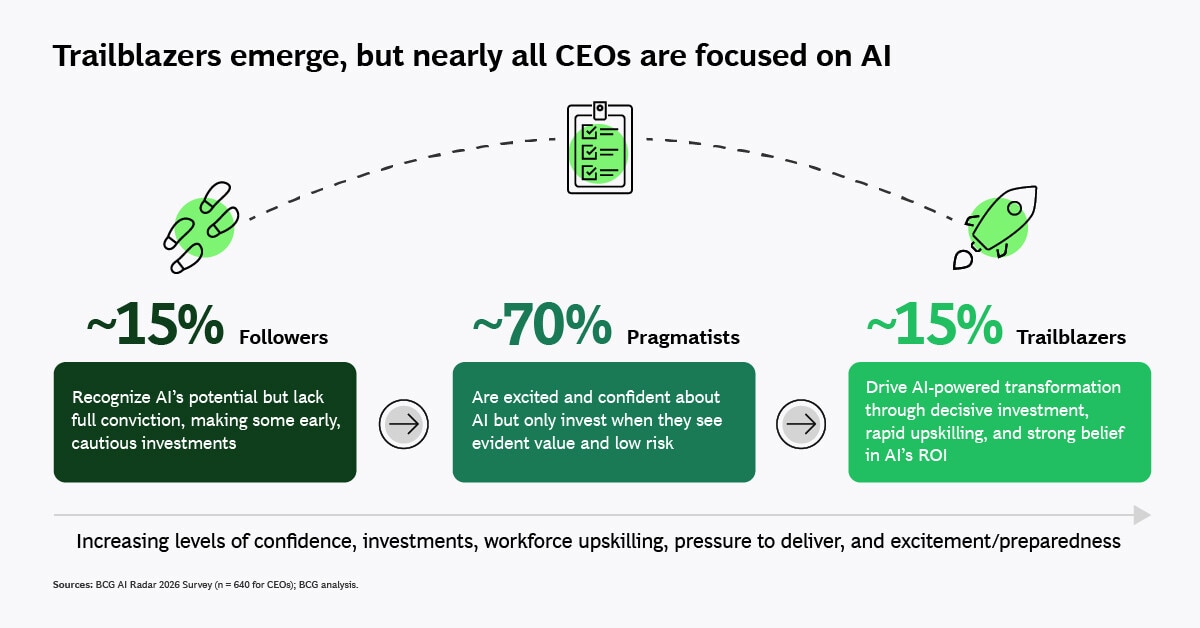
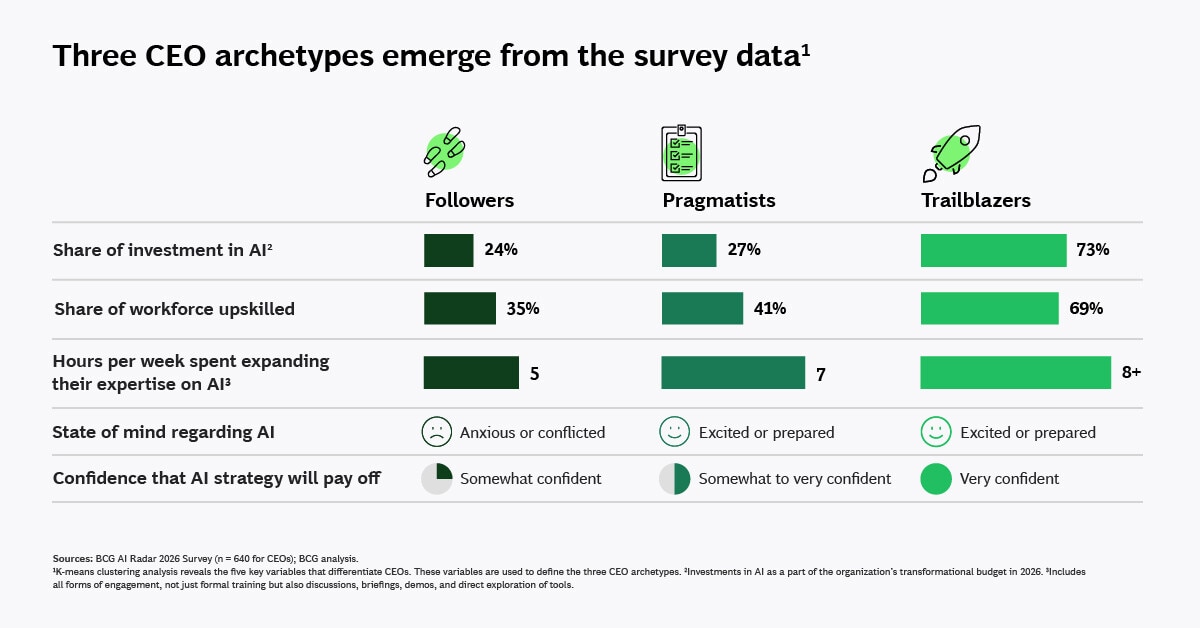
The days of casual, low-lift test pilots as a proxy for AI innovation are gone. Almost no CEO surveyed qualifies as an out-and-out AI skeptic; while some express anxiety and proceed with more caution than others, the momentum is undeniable. According to a number of key benchmarks, 70% are scaling at pace, and 15% embrace AI with great confidence. We refer to this latter cohort as "trailblazers".
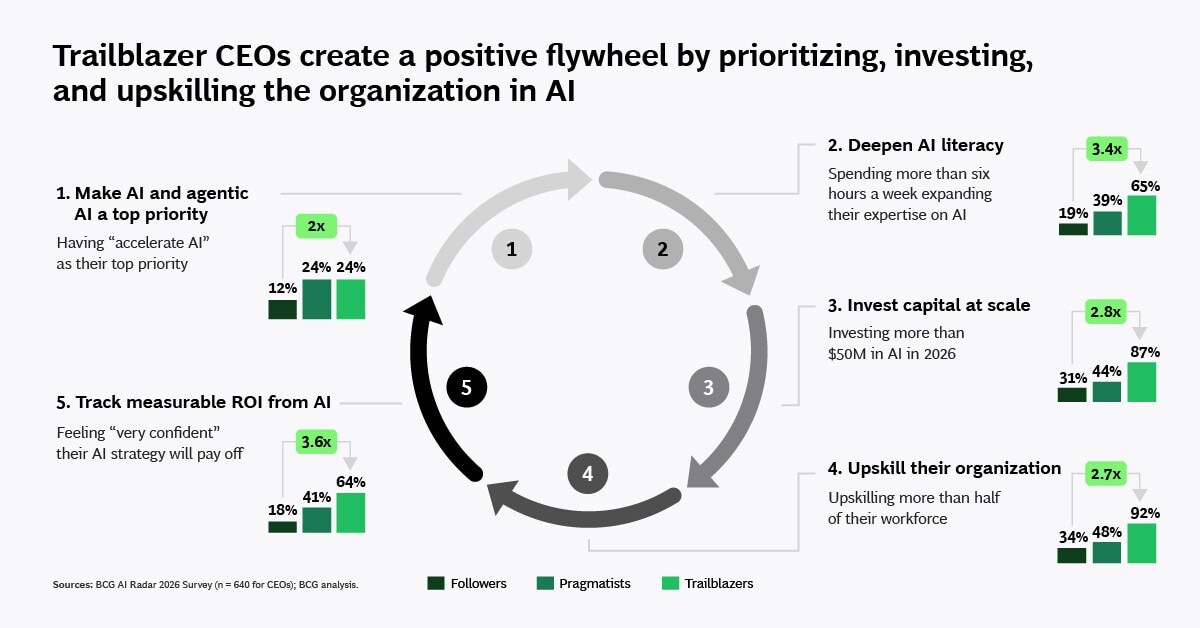
These trailblazing CEOs kick off a flywheel of AI growth opportunities by virtue of their enthusiasm alone. For instance, two-thirds of them spend more than six hours per week upskilling themselves, nearly twice as much as their less convicted counterparts.
Consequently, they commit three times the investment to accelerate AI – 73% of their transformation budget – and more than twice the amount on workforce upskilling compared to those who do not make AI a top priority.
BCG’s other recent report, The Widening AI Gap (September 2025), suggests that C-level executives and leadership teams who are deeply engaged with AI are an astounding 12 times more likely to be among the top 5% of companies winning with AI innovation.
The consensus is clear: AI success is a top-down endeavour. It is fundamentally dependent on meaningful engagement from the seniormost leaders in the organization.
Despite CEO excitement, AI anxieties persist
While the survey highlights overwhelming AI enthusiasm among CEOs, significant concerns still factor into decision-making. For example, nearly all CEOs believe AI agents will enable their organizations to realize measurable ROI in 2026; however, 60% admit they have intentionally slowed implementation due to concerns over potential errors and malfunctions.
Furthermore, the belief that AI will heavily disrupt the workforce impacts CEO enthusiasm. The data shows that while a relatively small percentage of CEOs are highly troubled by AI’s potential to displace workers, more than half say this prospect "dulls" their excitement to some degree.
Interestingly, the report finds that the CEOs most proactively pioneering AI are also the most concerned about worker displacement – even more so than those who openly acknowledge feeling worried about AI more broadly. It appears that the more a CEO understands the technology, the more convinced they become that workforce displacement is an inevitable reality within their own organization.
Have you read?
Getting AI right (or wrong) may define a CEO’s legacy
One of the survey's objectives was to understand how leaders feel about the tension between the imperative to invest and the lack of a guarantee that their AI initiatives will pay off, especially when the median CEO tenure is only about five years.
The data overwhelmingly suggests that those who hold the top job understand that AI is fundamentally transforming their industries and global business operations. While they admit that hype can obscure exactly where to focus, and acknowledge the fear of negative repercussions if initiatives fail, they are not dodging their responsibility.
The dramatic year-over-year shift in which CEOs have placed themselves at the centre of AI strategy indicates they understand that AI will influence how they are remembered as leaders – at a critical moment, in a pivotal year.
Don't miss any update on this topic
Create a free account and access your personalized content collection with our latest publications and analyses.
License and Republishing
World Economic Forum articles may be republished in accordance with the Creative Commons Attribution-NonCommercial-NoDerivatives 4.0 International Public License, and in accordance with our Terms of Use.
The views expressed in this article are those of the author alone and not the World Economic Forum.
Stay up to date:
Artificial Intelligence
Related topics:


Forum Stories newsletter
Bringing you weekly curated insights and analysis on the global issues that matter.


