Davos 2026: How middle powers are reading the global moment
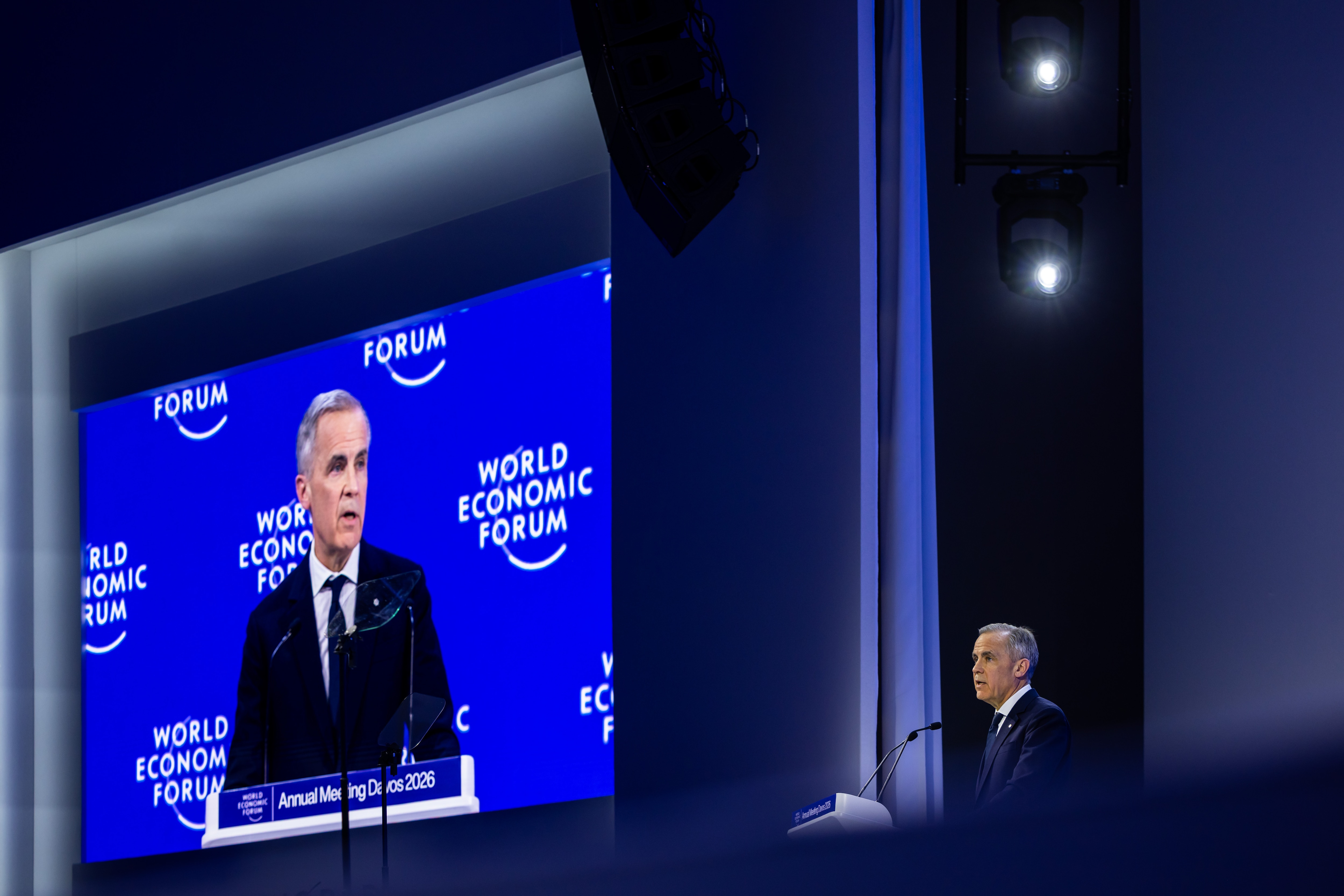
Carney: “We are in the midst of a rupture, not a transition", a statement indicative of how middle powers should think Image: World Economic Forum
- Middle powers agree the old order is no longer holding. From Europe to Asia, leaders described a world of permanent rupture, not transition.
- Sovereignty is being redefined as resilience, not retreat. Across regions, leaders framed capacity-building as the basis for agency in a more fragmented global economy.
- The response is collective, not passive. Rather than waiting, middle powers are building coalitions, asserting strategy and preparing to shape what comes next.
At Davos this year, the clearest signals came from the countries in between.
The so-called middle powers, first defined by sixteenth-century political thinker Giovanni Botero as states with “sufficient strength and authority to stand on [their] own”, made themselves heard across the week. In the modern era, they are less defined by scale than by role: contributors to the global economy, anchors of regional influence and increasingly, organisers of coalitions.
Despite their differences, these countries converged on a strikingly similar reading of the global moment: The rules-based order that once provided predictability has weakened. Great-power rivalry is no longer episodic but structural. And waiting for the old system to reassert itself is no longer a strategy.
As Canada’s Prime Minister Mark Carney put it, “We are in the midst of a rupture, not a transition.”
But it wasn’t a week of mourning. Instead, leaders described how they’ll navigate what’s next: strengthening sovereignty, building resilient coalitions and investing in capacities for the future.
The fiction is over
For many middle-power leaders, the starting point at Davos was not uncertainty but recognition: the world is operating on a story that no longer holds.
In his special address, Mark Carney invoked the ancient Greek historian Thucydides to remind the audience that systems endure not only through force, but also through participation that demands everyday acts of compliance with ideas privately known to be false.
“For decades, countries like Canada prospered under what we called the rules-based international order,” Carney said. “We joined its institutions, we praised its principles, we benefited from its predictability.”
But, he added, “We knew the story of the international rules-based order was partially false, that the strongest would exempt themselves when convenient, that trade rules were enforced asymmetrically. And we knew that international law applied with varying rigour depending on the identity of the accused or the victim.”
Still, he said, the performance continued. “This fiction was useful. So we placed the sign in the window. We participated in the rituals. And we largely avoided calling out the gaps between rhetoric and reality.”
“This bargain no longer works,” he said.
From the Gulf, the same reality was described in more direct terms. “The whole world is going through a pivotal moment,” said Mohammed bin Abdulrahman Al Thani, Prime Minister and Minister of Foreign Affairs of Qatar. “Since World War II, there was a system with checks and balances—those are gone now."
The acceleration of that breakdown is now impossible to ignore. “This year, we have seen there is an acceleration of that, so everyone is noticing that something is happening,” he said. “This is the system that needs a lot of reforms that we didn't look at for the past two decades.”
In Asia, the worry was not just eroding norms but compounding erosion. “We see disregard for the UN Charter,” said Tharman Shanmugaratnam, President of Singapore. “We see erosion of the norms, conventions and trust built up over 80 years,” describing the risk of “a self-reinforcing decline into disorder.”
For Carney, the danger is continuing belief in a system that no longer protects those who rely on it. “When the rules no longer protect you, you must protect yourself,” he said.
Nostalgia is not a strategy
If the fiction of the old order has been exposed, several leaders warned that the greater danger now lies in hoping it might somehow return.
In her special address, Ursula von der Leyen, President of the European Commission, framed the moment as irreversible. “Geopolitical shocks can and must serve as an opportunity for Europe,” she said. “The seismic change we are going through today is an opportunity, in fact, a necessity, to build a new form of European independence.”
What mattered most, she argued, was accepting permanence. “The truth is also that we will only be able to capitalize on this opportunity if we recognize that this change is permanent,” she said. “Of course, nostalgia is part of our human story, but nostalgia will not bring back the old order. And playing for time and hoping that things will revert soon will not fix the structural issues that we have.”
“And if this change is permanent,” von der Leyen continued, “then Europe must change permanently too. It is time to seize this opportunity and build a new independent Europe.”
That rejection of waiting was echoed by leaders well beyond Brussels. In Morocco, Aziz Akhannouch described a similar choice. “In a world that doubts itself, Morocco has chosen not to give up and fall back onto itself,” he said. “Morocco has decided to protect, to reform and to look forward.”
In Northern Europe, Finnish President Alexander Stubb placed the present moment in historical context. “The world order is changing much like it did after 1918, 1945 and 1989,” he said, warning that the alternative paths were clear. “One is a multipolar world… about transactions, deals and spheres of interest.” The other, he said, was a multilateral world grounded in institutions, rules and norms. “I support the latter, and I think that a majority of the states in the world do that as well,” he said.
“But the multilateral order that was created after World War II was created in the image of the West. Therefore, we now need to change the power structure and give agency to the bigger players in the global South. Otherwise, we go back into a dog-eat-dog world, and we try to avoid that.”
Sovereignty now means resilience
Middle powers now frame sovereignty less as withdrawal and more as capacity, from social to economic.
“For us, it all starts with a basic principle,” Morocco’s Akhannouch said. “We cannot build a geopolitical future on a fragile society... so we have decided to first protect our society and population.”
In Egypt, Hassan Elkhatib, Minister of Investment and Foreign Trade, described the same shift through the lens of industrial strategy. “The phase of globalization is phasing out,” he said. “The new world that we live in: the supply chain shift is a reality, it’s resilience vs efficiency.”
Elkhatib used the electric vehicle industry as an illustration. “The EV industry is completely dominated in China,” he said. “Does this mean we should not do an EV industry in the Middle East? I would say, we should.” The case, he argued, was not about matching China’s scale but about building competitiveness through collaboration, even if “it won’t be the cheapest option.”
What will matter, he suggested, is readiness, not retreat. “Countries will differ by the quality of their infrastructure. Openness, competitiveness, and easy business are Egypt’s future.”
Our latest Global Risks Report reflects this reality. “Major powers as well as middle powers are starting to compete with each other when it comes to resources and technologies,” said Saadia Zahidi, Managing Director at the World Economic Forum, around the launch of the report. “That's really what we're seeing playing out as underlying a lot of the risks that we're seeing this year.”
From East Asia, predictability emerged as a core concern. “Free trade and the rule of law are important principles Japan advocates,” said Akazawa Ryosei, Japan’s Minister of Economy, Trade and Industry. “What’s important for business is to secure predictability… We need to maximise our efforts to ensure predictability.”
Values without capacity fall short
While larger powers focused on security and rivalry, middle powers emphasized the limits of values without capability. “The whole discussion about ideology has to be eliminated,” said Daniel Noboa Azín, President of Ecuador. “The real enemy is misery... having impoverished nations that have billions of dollars, trillions of dollars in resources and still can't have three meals a day.”
The fight in Latin America, he said, is ‘democracy vs anarchy’. “We are very similar...we just need to fight the right fight.”
From Singapore, Tharman cautioned against moral exhaustion as well as moral posturing. “It will be tempting to think… that things have to get worse before they can get better,” he said. “That is a tempting thought but it is a false prospect.”
Instead, he argued, “We have to bend the trajectory,” starting not from idealism alone but from “a plan B that recognises that national interests will prevail.”
The contrast with larger powers was explicit at moments. Javier Milei, President of Argentina, framed the challenge in philosophical terms. “Justice and efficiency are two sides of the same coin,” he said, calling for a return to moral clarity.
Choosing your own path
Caught between competing hegemons, many leaders stressed that passivity now carries its own risks.
Speaking during a session on Rebuilding Trust in Latin America, Ngaire Woods, Dean of the Blavatnik School of Government at the University of Oxford, bluntly framed the challenge facing the region. “Every country on the continent is facing a competition between outside powers, the U.S. and China, for control,” she said. “The most important thing… is that each country and collectively the continent has a clear strategy of its own.”
In Europe, the stakes were framed in similarly stark terms. “We either stand together, or we will stand divided,” said Bart De Wever, Prime Minister of Belgium. “If the old is dying and the new is not yet born, you live in a time of monsters.”
For Croatian Prime Minister Andrej Plenković, the task was not to abandon alliances but to engage on more equal terms. “The United States is an ally and a friend,” he said. “So we need to talk to each other more… finding solutions for the global order.”
Across regions, the message was consistent: middle powers are clarifying their own strategies but also looking to act together where interests align.
Building coalitions that work
What replaces the old centre of gravity, many argued, will not be a single power or institution but dense networks of cooperation among states around shared interests.
“Collective problems require collective solutions and everyone has to pitch in with the right burden sharing,” said Singapore’s Tharman Shanmugaratnam. The response, he argued, is not to abandon the existing system but to work around its limits. “Build up the plurilateral alliances but do not repudiate Plan A.”
Across the week, middle powers framed these coalitions not as an alternative to sovereignty, but as a way of reinforcing it. “If we’re not at the table, we’re on the menu,” MarkCarney warned during his address, which ended with a standing ovation.
“We are not subordinate to this world,” said Friedrich Merz, theFederal Chancellor of Germany, speaking of Europe’s response to a harsher geopolitical environment. “We are working together in Europe between European partners and that will help us in these new times.”
By the end of the week, the message from the countries in between was clear. Middle powers are no longer waiting for order to be restored. They are preparing deliberately, collectively and with open eyes to shape what comes next.
License and Republishing
World Economic Forum articles may be republished in accordance with the Creative Commons Attribution-NonCommercial-NoDerivatives 4.0 International Public License, and in accordance with our Terms of Use.
The views expressed in this article are those of the author alone and not the World Economic Forum.

Forum Stories newsletter
Bringing you weekly curated insights and analysis on the global issues that matter.
More on Geo-Economics and PoliticsSee all

Samaila Zubairu
March 3, 2026


