Davos 2026: Special address by Emmanuel Macron, President of France
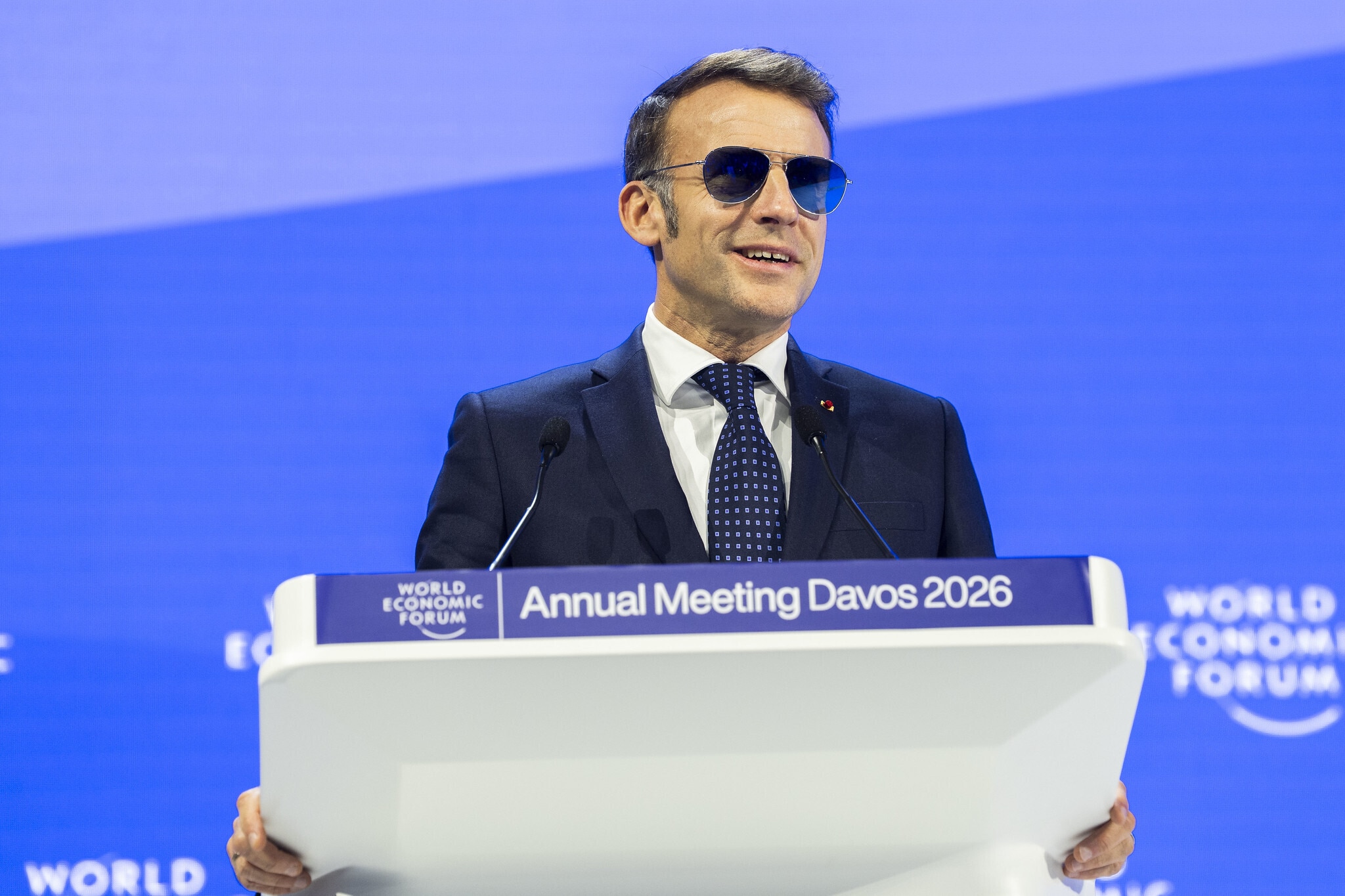
Davos 2026: Emmanuel Macron stressed the importance of global cooperation in his special address. Image: World Economic Forum/Valeriano Di Domenico
- This blog contains the full transcript of a Special Address by Emmanuel Macron, President of France, delivered at the World Economic Forum Annual Meeting 2026 in Davos.
- Macron advocated for European preference, simplification and investment in innovation, particularly in AI and clean tech.
- In addition, the French president stressed the need for greater cooperation to achieve peace, prosperity and decarbonization and underscored the importance of the rule of law.
This transcript was produced using AI and subsequently edited for style and clarity. The edits do not alter the substance of the speaker’s remarks.
Thank you very much for your words. Your majesties, distinguished heads of state and governments, President Lagarde, ministers, ambassadors, business leaders, ladies and gentlemen, I'm extremely happy to be here.
And it's great to be here, as the Financial Times would say, and it's a time of peace, stability and predictability. So, let's try to address the key challenge of this world in a few minutes time. But it's clear that we are reaching a time of instability, of imbalances, both from the security and defence point of view, and economic point of view.
Look at the situation where we are. I mean, a shift towards autocracy, against democracy. More violence, more than 60 wars in 2024 – an absolute record, even if I understood a few of them were fixed. And conflict has become normalized, hybrid, expanding into new demands, space, digital information, cyber, trade and so on.
It's as well a shift towards a world without rules. Where international law is trampled underfoot and where the only laws it seems to matter is that of the strongest. And imperial ambitions are resurfacing. Obviously the Russian war, the Russian war of aggression against Ukraine, which will enter into its fourth year next month, and conflicts continue in the Middle East and across Africa.
This is as well as shift towards a world without effective collective governance and where multilateralism is weakened by powers that obstruct it or turn away from it, and rules are undermined.
And I can multiply the examples of international bodies weakened or left by the key economies. And when we look at the situation, it's clearly a very concerning time, because we are killing this structure where we can fix the situation and the common challenges we have.
Without collective governance, cooperation gives way to relentless competition. Competition from the United States of America through trade agreements that undermine our export interests, demand maximum concessions and openly aim to weaken and subordinate Europe, combined with an endless accumulation of new tariffs that are fundamentally unacceptable – even more so when they are used as leverage against territorial sovereignty.
And competition from China, where massive excess capacities and distortive practices threaten to overwhelm entire industrial and commercial sectors. Export control has become more dangerous, new tools destabilizing global trade and the international system.
And the answer, in order to fix this issue, is more cooperation. And building new approaches. And it's clearly building more economic sovereignty and strategic economy, especially for the Europeans, which, for me, is the core answer.
In this context. I want to exclude two approaches. The first approach would be to, I would say, to passively accept the law of the strongest, leading to vassalization and bloc politics. I think accepting the sort of new colonial approach doesn't make sense. And all the heads of state and government and business leaders, which would be too complacent with such an approach, will take a huge responsibility.
The second would be to adopt a purely moral posture, limiting ourselves to commentary. That would condemn us to marginalization and powerlessness. Faced with the brutalization of the world, France and Europe must defend an effective multilateralism because it serves our interests and those of all who refuse to submit to the role of force.
And for me, the two answers, on one side more sovereignty and more autonomy for the Europeans, on the other side, an efficient multilateralism to deliver results through cooperation. Obviously, France and Europe are attached to national sovereignty and independence, to the United Nations and to its charter. And it's not an old-fashioned way to leave multilateralism.
It's used not to totally forget what we learned from the Second World War and remain committed to cooperation. And this is also because of this principle that we have decided to join a mutual exercise in Greenland without threatening anyone, but just supporting an ally and another European country, Denmark.
Facing this order and this new situation, this year, France holds the G7 presidency with a clear ambition – to restore the G7 as a forum for frank dialogue among major economies, and for collective and cooperative solutions. Trade wars, protectionist escalation, races towards overproduction will only produce losers.
This is why addressing global economic imbalances is our key priority. And if we look at the situation, the current imbalances are due to some key phenomena, and we all have to deliver our own agenda. This includes American overconsumption, Chinese underconsumption and overinvestment, and European underinvestment and lack of competitiveness.
And these imbalances are also reflected in development gaps, by the way. We can no longer settle for aid that neither delivers efficient results nor enables countries to escape poverty.
So, our objective through the G7 is to demonstrate that the world's major powers are still capable of reaching a shared diagnosis of the global economy and committing to concrete actions. Cooperating is not about blaming others. It is about assuming one share of responsibility and contributing to solutions.
So, the objective of this G7 will be to build this framework of cooperation, in order to fix the roots of these imbalances and restore efficient convergence and cooperation through multilateral frameworks.
And the other objective is as well to build bridges and more cooperation with the emerging countries, the BRICs and the G20, because the fragmentation of this world will not make sense.
Here, this point is, for, I would say, the global agenda and how we'll see our G7 agenda. On the other side, we have to European answer. And for me, Europe clearly has to fix its key issues – a lack of growth, the lack of GDP per capita growth – and the three pillars of our strategy to deliver more sovereignty, more efficiency and more growth should be based on protection, simplification and investment.
Because the diagnosis is well known, European competitiveness still lags behind that of the US and in the current global order, facing, precisely, the Chinese approach, we have to react.
So first, protection. Protection doesn't mean protectionism. Today's Europeans are too naive. This is a unique market, open to everybody without checking level playing field. Nobody can access the Chinese markets as people are accessing the European market, for sure. But even if you take the US, and a lot of other countries, the level of protection does exist for investment and trade. And the Europeans are the only one not to protect their own companies and their own markets, when the other countries don't respect the level playing field.
This is why we have to be much more realistic. If we want to protect our chemical industry, our industries – from the automotive sector to a lot of others – because they are being literally killed by the lack of respect of a normal framework and level playing field.
Europe has very strong tools now, and we have to use them when we are not respected, and when the rules of the game are not respected, by the way. The anti-coercion mechanism is a powerful instrument and we should not hesitate to deploy it in today's tough environment.
We must also advance the principle of European preference. There is a North American preference in your market. There is no European preference today. We are progressively creating it, and in the latest documents and decisions… we do have the first examples of that. But this is extremely good. And we are currently aligning closely with Germany to deliver an ambitious and simple framework.
And this is a decisive project and I count on the European Commission to present the proposal this way by early 2026, with the highest possible level of ambition in order to deliver, I would say, across the different sectors, the principle of European preference. This is a necessity.
We must act on imports, as well, regarding this protection issue. And in the context of escalating trade tensions and Asian overcapacity, Europe must strengthen its trade defence instruments, including mirror measures to enforce the regulatory standards, and we must improve the quality and added value of foreign direct investments targeting projects with strong export potential.
And this is core for the rebalancing with China. China is welcome, but what we need is more Chinese foreign direct investments in Europe, in some key sectors, to contribute to our growth, to transfer some technologies, and not just to export towards Europe, some devices or products which sometimes don't have the same standards, or are much more subsidized, than the ones being produced in Europe. It's not being protectionist, it's just restoring this level playing field and protecting our industry.
So, from safeguard clauses to European preferences and incentives for more FDI, this strategy is absolutely key. And in parallel, protecting our economies, will also require a resilience strategy, on both imports and exports, to derisk supply chains, particularly for raw materials, semiconductors, chips, and to diversify our trade partners.
The second pillar of the European economy and European strategy should be simplification. And when I speak about simplification, we started with CSRD, CS3D, and we have to do much more on different sectors. And we did it during the past few weeks on automotive, and we have to do it on chemical, digital, AI, banking and so on.
And the core of this simplification is sometimes to get rid of some recent regulations when they desynchronize in a certain way the European Union, in comparison with the rest of the world. But we have. as well, to accelerate the deepening of the single market. On all the sectors, the 450 million inhabitants and consumers market should be the domestic markets of all the EU companies. It's not yet the case, as long as you have complexities.
In doing so, we must ensure respect, technological neutrality and non-discrimination within the European Union. This is another pillar, another point of simplification – a neutral approach in terms of technology and non-discrimination. We discriminate during such a long time between the different source of energies, it’s counterproductive for the Europeans themselves.
Companies have a role to play, and we must act and you must act, and clearly you must help identify and concretely help us to simplify where it is needed. But for me, this agenda simplification is not a matter of discussion, but just implementation, speed and scale.
The third pillar of European strategy for more competitiveness and more autonomy, is based on investment and innovation. We have to invest much more. If there is a GDP per capita so different between the US and Europe, 65% to 70% of the explanation is due to the difference in terms of innovation.
And the US was much more innovative because of public and private investment. So, in our budget for the months to come, because we will negotiate this year in Europe, we have to invest much more money in the critical sectors where innovation will be made – AI, quantic, cleantech, level defence and security.
The size of our common budget is not the right one. We have to invest much more money in order to be much more credible and accelerate this innovation agenda. But at the same time, if you look at the situation, we don't have sufficient private investment. And this is one of the main differences.
We do have the savings as the Europeans, much more than the US, by the way. But this saving is overinvested in bonds and sometimes in equities – but outside Europe. So, this is why is the top priority should be securitization programme. It is prepared. We have to accelerate the implementation.
And second, capital market union, precisely in order to have more integration and simplification. But to have an efficient capital market union in order to invest much more money, and use our savings to be invested on innovation and equity in Europe.
This agenda, for me, is our top priority – both the global and the European one. And it is to be implemented in the months to come, because everything is about acceleration. And France is committed to deliver this agenda. We work very closely with our key partners and at the same time, our objective for France, is to stabilize our results and our macro approach and to remain the highly attractive country we are – we've been, the most attractive country of Europe during the past six years – and to consolidate our deep structural reforms and our key advantage.
And on top of the business framework we have, I want here to insist on the fact that we have a competitive, stable, low carbon electricity supply. We exported, last year, 93 TWh of electricity, and low carbon one based on the nuclear model. We have world-class innovation and research capabilities, and we will improve them. And we have one of the most vivid and active ecosystems in AI, quantum computing, energy transition, etc., etc. and a lot of start-ups and unicorns and large caps of these sectors are with me in my delegation today.
And on top of that, let me insist – and I will stop here – on the fact that we have a high-quality infrastructure and large market, with strong purchasing power, and we have a place where rule of law and predictability is still the rule of the game.
And my guess is that it is largely underpriced by the market, and beyond what you can do in terms of investment, what you can do in terms of strong ambitions, having a place like Europe, which sometimes is too slow, for sure, and needs to be reformed for sure, but which is predictable, loyal and when, well, you know that the rule of the game is just a rule of law, it's a good place. And I think this is a good place for today and for tomorrow.
So we will be committed during 2026 to try to deliver this global agenda in order to fix global imbalances, through more cooperations, and we will do our best in order to have a stronger Europe, much stronger and more autonomous, based on the pillars I just mentioned, and based, as well, and we can revert into dialogue, but on more investment and commitments on defence and security. Because we have to invest much more. Because we do believe and here, in the epicentre of this continent, we do believe that we need more growth, we need more stability in this world.
But we do prefer respect to bullies. We do prefer science to plotism, and we do prefer rule of law to brutality. You are welcome in Europe and you are more than welcome to France.
Don't miss any update on this topic
Create a free account and access your personalized content collection with our latest publications and analyses.
License and Republishing
World Economic Forum articles may be republished in accordance with the Creative Commons Attribution-NonCommercial-NoDerivatives 4.0 International Public License, and in accordance with our Terms of Use.
The views expressed in this article are those of the author alone and not the World Economic Forum.
Stay up to date:
European Union


Forum Stories newsletter
Bringing you weekly curated insights and analysis on the global issues that matter.
More on Forum in FocusSee all

Kaya Bülbül and Kate Whiting
January 30, 2026


