Why dialogue matters when disaster risk can no longer be insured
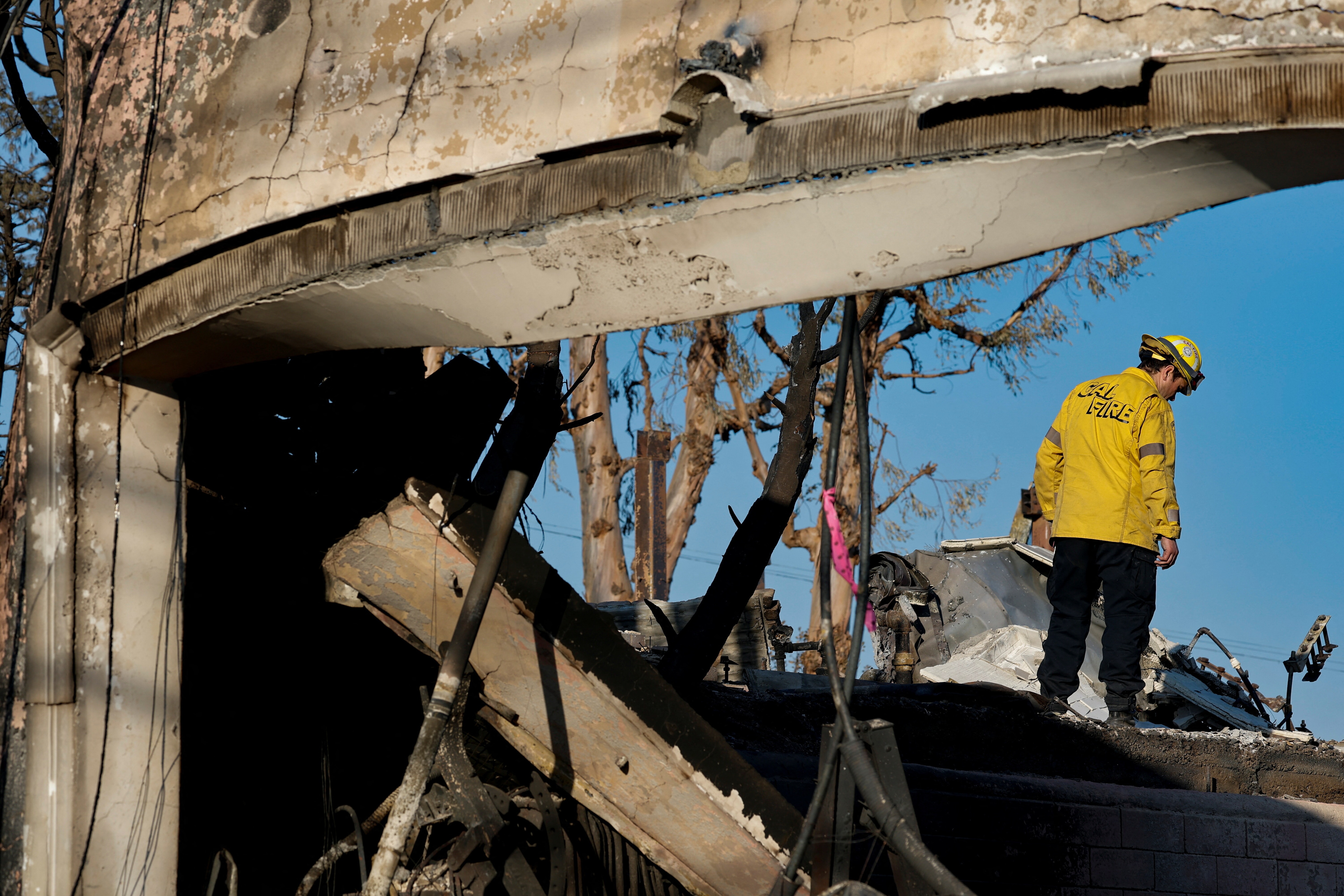
Disaster risks such as wildfires are becoming more common and many of the economic costs are falling on homeowners. Image: Reuters/Fred Greaves
- Homeowners and communities are increasingly exposed to significant loss as the frequency of wildfires, severe weather and catastrophes accelerates.
- The total economic costs of disasters are now estimated at more than $2.3 trillion per year once knock-on effects are included, according to the UN.
- Structured dialogue, backed by data and shared incentives, can enable us to build “shared resilience” insurance models as a collaborative project.
Wildfires, severe weather and catastrophes are becoming increasingly common, leaving homeowners and communities more exposed to significant loss.
By some estimates, the total economic costs of disasters now exceed $2.3 trillion once knock-on effects are included, according to the United Nations Office for Disaster Risk Reduction (UNDRR).
UNDRR’s Global Assessment Report on Disaster Risk Reduction 2025 estimates that when indirect impacts – including losses to health, livelihoods and supply chains – are included, the annual global cost of disasters is now close to $2.3 trillion.
Meanwhile, traditional risk transfer models are under strain as insurers, reinsurers, or governments acting as insurers of last resort can no longer fully cover the risk. A growing (re)insurance protection gap points to the need to urgently reduce disaster risks if they can no longer simply be transferred.
Yet investment in reducing disaster risk before disasters strike remains very small. Fewer than 2% of international aid projects and often less than 1% of public budgets focus on disaster risk reduction.
Insurance premiums increase when risks rise faster than prevention
When risk rises faster than prevention, insurers have to increase prices, narrow coverage, or withdraw from exposed areas. For households, this means higher premiums, exclusions for key perils or no meaningful offer of cover at all, with knock-on effects on mortgages, credit and the ability to buy, sell, or improve property.
Insurers recognize that this trajectory does not work for them either. Climate risk is making protection harder to offer, and closing the protection gap depends on investments that make homes more resilient and more insurable.
The question is how to organize those investments fairly, so costs are shared, instead of falling onto individual homeowners at the very moment their budgets are most constrained.
The World Economic Forum’s Annual Meeting 2026 in Davos, under the theme ‘A Spirit of Dialogue’, which includes a focus on how to rebuild prosperity within planetary boundaries, invites precisely this kind of cross-sector conversation.
Promising solutions are emerging through PwC’s collaboration with the World Economic Forum on the Global Wildfire Leadership Network and other efforts aimed at convening stakeholders with a joint interest in resilience.
Shifting focus from disaster mitigation to loss prevention
To scale what works for homeowners, three design principles for “shared resilience” models are emerging.
1. Shared data and standards
Stakeholders need common definitions of resilience, i.e., what counts as a resilient roof, a fire-safe home, or a flood-ready building, and they need a property-level understanding of disaster risk that insurers, banks, cities and households can trust.
The FORTIFIED standard for wind and hail resilience, developed by the Insurance Institute for Business & Home Safety (IBHS), is one prominent example. It provides a science-based benchmark now embedded in building programmes and insurance pricing in several US states.
Similar standards, such as IBHS’s Wildfire Prepared Home and city-specific climate resilience frameworks, help align decisions by homeowners, local governments and financial institutions around a shared understanding of risk and what defines a resilient property.
2. Blended financing that meets households where they are
Even the best standards will not be adopted at scale if homeowners are asked to pay for upgrades on their own.
The World Economic Forum and UNDRR argue for disaster risk reduction finance that combines public funding, concessional capital and private investment. UNDRR’s Target F work underlines the need to get that support to local levels where projects happen.
Recent consumer research conducted by PwC of US homeowners shows that most respondents have strong intent to act on a home resilience upgrade during a financial transaction. Furthermore, when different levels of cost coverage were tested, 76% said they would be ready to make an improvement in the next 90 days, and roughly 60% of those would act when up to 50% of the cost was covered.
3. Integrated community-based solutions
Finally, shared resilience calls for solutions that integrate analytics, mitigation and finance at a community level, supported by joint outreach.
Recent experiences in addressing wildfire risk show how data, scoring, mitigation planning and financing instruments can be combined into an integrated model for insurers, governments, investors and communities.
In California’s Lake Tahoe region, Firewise USA communities supported by the Safer from Wildfires framework can undertake neighbourhood-wide mitigation that may qualify residents for wildfire risk reduction discounts from multiple insurers.
In Florida, flood-prone communities such as Key West participate in the National Flood Insurance Program’s Community Rating System, earning community-wide premium discounts when they invest in flood-risk reduction.
In difficult times, dialogue can feel like a soft response to hard problems. However, in our experience, structured dialogue, backed by data and shared incentives, is becoming a necessity in a world where certain risks are harder to insure.
It’s how stakeholders move from an economy in which households quietly absorb rising climate risk to one in which resilience is planned, financed and rewarded as a shared project.
Don't miss any update on this topic
Create a free account and access your personalized content collection with our latest publications and analyses.
License and Republishing
World Economic Forum articles may be republished in accordance with the Creative Commons Attribution-NonCommercial-NoDerivatives 4.0 International Public License, and in accordance with our Terms of Use.
The views expressed in this article are those of the author alone and not the World Economic Forum.
Stay up to date:
Wildfires


Forum Stories newsletter
Bringing you weekly curated insights and analysis on the global issues that matter.
More on Global RisksSee all

Eric Usher
February 24, 2026


