Opinion
How rising electricity demand will drive decarbonization and global economic growth
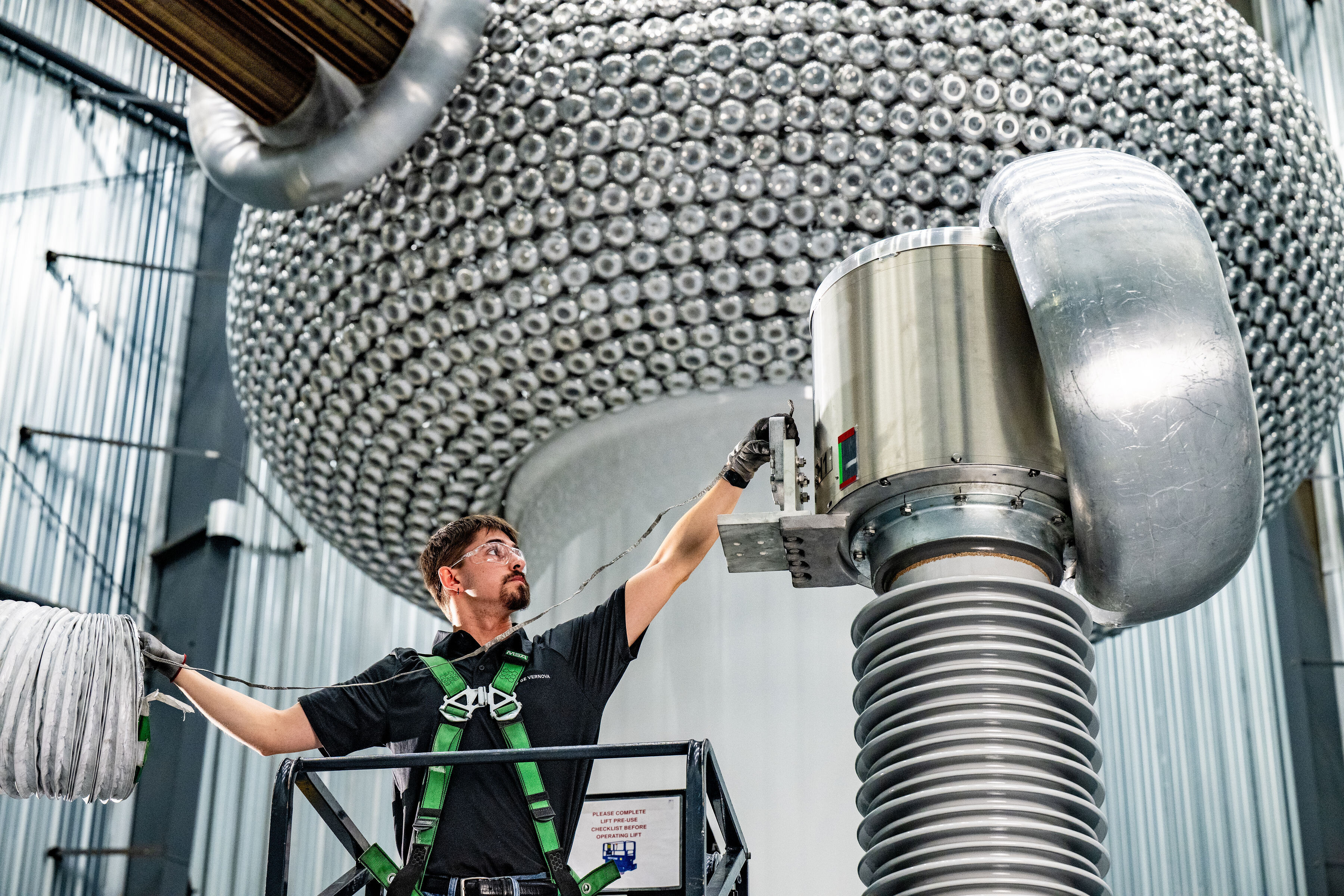
An ultra high voltage test lab at a GE Vernova power transmission facility in Pittsburgh, Pennsylvania. New technologies can help satisfy electricity demand and accelerate the energy transition. Image: Chris Rank/ Rank Studios
- From industrialization to the Internet Age, major leaps in productivity have been built on expanding access to reliable power.
- Current projections for rising global power demand mean countries must secure reliable and sustainable electricity to drive future economic growth.
- Economic growth and climate targets are not a trade-off; growth can accelerate decarbonization.
Global efforts to meet unprecedented electricity demand will be the single greatest accelerator of decarbonization ever. This will be fundamental to global economic growth in the coming decades.
Electricity has long been the engine of modern economic development. From industrialization to the Internet Age, every major leap in productivity has been built on expanding access to reliable power. Nations that scale smarter electricity generation and modernized grid infrastructure consistently unlock faster growth, higher living standards and more competitive industries.
What differentiates the current moment, however, is the nature and scope of global demand. The International Energy Agency’s (IEA) World Energy Outlook 2025 forecasts strong electricity demand growth of 40-50% to 2035. This forecasted demand will, in part, be driven by the swell of artificial intelligence and data centres, but will also include growing electricity needs for advanced manufacturing, industrial heating and cooling, transportation and other sectors.
This means that countries that secure abundant, reliable and sustainable electricity now will have a decisive economic advantage in the future. At the same time, that economic growth could be used to accelerate work to lower carbon intensity throughout the global power system.
For too long, policy and market frameworks have treated decarbonization and economic growth as parallel or competing objectives. That view is now outdated. Rather than “either/or” this should be a “yes/and” scenario. Trade-offs aren’t necessary. The scale of projected electricity demand means that the best path forward is one that directly aligns decarbonization with economic growth.
How can AI and electrification drive energy technology innovation?
History tells us that major infrastructure buildouts and economic growth often follow moments of urgency. The Cold War accelerated the aerospace industry. The internet boom gave us global fiber optic network connections. And today’s AI and electrification wave could create momentum to rethink what’s possible in energy.
This will require maximizing smarter power generation and transmission, strengthening flexible and dispatchable power, and deploying storage and advanced grid technologies at scale. No single technology can meet the moment. The world will need an integrated system that prioritizes reliability, security and speed.
Some technologies in this space are already moving from concept to reality. Small modular nuclear reactors (SMR) are a perfect example. Roughly the size of a soccer pitch, SMRs such as the one GE Vernova is currently constructing in Ontario, Canada, are power-dense and carbon-free. They carry a smaller footprint than traditional nuclear plants and are also less costly due to their repeatable design, allowing for faster deployment.
The forecasted surge in electricity demand will drive investment and new capital at levels that unlock other innovations, add more manufacturing capacity and boost supply chain maturity. Like a snowball rolling down a hill, progress will build. The result will be faster deployment and accelerated scale.
These are essential ingredients for growth that will also play a major role in reducing carbon intensity in the power system. As the world’s energy companies work to meet unprecedented power demand from customers and governments, decarbonization will accelerate.
How to satisfy energy demand and cut emissions
Innovation stands to benefit the most from this momentum. More funding and a concentrated focus could lead to more breakthroughs that move new technologies from the lab to commercialization at a faster clip. This could also create new jobs and strengthen competitiveness and economic growth.
This year alone, global energy investment will total $3.3 trillion, according to the IEA, with the vast majority of this going to lower carbon energy technologies. What used to be an aspiration is now an imperative for expanding businesses.
Meeting surging demand while reducing emissions is not simply possible; it is a pragmatic and profitable course of action. Seizing this moment will ensure that rising electricity needs do not slow climate progress, but rather accelerate it at historic speed and scale.
The world does not have to choose between growth and climate targets. Rather, growth can drive decarbonization at a faster rate. The countries and companies that understand and act on this will lead the global economy in the decades ahead.
Don't miss any update on this topic
Create a free account and access your personalized content collection with our latest publications and analyses.
License and Republishing
World Economic Forum articles may be republished in accordance with the Creative Commons Attribution-NonCommercial-NoDerivatives 4.0 International Public License, and in accordance with our Terms of Use.
The views expressed in this article are those of the author alone and not the World Economic Forum.
Stay up to date:
Energy Transition
Related topics:


Forum Stories newsletter
Bringing you weekly curated insights and analysis on the global issues that matter.
More on Energy TransitionSee all

Renée van Heusden
April 6, 2026


