Elon Musk at Davos 2026: why technology could shape a more 'abundant future'
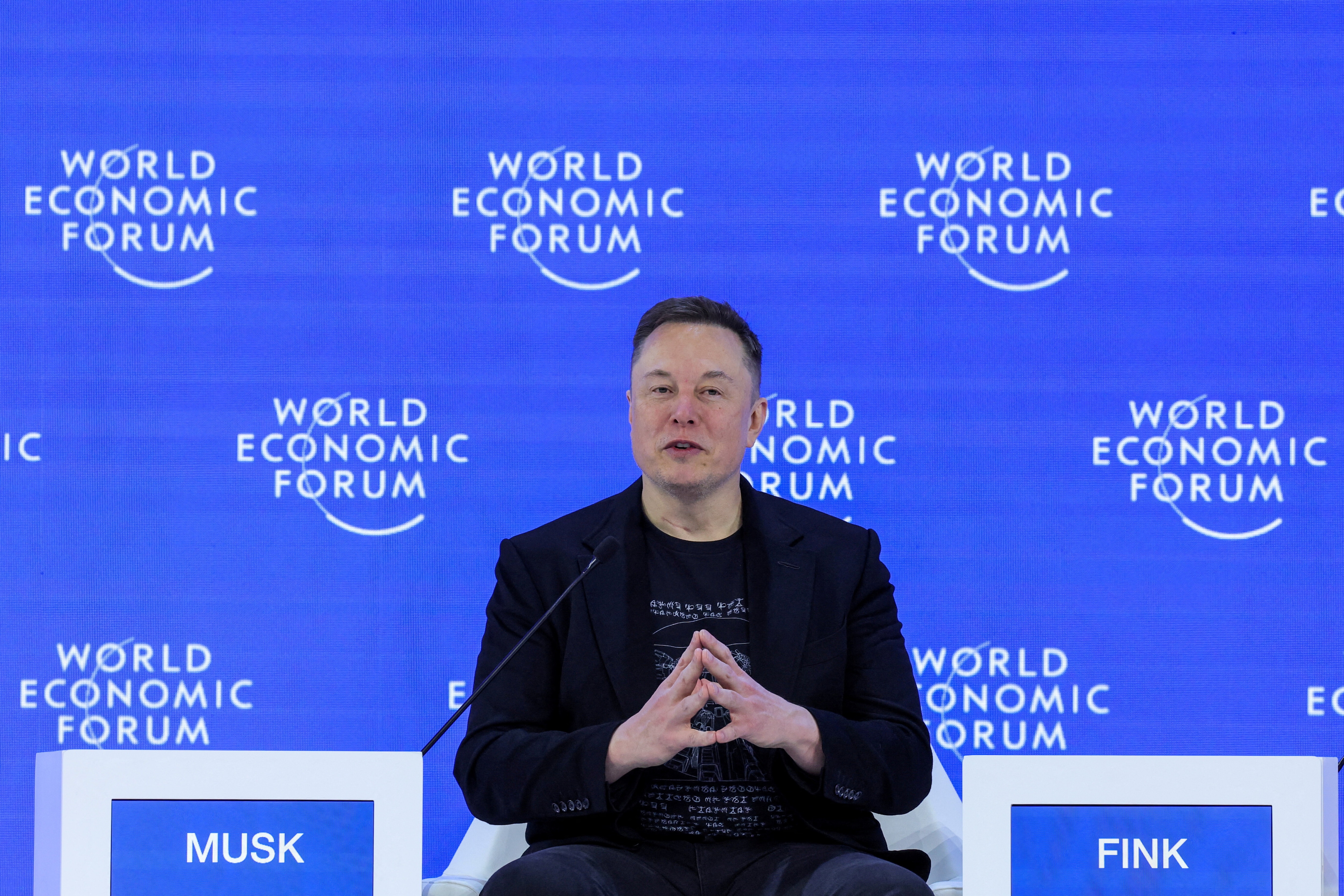
Elon Musk says AI and robotics are the pathway to abundance Image: REUTERS/Denis Balibouse
- At Davos 2026 Elon Musk and Larry Fink spoke about transformative technologies and how to scale them.
- Musk argued that if AI, robotics and solar power can be deployed more broadly, they could unlock an era of unprecedented global abundance.
- Tech leaders gathered in Davos to explore how the ethical use of AI and other emerging technologies will translate into solutions for real-world challenges.
From artificial intelligence (AI) and humanoid robots to solar power and life beyond Earth.
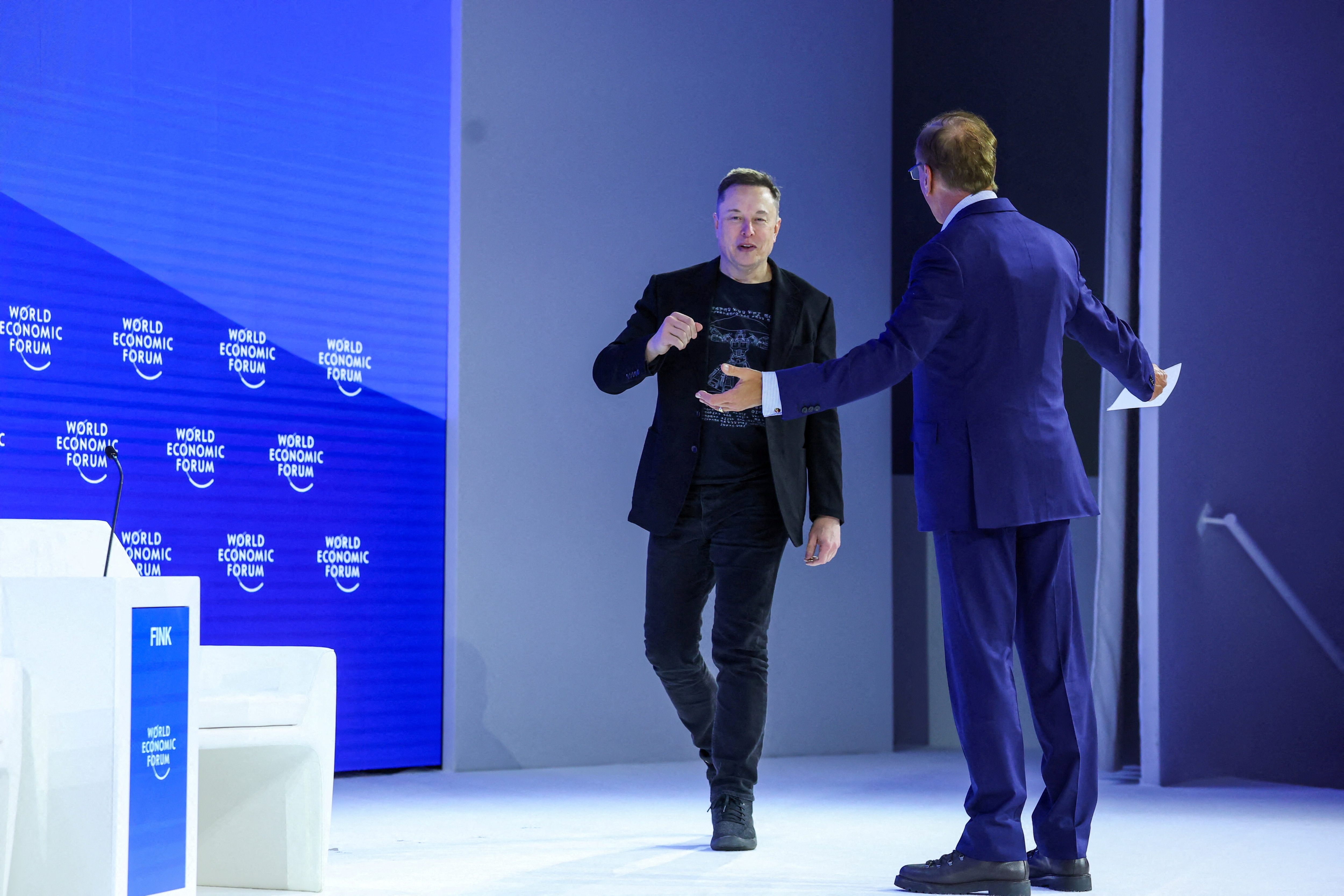
In a wide-ranging and at times somewhat awkward discussion, Larry Fink and Elon Musk explored how today’s technological progress could determine the future of civilization. Musk spoke about the potential of AI, the rise of humanoid robotics and the energy systems needed to power the future.
The future of humanity
Across all of his companies, Musk sees a common purpose.
“They’re all very difficult technology challenges,” he said. “But the overall goal of my companies is to maximize the probability that civilization has a great future.”
SpaceX’s mission, he said, is rooted in a simple but profound assumption: that life and consciousness may be extraordinarily rare and “we need to do everything possible to ensure that the light of consciousness is not extinguished.”
Tesla’s role, meanwhile, is centred on sustainable energy. His work on AI and robotics could be considered the “pathway to abundance” and could raise living standards globally, including eliminating poverty, he argued.
We are in the most interesting time in history.
—Elon Musk, CEO, Tesla; Chief Engineer, SpaceX; CTO, xAI
”AI and robotics’ potential for economic growth
Discussing the potential of AI and robotics, Musk believes these technologies will fuel the global economy.
“If you have ubiquitous AI that is essentially free or close to it and ubiquitous robotics,” he said, “you will have an explosion in the global economy that is truly beyond all precedent.”
Humanoid robots, in particular, could redefine productivity. Economic output, Musk suggested, could be calculated from the average productivity of a robot multiplied by the number of robots deployed.
In that future, robots could perform industrial tasks, care for ageing populations and support families, addressing labour shortages while lowering costs.
That vision raised the question about human purpose in a world where robots outnumbered humans by Fink. But Musk argued that scarcity and narrow prosperity are not compatible with inclusive well-being. “You can’t have work that has to be done by only some people and amazing abundance for all,” he said.
Despite the risks, which he acknowledged, referencing a despotic Terminator scenario that nobody wanted, Musk was optimistic: “We are in the most interesting time in history.”
Energy needs
While the cost of AI is falling rapidly, Musk identified that energy is a limiting factor and that we don't have the necessary electrification capacity to scale.
“We’re very soon going to be producing more chips than we can turn on,” he warned. The limiting factor, he argued, is not compute itself but the electricity needed to power data centres, factories and AI systems at scale.
Solar energy, Musk believes, will be central to overcoming that constraint. On Earth, a surprisingly small land area could power entire economies. “Roughly 100 miles by 100 miles of solar is enough to power the entire United States,” he said.
China’s rapid expansion of solar and nuclear capacity stands out in contrast, while tariff barriers in the US and Europe continue to shape the ability to deploy solar panels at scale.
Musk revealed that Tesla and SpaceX are independently working to build up to 100 gigawatts a year of solar manufacturing capacity in the US.
Looking further ahead (but not that far ahead), he pointed to space.
“Beyond Earth, the Sun rounds up to 100% of all energy,” Musk said. Solar-powered AI data centres in space, where sunlight is constant and cooling is efficient, could become economically viable within a few years.
We might have AI that is smarter than any human by the end of this year...
—Elon Musk, CEO, Tesla; Chief Engineer, SpaceX; CTO, xAI
”The economics of advancing in space
Automation and AI are also reshaping the economics of spaceflight. SpaceX’s next major milestone, Musk said, is full reusability of its Starship rocket, which could also reduce the cost of access to space by a factor of 100.
“If you had to throw away an aircraft after every flight, that would be a very expensive flight,” he said. “If you only have to refuel, then it’s the cost of the fuel.”
Lower launch costs could unlock everything from large satellite constellations to space-based solar infrastructure and, eventually, human missions to Mars.
And the pace of AI progress is exponential. “We might have AI that is smarter than any human by the end of this year,” he said, adding that within five years, AI could surpass humanity’s collective intelligence.
The long view
Towards the end of the conversation, Fink turned it personal, asking Musk to reveal his inspiration, which he traced to his childhood, love of science fiction, fantasy and comic books, and a desire to turn imagination into reality.
At its core, he described his philosophy as one of curiosity: understanding how the universe works, what questions remain unasked and how technology can help humanity explore them.
His parting message to Davos was of forward-looking optimism:
“I would encourage everyone to be optimistic and excited about the future good. And generally, I think for quality of life, it is actually better to err on the side of being an optimist and wrong rather than a pessimist and right.”
Watch the full session here:
Don't miss any update on this topic
Create a free account and access your personalized content collection with our latest publications and analyses.
License and Republishing
World Economic Forum articles may be republished in accordance with the Creative Commons Attribution-NonCommercial-NoDerivatives 4.0 International Public License, and in accordance with our Terms of Use.
The views expressed in this article are those of the author alone and not the World Economic Forum.
Stay up to date:
Future of Work


Forum Stories newsletter
Bringing you weekly curated insights and analysis on the global issues that matter.
More on Artificial IntelligenceSee all

Jovan Jovanovic
March 11, 2026


