5 pathways shaping national strategies for AI investment

The rapid ascent of artificial intelligence (AI) is redefining global competitiveness. Image: Unsplash/Getty Images
- The rapid ascent of artificial intelligence (AI) is redefining global competitiveness through the concept of AI sovereignty – an economy's ability to shape, deploy and govern its AI ecosystem in accordance with its own values.
- With annual investments in AI applications predicted to reach $1.5 trillion by 2030, a new white paper from the World Economic Forum and Bain & Company explores a range of potential investment strategies across the AI value chain.
- It identifies five pathways that reflect the different starting positions of economies in the AI race, along with other potential routes between them to guide investment approaches.
The rapid ascent and spread of artificial intelligence (AI) is continuing to reshape industries and economies. Control over AI resources — particularly infrastructure — is redefining economies' competitiveness and even their sovereignty.
This has given rise to the concept of AI sovereignty, an economy's ability to shape, deploy and govern AI ecosystems in accordance with its own values. Through a combination of localized investment and international collaboration with trusted partners, economies can ensure strategic and operational control of these ecosystems.
The journey to AI sovereignty can differ substantially across economies, a new white paper from the World Economic Forum and Bain & Company, Rethinking AI Sovereignty: Pathways to Competitiveness through Strategic Investments, finds.
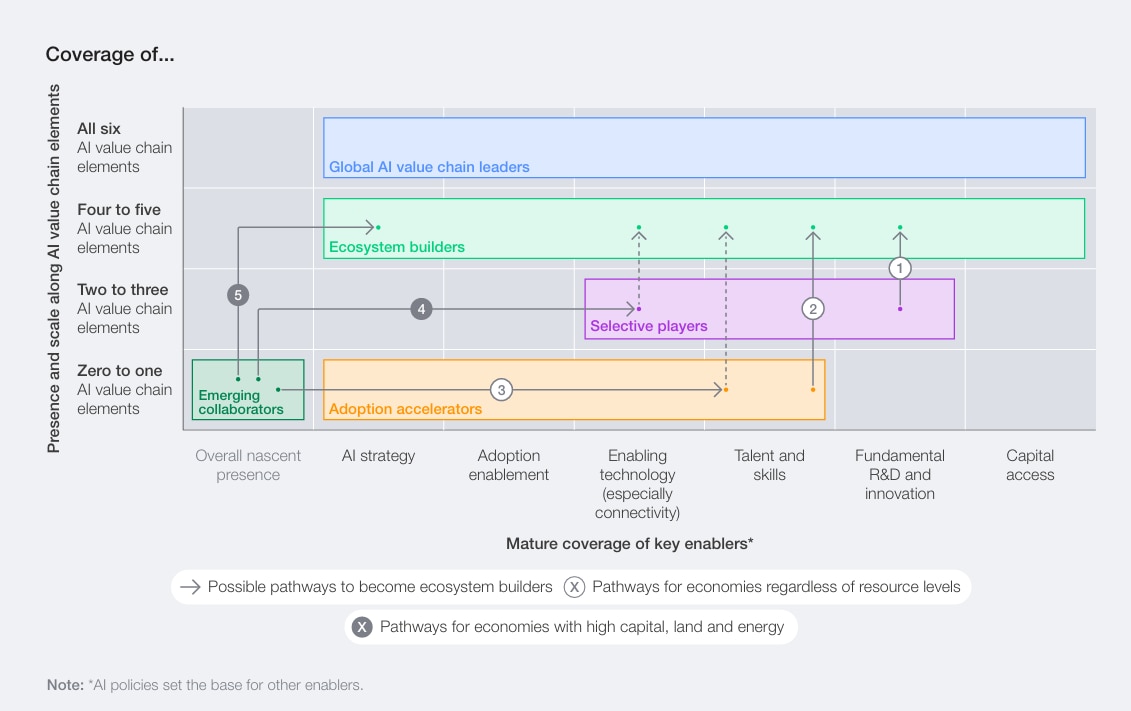
The paper identifies five potential pathways for greater AI sovereignty and competitiveness that build on five archetypes that consider the status quo of economies along the AI ecosystem.
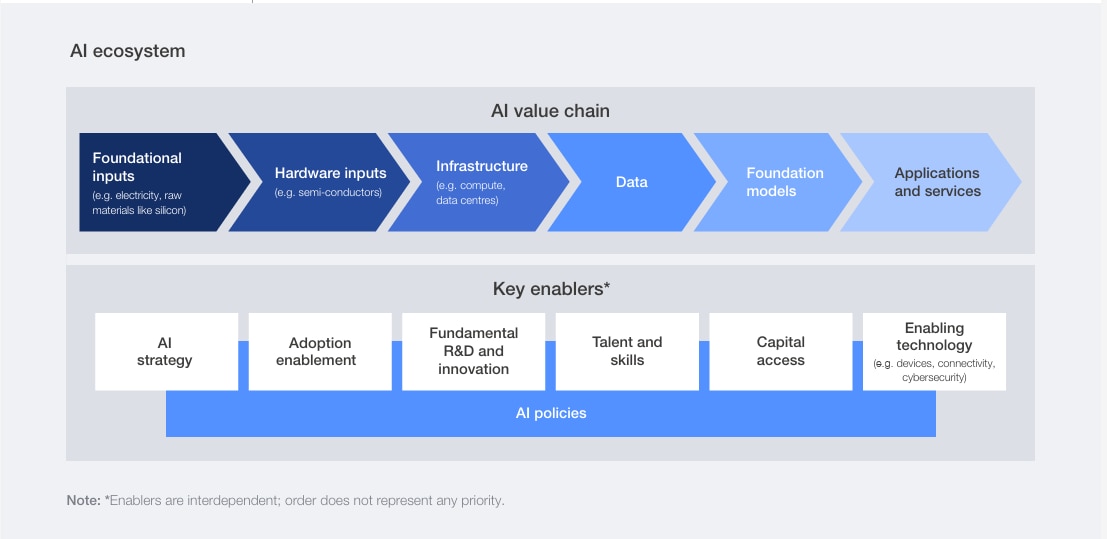
What has driven investment decisions to date?
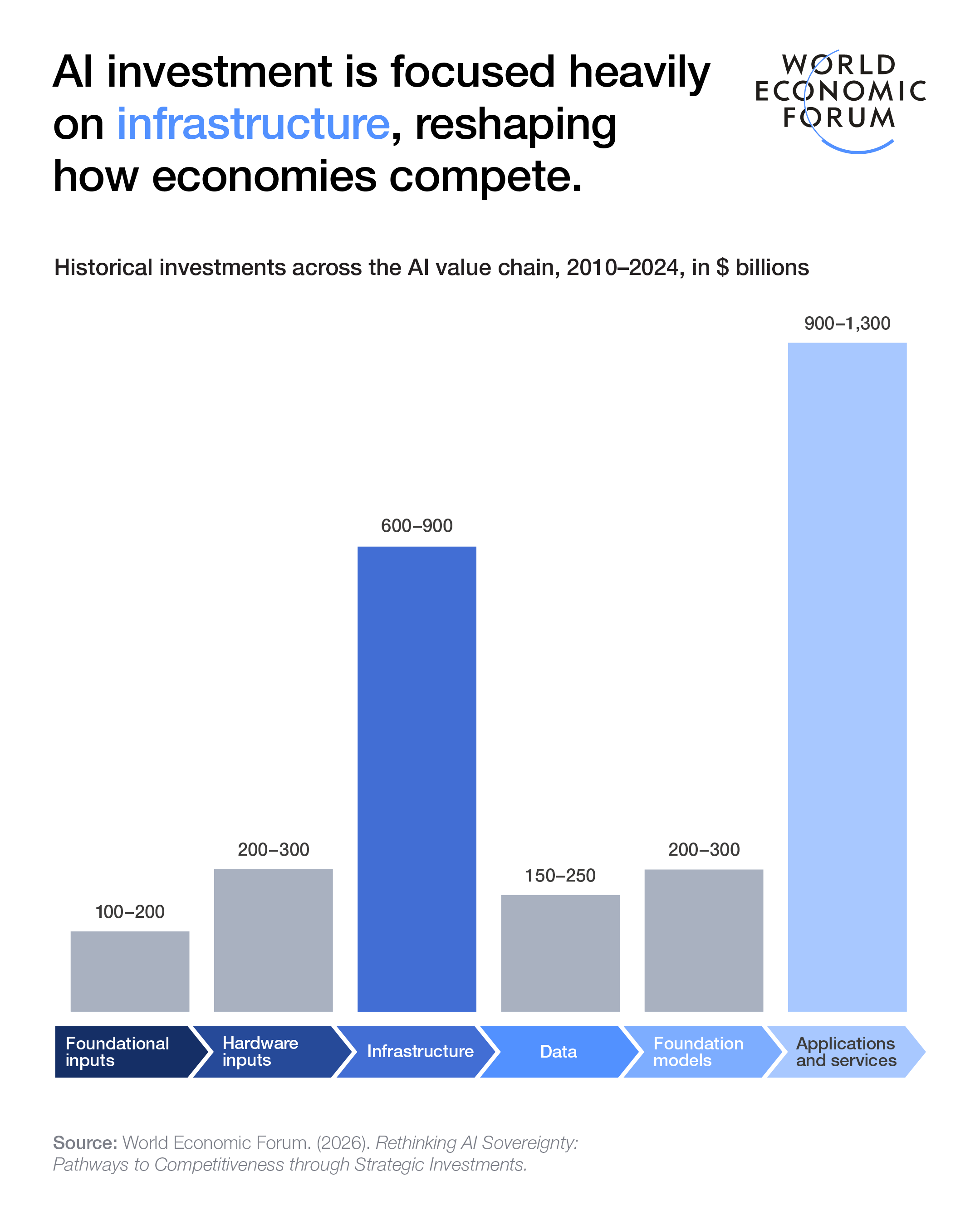
Major commitments are being made around the globe to develop AI capabilities domestically in search of AI sovereignty. The annual growth in investments across the AI value chain between 2010 and 2024 amounted to around 33%, with infrastructure, applications and services attracting the majority of the investments. Cumulatively, more than $600 billion was invested in AI infrastructure over that period.
For some, the key is to be involved in all stages of the AI value chain. While others, like China, have focused on aspects such as domestic chip development and adoption. Meanwhile, the EU is set on building AI gigafactories for creating and training next-generation AI models.
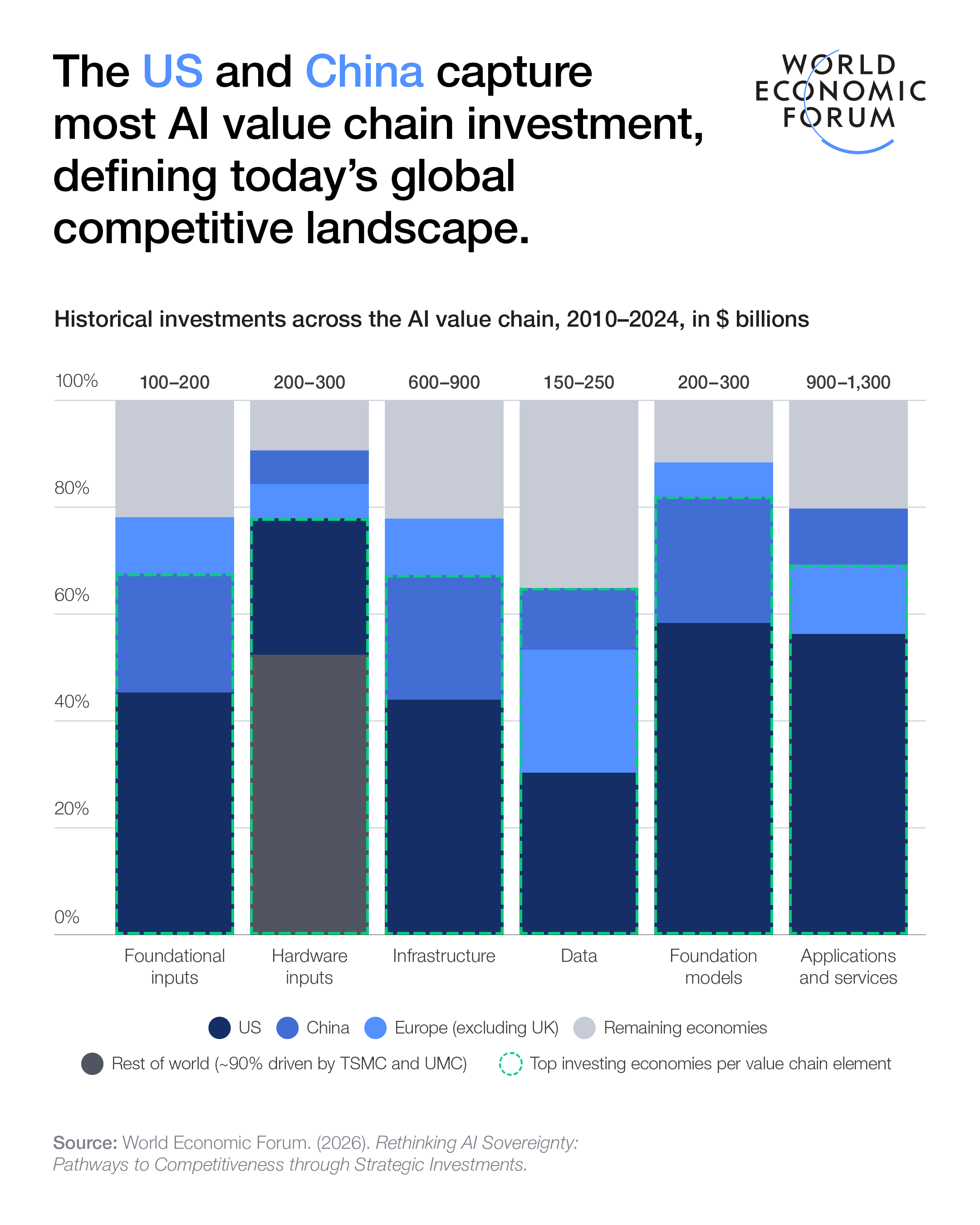
The US and China dominate the investment landscape, capturing about 65% of aggregate global investment in the AI value chain. Their outsized presence in every element of the AI value chain reflects a full-stack approach that few economies can match, given the scale of investment needed.
Five pathways for AI competitiveness through investments
By 2030, annual investments in AI applications are predicted to reach $1.5 trillion. With economies starting at different positions, these five archetypes can help assess, in a structured way, where economies stand — in local, regional and global contexts — to support their next AI investment strategies.
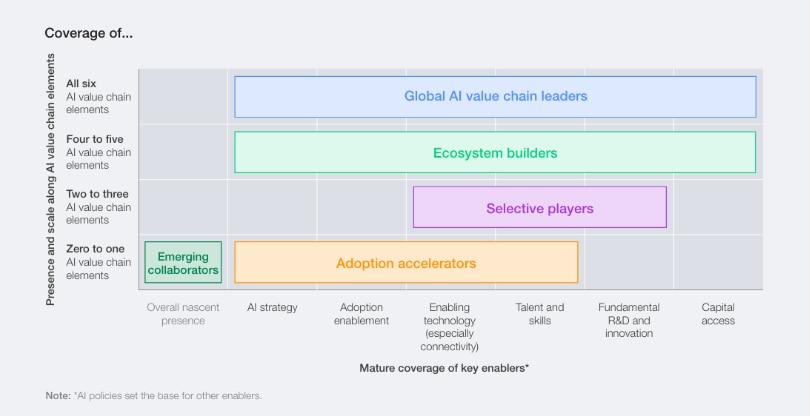
Pathways for AI competitiveness consider both coverage and maturity across the six value chain elements and key enablers such as adoption enabling, technology, talent and skills, R&D and capital access.
1. Global AI value chain leaders have already made significant investments across all six AI value chain elements and key enablers such as technology, skills, innovation and capital access. They have typically invested in all elements of the value chain and have a unique capacity to fund and develop foundation models (e.g. Large Language Models). Examples here are the US and China.
2. Ecosystem builders have made broad but balanced investments into a strong local AI ecosystem, with regional influence and increasing participation in international alliances and partnerships. These economies have invested across most AI value chain elements, with the exception of hardware. They count on national champions to play key roles in their AI ecosystems – for example, by partnering with hyperscalers and trusted vendors. Efforts have been strongly government-led or incentivized, such as in Singapore and the UAE.
3. Selective players, including Germany and France, have focused their investments on developing selected elements of the value chain domestically, but rely on international cooperation for other aspects. These investments have largely been government-led, creating islands of mature coverage among some key enablers — such as R&D and education — but leaving strategic gaps elsewhere.
How the Forum helps leaders make sense of AI and collaborate on responsible innovation
4. Adoption accelerators like India have focused investments in local enablers to boost adoption, such as on digital literacy and open data initiatives, as well as in locally tailored applications and services for priority sectors (e.g. agriculture, finance and healthcare), but rely on externally developed hardware and foundation models.
5. Emerging collaborators like Rwanda are in the early stages of AI development, with fragmented capabilities. Investments typically come through international partnerships or from donors. This leaves these economies with persistent challenges across certain enablers, such as talent attraction and connectivity, and reliant on external cooperation.
These pathways are not fixed categories. With clear strategies and targeted investments, economies can develop new routes. Most economies will achieve better outcomes by becoming effective ecosystem builders, scaling what they can master domestically while partnering internationally for other elements.
Adoption accelerators can command a greater share of the AI value chain by leveraging their early digital public infrastructure, as well as active start-up ecosystems and strong AI adoption levels to grow into ecosystem builders, supported by mechanisms such as blended finance models and coordinated industrial policies.
This illustrates one of the five potential pathways outlined in the paper describing how economies can strengthen their coverage and maturity in the AI ecosystem.
Rethinking AI sovereignty
The white paper suggests that economies should rethink their approach to AI. Instead of aiming for AI sovereignty by controlling the entire AI value chain, they should invest strategically and collaborate with trusted partners to narrow the gap between “AI makers” and “AI takers” and pursue shared prosperity.
License and Republishing
World Economic Forum articles may be republished in accordance with the Creative Commons Attribution-NonCommercial-NoDerivatives 4.0 International Public License, and in accordance with our Terms of Use.
The views expressed in this article are those of the author alone and not the World Economic Forum.
Related topics:

Forum Stories newsletter
Bringing you weekly curated insights and analysis on the global issues that matter.
More on Artificial IntelligenceSee all

David Haber
March 6, 2026


