The future of jobs: 6 decision-makers on AI and talent strategies
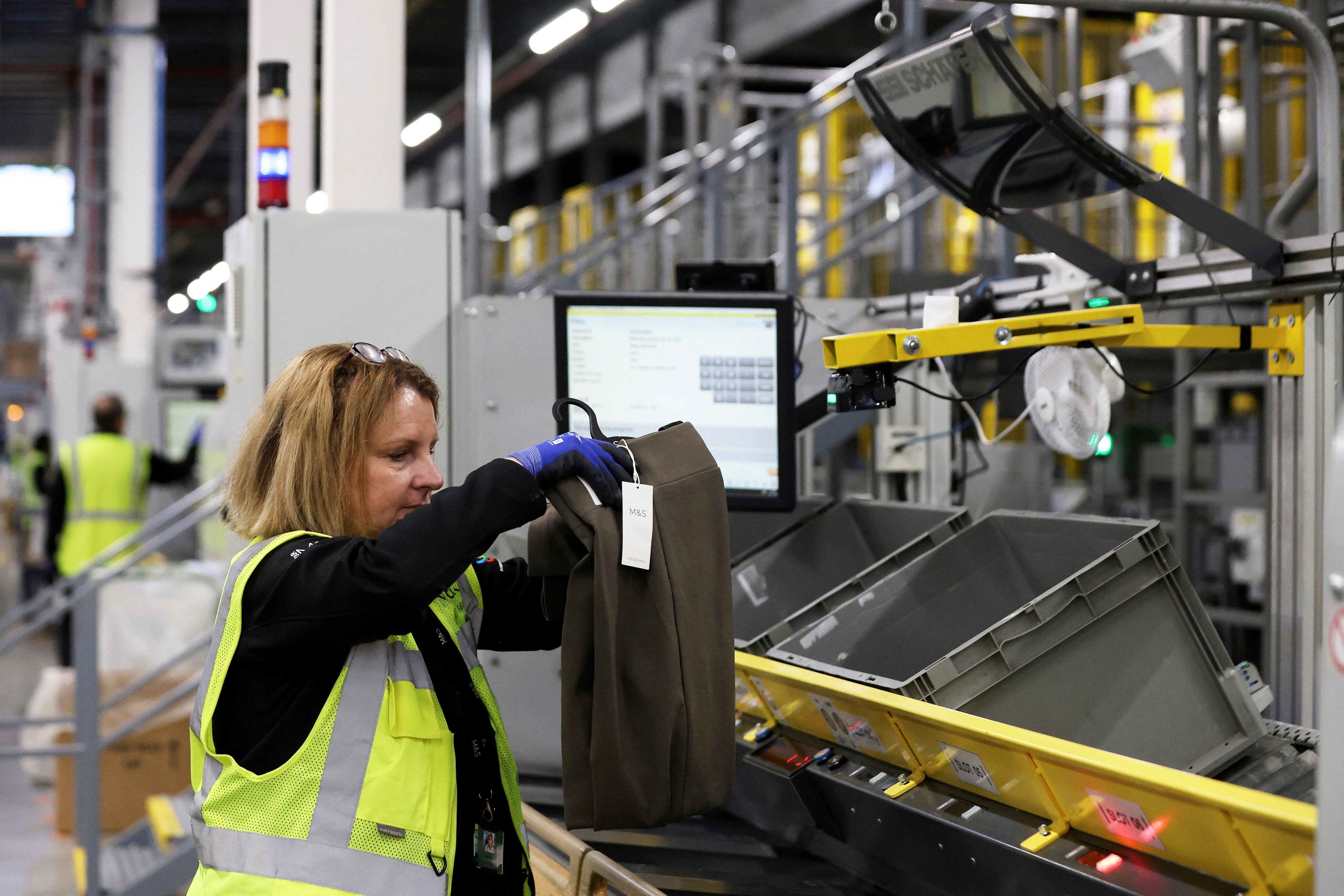
A new World Economic Forum report sets out four scenarios for how AI and talent trends might shape the future of jobs by 2030, with varying risks and opportunities across industries. Image: REUTERS/Temilade Adelaja
- Rapid commercialization of AI is poised to reshape workplaces and business strategies.
- A new World Economic Forum report sets out four scenarios for how AI and talent trends might shape the future of jobs by 2030, with varying risks and opportunities across industries.
- Business leaders offered their thoughts on the critical uncertainties related to ongoing AI and workforce transformation, and their own strategic responses.
Businesses increasingly grapple with the pressure to innovate, adapt and navigate uncertainty.
The rapid commercialization of AI is among the most transformative trends, reshaping approaches to work and value creation across nearly all industries. The key uncertainty is no longer whether AI will impact the global economy, but how rapidly and how deeply it will reshape it.
The second edition of the World Economic Forum’s Scenarios for the Global Economy Dialogue Series – Four Futures for Jobs in the New Economy: AI and Talent 2030 – sets out four plausible scenarios for AI and talent trends by the year 2030. These scenarios are not predictions. Instead, they explore alternative trajectories – from human-AI synergies, to futures where AI outpaces workforce readiness to adapt – and provide a framework to help leaders understand risks, stress-test assumptions, and prepare for the future.
While the accelerating rate of AI adoption makes its impact less predictable, one thing is clear: the technology alone will not define the future of workplaces. Decisions made today about innovation and talent strategies will determine how well businesses, workforces and institutions can navigate ongoing shifts.
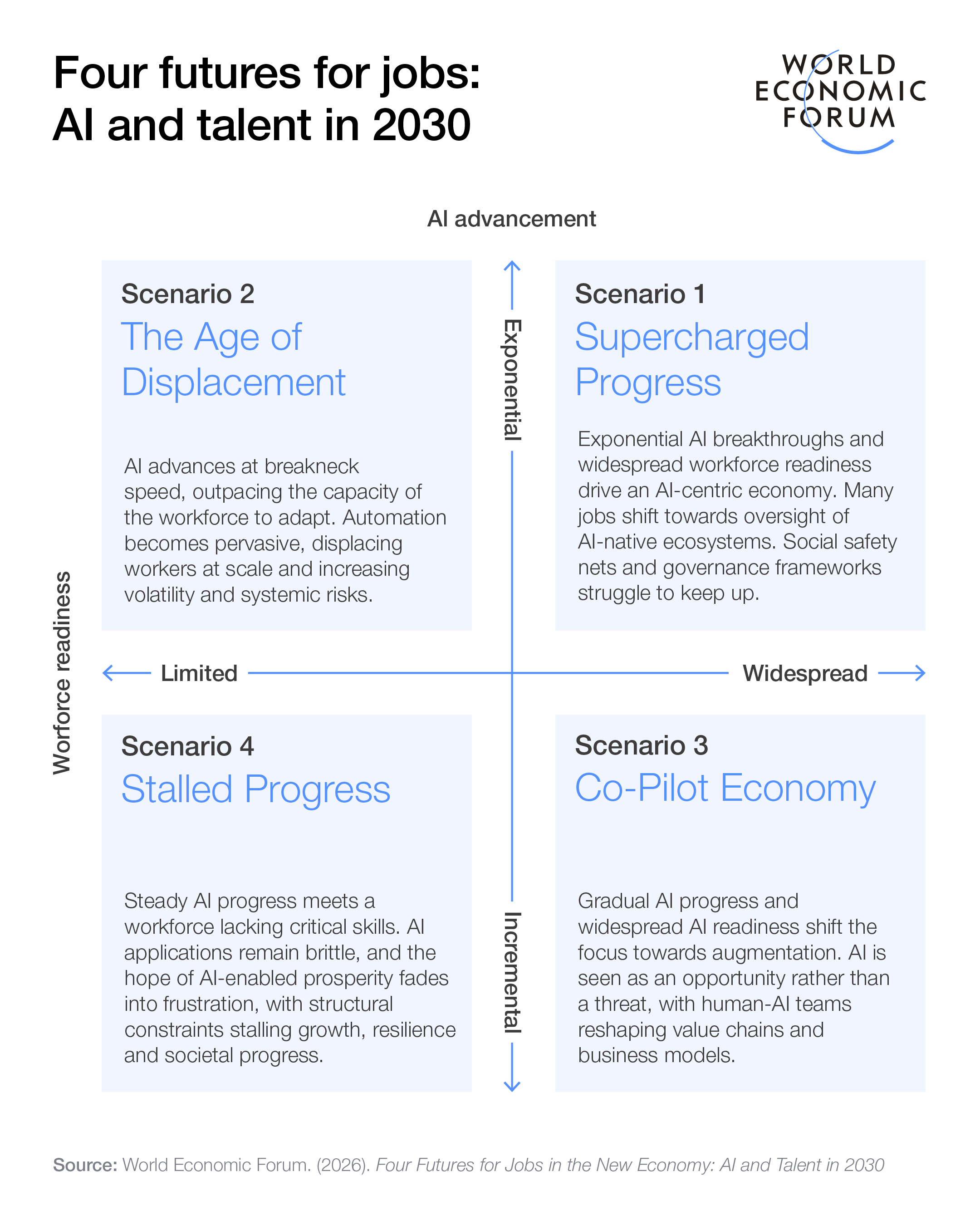
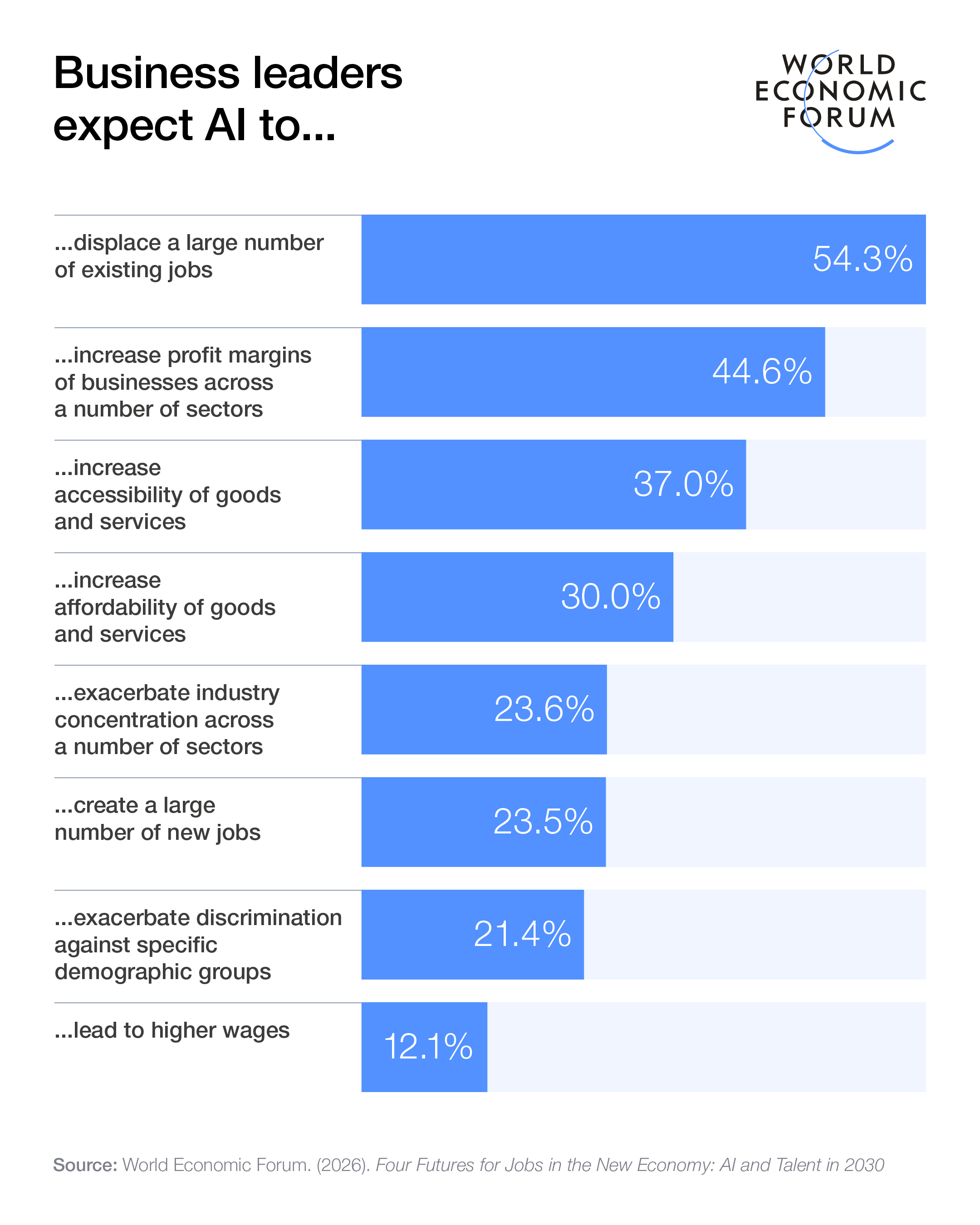
We asked top executives about which AI and talent trends will have the most significant impact within their industry over the next five years, and the related risks and opportunities. Here's what they said.
Gunter Beitinger, SVP Manufacturing and Head of Factory Digitalization, Siemens
“By 2030, the most profound impact on workflows and strategy will arise from the collision of three forces: the commercialization of AI, a rapidly evolving talent landscape, and increasingly fragmented geoeconomics. Their interaction – not their individual effects – will determine whether organizations achieve shared productivity or face structural disruption.
“AI is moving from experimentation to the core of operations. The decisive advantage will not come from automation alone, but from redesigning end-to-end workflows around human-AI collaboration. The primary risk is organizational inertia and insufficient reskilling; the opportunity lies in building augmented organizations where human judgement and creativity are amplified by AI.
“At the same time, the workforce is transforming. Skills are depreciating faster than traditional models can accommodate, while remote work, platform talent, and AI-enabled learning decouple capability from location and tenure. Firms that embed continuous learning as a strategic performance metric will outperform; those that do not risk a bifurcated workforce and rising inequality.
“Geopolitics is further reshaping work. Regionalization and divergent regulation are replacing global optimization with the need for resilient, multi-regional workforce strategies.
“Ultimately, the future of jobs will be shaped less by technology than by leadership choices – particularly around inclusive reskilling, responsible AI, and the ability to anticipate signals from technology, policy, and labour markets.”
Dante Disparte, Chief Strategy Officer and Head of Global Policy, Circle Internet Financial
“By 2030, one transformational trend to watch – particularly in financial services, but likely across all service intensive industries – is the indistinguishable crossover between human service and AI-powered services.
“On the one hand this trend can free up human capacity for higher and greater use. On the other hand, it will make the already often out-of-reach ladder of economic mobility harder to grasp, especially for entry-level workers, for whom frontline service work was one of the promises of globalization.
“Another compelling trend is the organizational embeddedness of an agentic workforce, which will expand the managerial horizon as the jobs to be done will be carried out by a hybrid workforce of machines and humans – while leadership accountability for results, risks, and rewards will remain unchanged.”
Cyril Perducat, SVP and Chief Technology Officer, Rockwell Automation
“Advancements in AI, robotics, and other industrial technology are enabling a shift from automation to autonomy. And while automation remains a cornerstone of modern manufacturing – ideal for repetitive, high-precision tasks – we can now supercharge those systems to self-organize and self-optimize. We can also simplify the complexity of industrial processes with intuitive AI technology designed to solve industrial challenges. This allows people to spend less time on repetitive tasks that lead to disengagement or injury, and focus on more valuable supervisory and improvement activities. For example, AI enables code generation so engineers no longer need to program machines line by line and can focus on product enhancements. It also allows operators previously tasked with ongoing manipulation at a single machine to take a broader view of lines and processes. It’s about helping people maximize their potential with technology.
“And while many organizations are eager to adopt industrial AI, deploying it successfully requires intentional adoption and a pragmatic approach. Implementing AI-powered solutions involves converging digital and physical systems in complex industrial environments where safety, security, and reliability are essential. Successful deployment and scalability requires AI that is designed for industry, and the people who work with it.
“Technology alone isn’t transformative – executing a strategy centred on people is essential. What’s exciting for me is we’re giving people superpowers and enabling people to be more strategic and more creative. This is about creating synergy between people and machines enabling both to reach their highest potential.”
Sulaekha Kolloru, Chief Strategy Officer, Pearson
“New developments in the capabilities of generative and agentic AI will enable personalized learning experiences, facilitate new approaches to assessment, and shape how content is created and curated. Over the next five years, this will see providers across the education industry delivering increasingly personalized content at scale, and supporting both educators and learners with real-time feedback and coaching.
“Within organizations, learning will happen seamlessly in the flow of work, with AI systems delivering live, personalized content, feedback, and assessment. Skills tracking and credentialing will become central to both more agile workforce development and greater career mobility for individuals. All of this will require learning and development departments to shape and implement continuous learning.
“While the early focus of AI usage has been on what roles can be automated, sustained productivity benefits will come through people’s ability to harness the technology effectively. This will only be achieved by addressing the ‘learning gap’ between what AI tools can do and how well workforces can use them. The most successful organizations will invest in building the human capabilities that are essential for success – such as critical thinking, creativity, and discernment – alongside AI fluency. Education providers will need to build tools that are transparent, trustworthy and intuitive, and intentionally designed to deliver learning outcomes and that help educators leverage the power of AI safely and effectively for improved learning impact across the industry.”
Antonio de la Torre Diaz, Head, Corporate Strategy and Optimization, Repsol
“Energy is one of the most important industries for the development of economies and the prosperity of societies. Under the current, incremental uncertainty, due to political fragmentation, the energy transition is facing both new challenges and opportunities for making an optimized journey globally – one that combines environmental awareness, security of supply, industrialization and affordability.
“Our people are the key component of the evolved, global value chain of energy addition that we are building. The way in which we optimize the proper combination of AI and people, bearing in mind their unique characteristics, will reinforce competitive advantages and help provide more value-added products and services for the benefit of all stakeholders. This is a new challenge for the energy industry – which is generating more specialized, but also global, job profiles in order to reach that goal.”
Adam Hines, Chief of Staff, Office of the CEO, Senior Managing Director, Hines
“The tailwinds behind AI are undeniable, no matter what industry you’re in. Global real estate investors such as Hines are already seeing some critical inflection points in the medium and near term.
“A critical shift to watch is the convergence of asset classes as AI impacts everything from worker productivity, to transit, and the use cases for properties.
“Workers are accomplishing tasks more quickly or are not having to do tasks that have been automated by AI. The workforce is already feeling this shift at the lowest rungs of the corporate ladder, as companies hire fewer entry-level workers.
“But it is also re-shaping how employers – those who occupy our portfolio – view their space needs. It’s not necessarily about how much space they need, but rather what kinds of space they need. It’s possible that in the future, the buildings that make up our cities will be measured in terms of productivity, and AI will enable this.
“The opportunity we see is clear: real estate projects, such as data centres, powered land, and industrial properties, are now the new “infrastructure” supporting not only our cities but also the ongoing AI boom.”



License and Republishing
World Economic Forum articles may be republished in accordance with the Creative Commons Attribution-NonCommercial-NoDerivatives 4.0 International Public License, and in accordance with our Terms of Use.
The views expressed in this article are those of the author alone and not the World Economic Forum.
Contents
Gunter Beitinger, SVP Manufacturing and Head of Factory Digitalization, SiemensDante Disparte, Chief Strategy Officer and Head of Global Policy, Circle Internet FinancialCyril Perducat, SVP and Chief Technology Officer, Rockwell AutomationSulaekha Kolloru, Chief Strategy Officer, PearsonAntonio de la Torre Diaz, Head, Corporate Strategy and Optimization, RepsolAdam Hines, Chief of Staff, Office of the CEO, Senior Managing Director, Hines
Forum Stories newsletter
Bringing you weekly curated insights and analysis on the global issues that matter.
More on Economic GrowthSee all

Pooja Chhabria
February 27, 2026


