After India's EVs success, its next clean energy revolution could begin in the kitchen
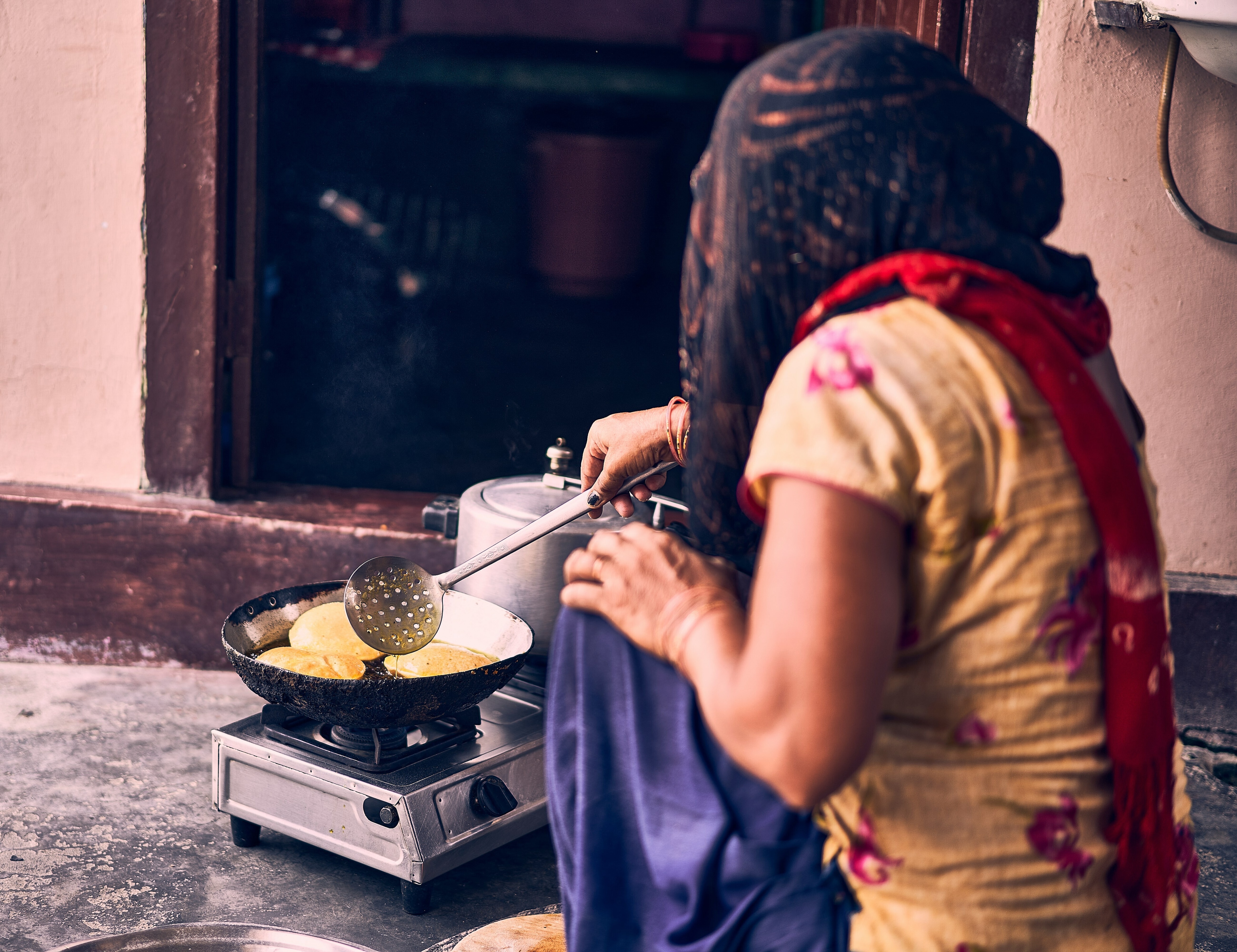
Bhalsona, Uttar Pradesh, India. A woman cooks on a stove. With the right support, electric cooking (e-cooking) could be seen as a valid fuel choice for preparing food in India. Image: Unsplash/Ashwini Chaudhary(Monty)
Purva Jain
Energy Specialist (Gas & International Advocacy), Institute for Energy Economics and Financial Analysis (IEEFA)- Electric vehicle (EV) use is booming in India, thanks to supportive policies, operational cost reductions and rising consumer awareness.
- The same factors could be used to increase electric cooking (e-cooking) versus the use of more traditional fuels like liquefied petroleum gas (LPG) and piped natural gas (PNG).
- E-cooking is becoming cheaper and offers many other benefits including time savings, lower import dependence and less indoor air pollution.
In India, electric vehicle (EV) use crossed a major milestone of 2 million registrations in 2025. This is a significant feat for a category that saw fewer than 50,000 registrations per year until just a decade ago.
The rise in EV use has been driven by a combination of the right factors coming together over time: strong government policy, lower operational costs compared to conventionally fuelled vehicles and rising consumer awareness through local, nation and global campaigns.
A similar combination of the right factors could also position electric cooking (e-cooking) as a valid fuel choice for preparing food in India. E-cooking offers benefits like higher efficiency, time savings, lower energy import dependence and less indoor air pollution. It also allows for the possibility of technological advancements like precision cooking and smart cooktops.
Liquefied petroleum gas (LPG) is currently the most widely used cooking fuel in India, although urban areas are gradually adopting piped natural gas (PNG). A significant share of the population still relies on harmful traditional fuels due to the affordability challenges of LPG and PNG.
An October 2025 report from Institute for Energy Economics and Financial Analysis (IEEFA) shows e-cooking is already cheaper than non-subsidised LPG and PNG, however, and it was competitive with subsidised LPG last year. E-cooking is also around 85–90% more energy-efficient and reaches boiling point in half the time. Since it produces no indoor emissions, unlike LPG and PNG, there is a strong case for e-cooking to propel India’s clean cooking transition.
Strong government support
The massive uptake of EVs in India was based on policy support from both the central and state governments, beginning with the Faster Adoption and Manufacturing of (Hybrid &) Electric Vehicles in India (FAME India) Scheme. Launched in 2015 and concluded in 2024, FAME was aimed at market creation and early adoption through infrastructure deployment, demand incentives and domestic manufacturing.
While phase one of the scheme established these factors, the second phase consolidated its gains, driving market maturity through subsidies for advanced batteries and promoting domestic manufacturing and assembly of EVs. Despite vastly different capital costs, the lessons from India’s EV growth could offer a policy blueprint for e-cooking.
A similar scheme to FAME could create a market for e-cooking through demand incentives and by reducing upfront purchase costs for wider adoption. A policy promoting e-cooking in commercial spaces could also be beneficial, much like how state policies and the PM-eBus Sewa scheme increased the use of electric buses for public transport in India.
Lower running costs
Another factor that worked in the EV sector’s favour in India was the operational cost savings compared to conventional fuels. Research shows that an EV’s running cost is about 36% lower than that of a petrol version of the same car – a gap that would widen even further with any rise petrol prices.
During FAME, EVs were more expensive than petrol cars, closing the gap in operational cost savings. But upfront price reductions incentivized by the government helped encourage EV use and now they will soon be priced on a par with petrol vehicles.
The IEEFA report published in October 2025 found similar operational cost savings when comparing e-cooking to the use of conventional fuels like LPG and PNG. In fiscal year 2024-25, electric cooking for a family of four in the city of Delhi was 14% cheaper than using PNG, 37% cheaper than using non-subsidised LPG and 10% cheaper than using universally subsidised LPG.
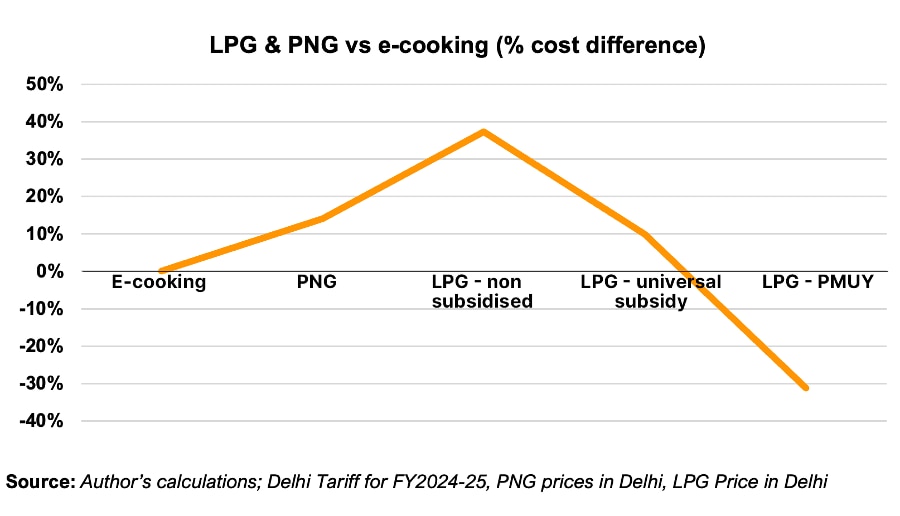
Since e-cooking faces similar barriers to EV uptake – high upfront capital costs and limited stove design options – strategic policy interventions like those devised for EVs could also be used to address these challenges for e-cooking.
Rising consumer awareness
It’s also important to help people understand the benefits of e-cooking versus conventional methods.
An increased awareness of rising temperature, erratic weather patterns, carbon emissions and the real-life benefits of greener lifestyle choices played a significant role in the adoption of EVs in India. Public awareness campaigns by the government – including NITI Aayog’s Shoonya campaign, the e-Amrit awareness web portal and the Delhi government’s Switch Delhi initiative – also helped to address initial transition challenges. Now, even businesses are launching their own initiatives to increase consumer awareness of EVs, such as JSW MG Motor’s EV Sahi Hai campaign.
Participating in global campaigns can also help. For EVs, the Clean Energy Ministerial’s EV 30@30 aimed to increase new EV sales by 2030. Celebrating World EV day also boosted EV awareness and purchases around the world. In 2024, global electric car sales reached a 20% share of total car sales, with emerging economies in Asia and Latin America rapidly expanding adoption.
A similar trend could be used in India for e-cooking since it is also picking up pace globally. Global coalitions and research programmes like Modern Energy Cooking Services (MECS) and Global Electric Cooking Coalition (GeCCo) promote clean cooking technologies, particularly e-cooking, because it has been found to be among the more viable and cost-effective of clean fuels.
Similar to the strong EV adoption seen in Asia and Latin America, Africa could emerge as a hub for e-cooking uptake. Kenya launched a national electric cooking strategy (KNeCS) in 2024 with the aim of transitioning 10% of all Kenyan households to e-cooking by 2028. And in Tanzania, pilot e-cooking kitchens have been set up in schools.
The benefits of e-cooking
India could take inspiration from these examples while also taking advantage of increased electricity access and a rapidly greening grid across the country.
And mirroring EV success in e-cooking would not even require large-scale deployment of private and public charging infrastructure. It would actually eliminate the need for dual connections for electricity and cooking fuels in Indian homes, a transition that is already being actively pursued in many advanced nations.
Strategic policy interventions and a nudge in the right direction could make e-cooking a huge success in India.
Don't miss any update on this topic
Create a free account and access your personalized content collection with our latest publications and analyses.
License and Republishing
World Economic Forum articles may be republished in accordance with the Creative Commons Attribution-NonCommercial-NoDerivatives 4.0 International Public License, and in accordance with our Terms of Use.
The views expressed in this article are those of the author alone and not the World Economic Forum.
Stay up to date:
Renewable Energy


Forum Stories newsletter
Bringing you weekly curated insights and analysis on the global issues that matter.
More on Energy TransitionSee all

Arslan Khalid and Rabia Ferroukhi
March 11, 2026


