Latin America lags in unlocking AI value. Here’s a roadmap to accelerate progress

A regional AI Competitiveness Roadmap suggests key actions for measurable economic impact, while ensuring people-centric, sustainable development.
Marisol Argueta de Barillas
Head of the Regional Agenda, Latin America; Member of the Executive Committee, World Economic Forum- AI adoption in Latin America could lift productivity by 1.9–2.3% annually and generate $1.1-1.7 trillion in additional economic value each year.
- Despite this potential, a survey developed by the Forum and McKinsey shows actual economic impact and value capture has remained limited.
- A regional AI Competitiveness Roadmap suggests key actions for measurable economic impact, while ensuring people-centric, sustainable development.
Artificial intelligence (AI) is revolutionizing industries, transforming governments and organizations by automating tasks and workflows and augmenting decision-making.
It has the potential to significantly increase productivity, allowing workers and businesses to focus on higher value activities, boosting output for the same time, labour and capital investment. This is part of the transition to a new Intelligent Age, which offers unparalleled opportunities to maximise growth as well as to tackle long-lasting societal challenges if well managed.
This new Intelligent Age presents a strategic opportunity to boost productivity in Latin America, where competitiveness has historically been lower than other regions. The World Economic Forum and McKinsey & Company have partnered on a white paper that sheds light on the region’s AI competitiveness potential, brings original data on the state of adoption, and proposes a regional AI Competitiveness Roadmap to foster regional collaboration and coordinated action.
Have you read?
Latin America’s AI competitiveness: potential and state of play
A regional deep dive derived from global estimates by McKinsey shows that advancing AI adoption throughout the region may increase productivity by 1.9% to 2.3% per year and create an estimated $1.1 trillion to $1.7 trillion in additional annual economic value. Some 60% of that potential will come from analytical AI, generating $0.6 trillion to $1 trillion in annual value. For Generative AI, the estimate is of an additional $0.5 to $0.7 trillion.
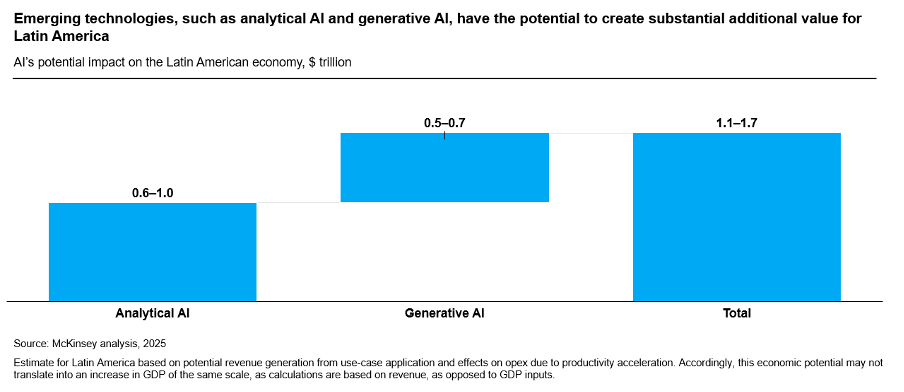
Early adoption can be found across key industries and countries in Latin America, particularly where data availability, the region's global competitive advantages, and clear use cases converge. Examples include the use of drones and AI analytics for field scouting and soil improvement in agriculture in Argentina, Brazil and Uruguay. Chile has applied AI in mining to improve geological analysis and worker safety. Expanding adoption in the sectors where the region has a competitive edge can yield tangible benefits. Beyond traditional sectors, lighthouse examples of AI adoption in Latin America have been mostly concentrated in the financial sector.
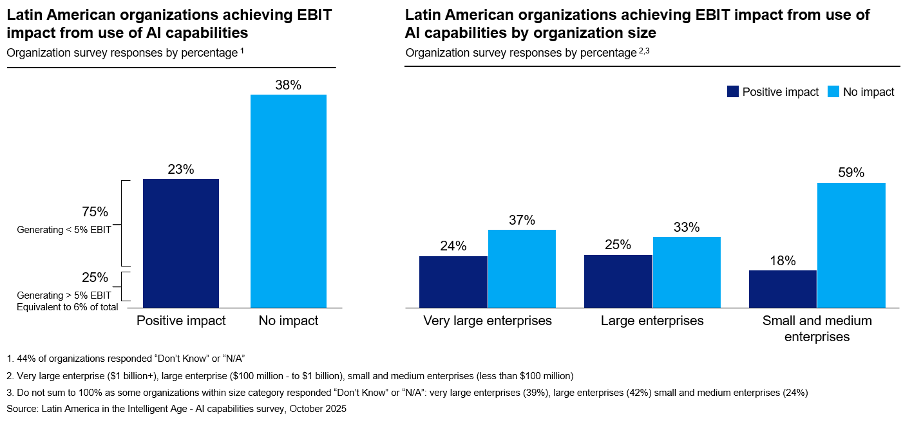
Despite these early movers, the regional survey undertaken by the Forum and McKinsey as part of the white paper shows that actual economic impact and value capture remain limited. Only 23% of Latin American organizations are generating any economic value from AI use, and only 6% across the region report significant value creation from AI. This impact is primarily captured by very large and large enterprises, with six in ten small and medium-sized enterprises (SMEs) reporting that they are not generating any measurable value from AI.
Importantly, Latin America scores below global leaders in key AI competitiveness dimensions. This result highlights that there are existing pathways that the region can follow to improve AI value capture when adapted to its unique characteristics.
Four targeted groups of actions, further expanded in the regional AI Competitiveness Roadmap presented in the white paper, summarise how to drive execution:
1. Define implementable AI strategies
AI strategies should focus on reimagining core business processes and whole business models, rather than simply seeking incremental productivity tools. Both at the national and organizational level, leadership can set AI strategic adoption in priority sectors based on measurable outcomes to secure early wins and encourage subsequent steps.
2. Build the infrastructure and data backbone
The region has natural endowments that position it as a strategic location for AI investments, including varied sources of abundant clean energy. Nevertheless, the surge in Generative AI demand creates additional pressure over natural resources.
Latin America can leverage its competitive advantage while addressing sustainability and equity concerns by planning for responsible land, water and energy use. Improving power generation and distribution capacity is also important to better connect supply and demand. Expanding connectivity in rural areas, supplemented by new technology that enables autonomous operation, can have substantial impact in building an efficient infrastructure.
Instead of trying to compete with other regions for the latest AI breakthroughs in the short term, Latin America could first benefit from applying frontier technologies to the region’s context. Updated and comprehensive national data portals can support this adaptation journey by providing the regional inputs that models can transform into practical insights.
3. Provide clear paths to develop talent
Fostering talent is one of the most critical challenges for Latin America. Companies in the region should create career paths for AI talent and train their existing employees across all levels. At the same time, it is key to expand the talent pool to increase the attractiveness of the region as an innovation destination. This includes, for instance, updating educational curricula to align with core skill demands. Special attention should be provided to reskilling needs as well as to models that meet the needs of SMEs.
4. Enable trust, capital and coordination
The AI economy flourishes better with economies of scale. Therefore, harmonising regulation and integrating markets can have positive effects. Global frameworks, such as the Hiroshima AI Process, can provide a common ground for structuring AI governance in the region responsibly and safely. Scaling investments, thought innovative financing models and the active participation of development banks, can help to mobilise needed capital. This can be further amplified by joint infrastructure and research projects among countries in the region. Useful examples include Chile, the Dominican Republic, and the Development Bank of Latin America and the Caribbean (CAF) partnering on supercomputing as well as broader regional collaborations in the area of digital public infrastructure, such as LACChain and LACNet.
How the Forum helps leaders make sense of AI and collaborate on responsible innovation
Path forward
The Intelligent Age offers a timely opportunity for Latin America to increase its competitiveness and address long-lasting economic challenge. In this journey, people-centric and sustainable development paths should remain in the core of each pathway. We hope the regional AI Competitiveness Roadmap and the broader insights presented in this article and in the white paper contribute to accelerate organizational transformation and collaboratively policies in the region.
We also invite leaders join us in the Regional Collaboration initiative of the AI Global Alliance and the activities that we plan to host in Latin America to further facilitate the debate.
Don't miss any update on this topic
Create a free account and access your personalized content collection with our latest publications and analyses.
License and Republishing
World Economic Forum articles may be republished in accordance with the Creative Commons Attribution-NonCommercial-NoDerivatives 4.0 International Public License, and in accordance with our Terms of Use.
The views expressed in this article are those of the author alone and not the World Economic Forum.
Stay up to date:
Latin America


Forum Stories newsletter
Bringing you weekly curated insights and analysis on the global issues that matter.
More on Artificial IntelligenceSee all

David Haber
March 6, 2026


