What is planetary intelligence and how could it move AI from the internet to the real world?
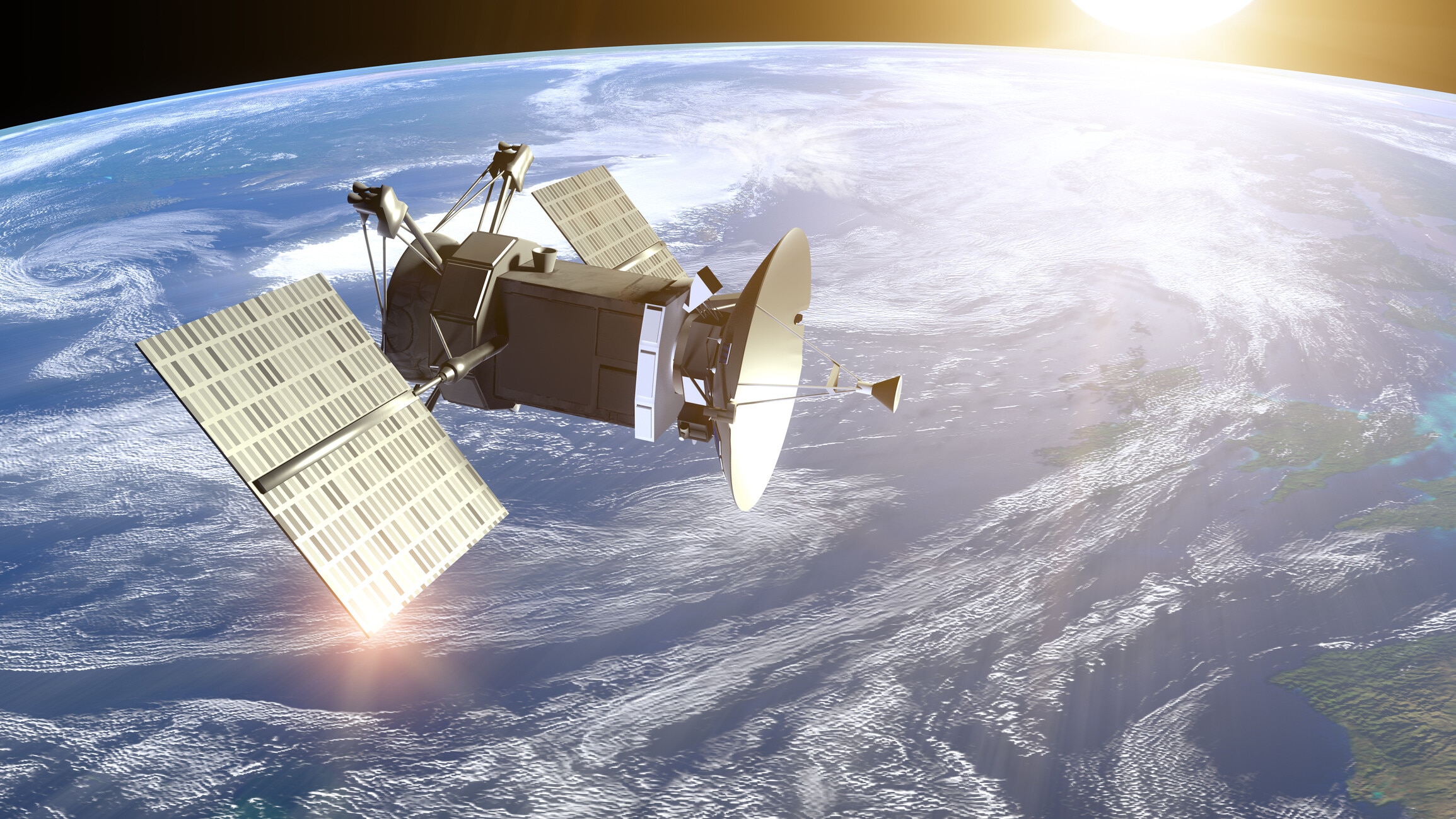
Satellites could help usher in a new phase of AI development called 'planetary intelligence'. Image: iStockphoto/koto_feja
- By combining large-scale AI models with sensing capabilities, machines could help us better understand the world in real time.
- Known as "planetary intelligence", this could have significant implications for climate adaptation, economics, security and other global risks.
- At the World Economic Forum Annual Meeting 2026, participants will explore how the ethical use of AI could create solutions for real-world challenges.
For the past decade, artificial intelligence (AI) has been largely trained on text scraped from the internet. As it becomes multimodal, it now includes photographs, videos and more – but only what we’ve uploaded. Using this data as inputs, these systems have learned how we write, speak, argue, joke and imagine.
We’ve all seen this incredible power, but these systems still remain curiously detached from the physical world. They do not see the planet as it changes. They do not anticipate what should happen next, nor register surprise when reality veers off course.
That is about to change. A new paradigm – “planetary intelligence” – could mark a genuine change in both AI and humanity’s relationship with the Earth. It involves coupling large-scale AI models with a global network of sensing and computing satellites to help machines develop beyond merely describing the world to become systems that can understand, anticipate and reason about it in real time.
Building computing power in space
To understand why this matters, it helps to borrow an analogy from biology. Until recently, Earth-imaging satellites functioned like disembodied eyes. Wide-field constellations scanned the planet continuously, like peripheral vision. High-resolution satellites could zoom in on specific locations, just like the human eye can. They saw everything, everywhere – but seeing alone is not intelligence.
The significant amount of compute needed to support AI is akin to a brain without eyes. But now, computing power and sensing satellites are being put together. In the same way, as animals evolved, their sensors and brain started to work together to process a wealth of information more efficiently and with more powerful results.
The addition of substantial computing power in space is creating this leap for AI. With advanced processors on board satellites, raw imagery no longer has to be sent to Earth for interpretation. Instead, data can be processed, analyzed and acted upon in orbit. The satellites are still the senses, but now something like a brain has been attached.
Today in AI, everyone wants to expand to ‘real-world’ models that incorporate historical and up-to-date data about the state of the physical world. This would significantly expand the real-world applications of AI. Real-world models can address real-world issues including disaster response, agriculture, security, energy, conservation and much more.
But real-world models also need real-world data. This is where space comes in.
Getting data about Earth from space
Satellites have been collecting images – or data – of the Earth for decades. NASA’s Landsat programme has been documenting change on Earth from space for over 50 years. More recently, Planet, an Earth observation company, has been collecting daily images of the whole Earth, amassing around 3,500 images of each place on its landmass.
And while satellites in space have collected all of this data, governments and companies have previously not been able to use it – processing hundreds of petabytes of data is not for the faint of heart. Historically, this has required huge teams with specialized knowledge and access to supercomputers, plus years or even decades of work to develop new types of analysis.
All of this has changed with AI. Now, these incredible datasets can be used to train AI to better understand our physical world – from agriculture, shipping and urban development, to ecosystem health, climate and more.
How planetary intelligence works
But the real breakthrough comes when this space-based compute is used to run a new class of AI: a Planetary Intelligence Model (PIM). If the satellites are the eyes and the processors are the brain, the PIM is closer to a mind or consciousness – a system that maintains an internal model of how the world works and continuously checks that model against reality.
This mirrors a principle from neuroscience known as predictive coding. The human brain does not simply absorb sensory input, it constantly predicts what it expects to see next, then updates its understanding only when reality diverges from expectation. You do not notice the feeling of your shirt against your skin because it matches your brain’s prediction. But a sudden pain or imbalance demands attention.
Applied to the planet, this is transformative. A PIM trained on ecosystem science, physics, climate dynamics and human systems like commerce and urban infrastructure could develop a baseline sense of how Earth – and the humans on it – behave. It would “expect” seasonal crop health in the US Midwest, typical snowpack levels in Spain’s Sierra Nevada and normal shipping traffic through the Strait of Hormuz in the Middle East. Satellite observations would then serve as continuous reality tests.
When expectation and observation align, nothing would need to happen. But when they diverge – when smoke appears where healthy crops were predicted, when water levels fall faster than hydrology models allow, when troop movements emerge where none were anticipated – the system would generate a prediction error. That error is not noise, it is insight.
Addressing cascading global risks
Planetary intelligence can reframe satellite imagery from a passive archive into an active diagnostic tool. The most valuable signal is not what looks normal, but what violates our best understanding of how the world works. In effect, the planet and humans would gain something like proprioception, or an awareness of our own state.
With reasoning layered on top, planetary intelligence moves into something akin to executive function. The system would not just detect a wildfire, it would reason about wind, terrain and fuel to infer which communities will be threatened next. It would not simply observe flooding, it could predict downstream impacts on infrastructure and food supply. It would not just spot military assets, it could recognize patterns that suggest escalation or imminent conflict.
The implications are profound. For disaster response, this could mean earlier warnings and more precise evacuations. For climate adaptation, it would offer a living model of Earth’s changing systems rather than static reports published months later. For economics and security, it would provide a shared, continuously updated picture of physical reality. It could help to reduce uncertainty in a world increasingly defined by cascading risks.
A new phase of AI development
The development of planetary intelligence also marks a turning point for AI itself. Large language models taught machines to navigate human communication. Planetary intelligence extends that capability to the living and physical world we inhabit together. It goes beyond words and images, to anchor AI in rivers and roads, crops and clouds, ships and trains, ice sheets and cities.
Planetary intelligence, in effect, could provide humanity with a whole new capability: a planetary-scale mind that watches, predicts and learns alongside us. If used wisely, this would help us to move from reacting to crises after they unfold to understanding and shaping the conditions that produce them. Rather than an incremental improvement in AI, this is a phase change in how we perceive and engage with the only planet we have.
Don't miss any update on this topic
Create a free account and access your personalized content collection with our latest publications and analyses.
License and Republishing
World Economic Forum articles may be republished in accordance with the Creative Commons Attribution-NonCommercial-NoDerivatives 4.0 International Public License, and in accordance with our Terms of Use.
The views expressed in this article are those of the author alone and not the World Economic Forum.
Stay up to date:
Artificial Intelligence
Related topics:


Forum Stories newsletter
Bringing you weekly curated insights and analysis on the global issues that matter.
More on Artificial IntelligenceSee all

Jeremy Jurgens
February 27, 2026