Reskilling Revolution: Preparing 1 billion people for tomorrow’s economy

The Reskilling Revolution focuses on sourcing commitments, co-creating solutions and connecting stakeholders to promote future-ready workforces. Image: Getty Images
- Amid a rapidly changing jobs landscape, an urgent investment in human capital is needed to sustain growth, competitiveness and opportunity.
- By 2030, 22% of jobs are expected to be disrupted as technology, the green transition, demographic change and geoeconomic fragmentation reshape labour markets.
- The World Economic Forum is working with over 350 organizations to enable 1 billion people with access to better education, skills and economic opportunities by 2030.
Why this moment matters
Artificial intelligence (AI), the green transition and geoeconomic fragmentation are no longer future disruptions but are actively reshaping work, business models and national competitiveness. Now, access to skills and talent has become a binding constraint on growth, innovation and resilience.
The Reskilling Revolution – a World Economic Forum initiative to empower 1 billion people with better education, skills and economic opportunity by 2030, driven by champions and partnerships – is evolving.
From mobilizing commitments, it is now implementing systemic change by embedding skills into workforce transformation, economic policy, and education and talent systems.
The impact of the Reskilling Revolution
Since January 2020, the Reskilling Revolution has mobilized primarily systems-level commitments expected to reach over 856 million people globally by 2030, spanning policy, business strategy and education-to-employment systems.
While most efforts have focused on digital skills such as AI, big data and technological literacy, business leaders also strongly emphasize attitudes and human-centric skills, such as leadership, curiosity and resilience; over half are dedicated to preparing a green workforce.
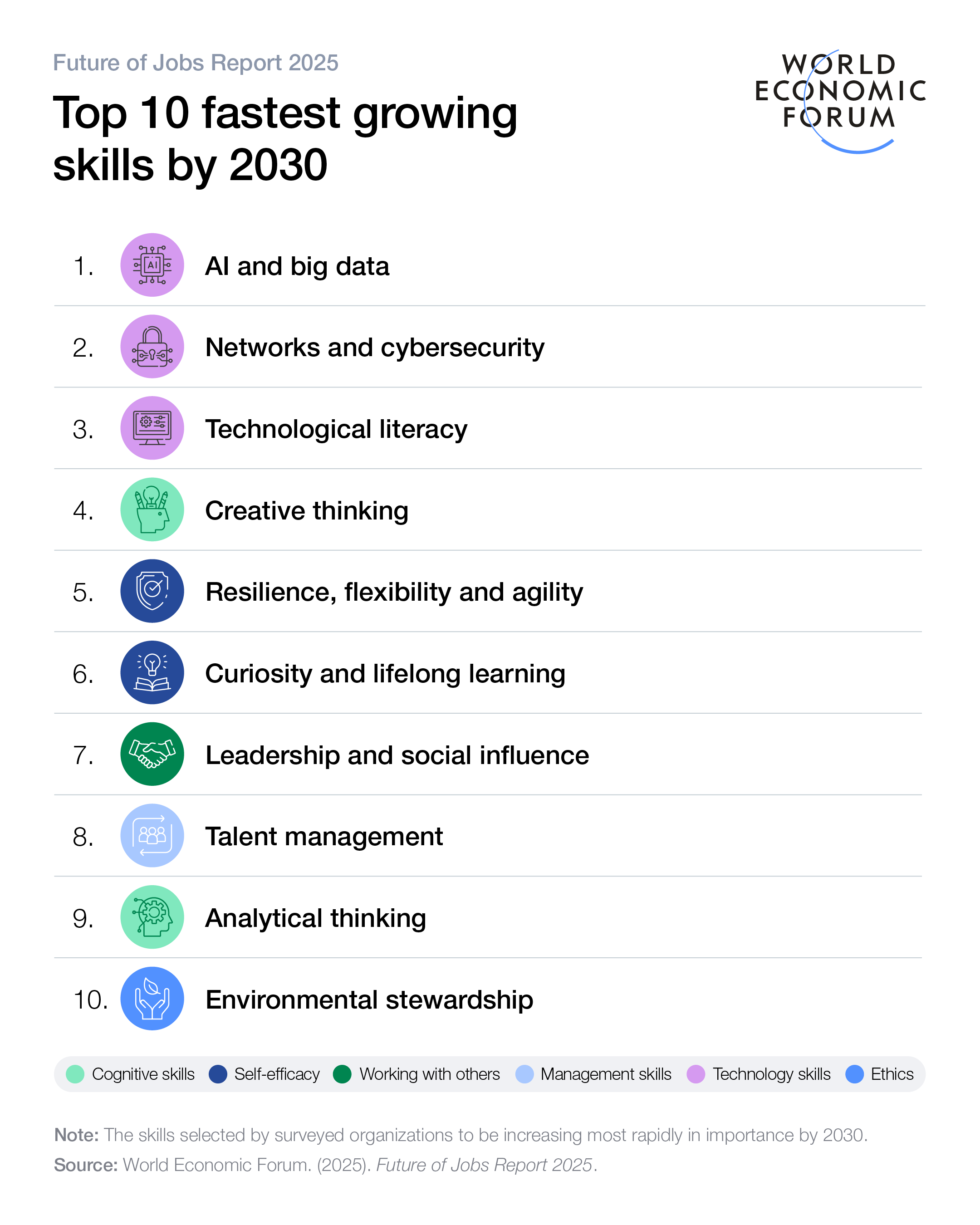
Founding members of the initiative’s 350-strong multistakeholder community include the Adecco Group, the government of the United Arab Emirates, iamtheCODE, Infosys, the Lego Foundation, LinkedIn, ManpowerGroup, PwC, Salesforce and UNICEF.
What’s the challenge?
Labour markets are evolving faster than education, training and talent systems can adapt.
The Future of Jobs Report 2025 finds that job disruption could affect 22% of jobs by 2030, creating 170 million new roles, while displacing 92 million.
As a result, workforce transitions are becoming larger in scale, more frequent and more uncertain across economies and sectors, as learning, talent and credentialing systems fail to keep pace.
Reskilling is not just about adapting to change; it is about empowering people and communities to thrive in an intelligent age. At Sonae, we believe we bear this responsibility and are committed to this transformative journey, ensuring that innovation and opportunity go hand in hand to build a more inclusive and resilient future for all.
”While there is an overall expected net positive between job growth and decline, 39% of workers’ core skills are anticipated to change by 2030 as AI moves from experimentation into workflows, including agentic AI.
Employers will demand not only technical capabilities but also human-centric skills, such as judgment, problem-solving and collaboration to work effectively with technology.
At the same time, the longevity of technical skills is shortening, meaning workers, employers and training systems must continuously adapt; but evidence shows workforce readiness is lagging.
What’s more, foundational skills such as literacy, numeracy and problem-solving are stagnating or declining in many economies, weakening preparation for lifelong learning just as this demand is rising.
Currently, only 0.5% of global gross domestic product (GDP) is invested in adult lifelong learning; more investment in reskilling and upskilling could boost GDP by $6.5 trillion by 2030, while investing in future-ready school-level education could add $2.54 trillion over the same period.
Inclusive growth in the AI era depends on skills at scale, but no single organization can reskill the workforce alone. Through the Reskilling Revolution, Workday is partnering to support millions of individuals with accessible, job-relevant learning and hands-on experience.
”Our approach to reskilling
For 2026-2027, the three priorities are:
- Strengthening education and talent system readiness for technological change.
- Defining and scaling future-critical skills through shared frameworks and credentialing.
- Improving learning-to-eearning pathways through employer-education collaboration.
At the heart of the initiative is a sustained commitment from over 35 Reskilling Revolution champions, CEOs and leaders from international organizations, government and civil society, who help set direction, sustain momentum and support the scaling of proven models across regions and industries.
A further tier comprises active senior-level communities, including chief learning officers, the Future Skills Alliance, the Education 4.0 Alliance and the Forum’s Education Industry community, which convenes senior leaders to align on shared priorities and frameworks, while translating insights into coordinated action across education, skills and talent systems.
There is also a growing network of Skills and Education Accelerators. Brazil is one of the current 22 accelerators reaching 6 million people globally. Since 2022, it has reached 4.4 million learners, towards an 8 million target by 2030.
In collaboration with the National Service for Industrial Training (SENAI), the Brazil Skills Accelerator expands professional qualification pathways, strengthens apprenticeships and embeds digital and vocational skills across education systems.
In Latvia, the Education Accelerator garnered feedback that only 40% of high school students were confident in making career decisions.
In response, it launched an AI-powered platform to provide students with personalized recommendations and detailed information on over 450 careers and 4,000 active employers, including required skills, salary ranges and regional demand.
Looking ahead, a new flagship Skills Accelerator is being developed in India in 2026, alongside the launch of national action plans in Bahrain and Nigeria.
In business, Salesforce is expanding access to learning through its Trailhead platform, aiming to reach more than 16 million learners by 2030.
Cisco and SAP are also scaling training in digital, networking, cybersecurity and AI skills, with commitments to train 25 million and 12 million people, respectively, by 2030.
In addition, Telefónica is expanding access to skills development and job pathways through programmes that support youth, older adults and rural communities. JD.com, the first Chinese company to make a Reskilling Revolution commitment, is providing hands-on labs for logistics and retail roles.
Get involved
The Forum’s Centre for New Economy and Society serves as the Reskilling Revolution’s global secretariat.
The platform channels efforts into three critical areas: boosting economic growth while preparing for future risks; investing in talent and human capital; and advancing equity and inclusion.
Through insights, initiatives and open dialogue, stakeholders deepen their understanding of complex issues, shape new models and standards, and drive collaborative action for systemic change.
Working with leaders and innovators across hundreds of cross-sector global partners, the centre promotes new approaches to competitiveness and supports the deployment of education and skills for tomorrow’s workforce.
Stay up to date:
Future of Work





Forum Stories newsletter
Bringing you weekly curated insights and analysis on the global issues that matter.