Special Address by Friedrich Merz, Federal Chancellor of Germany
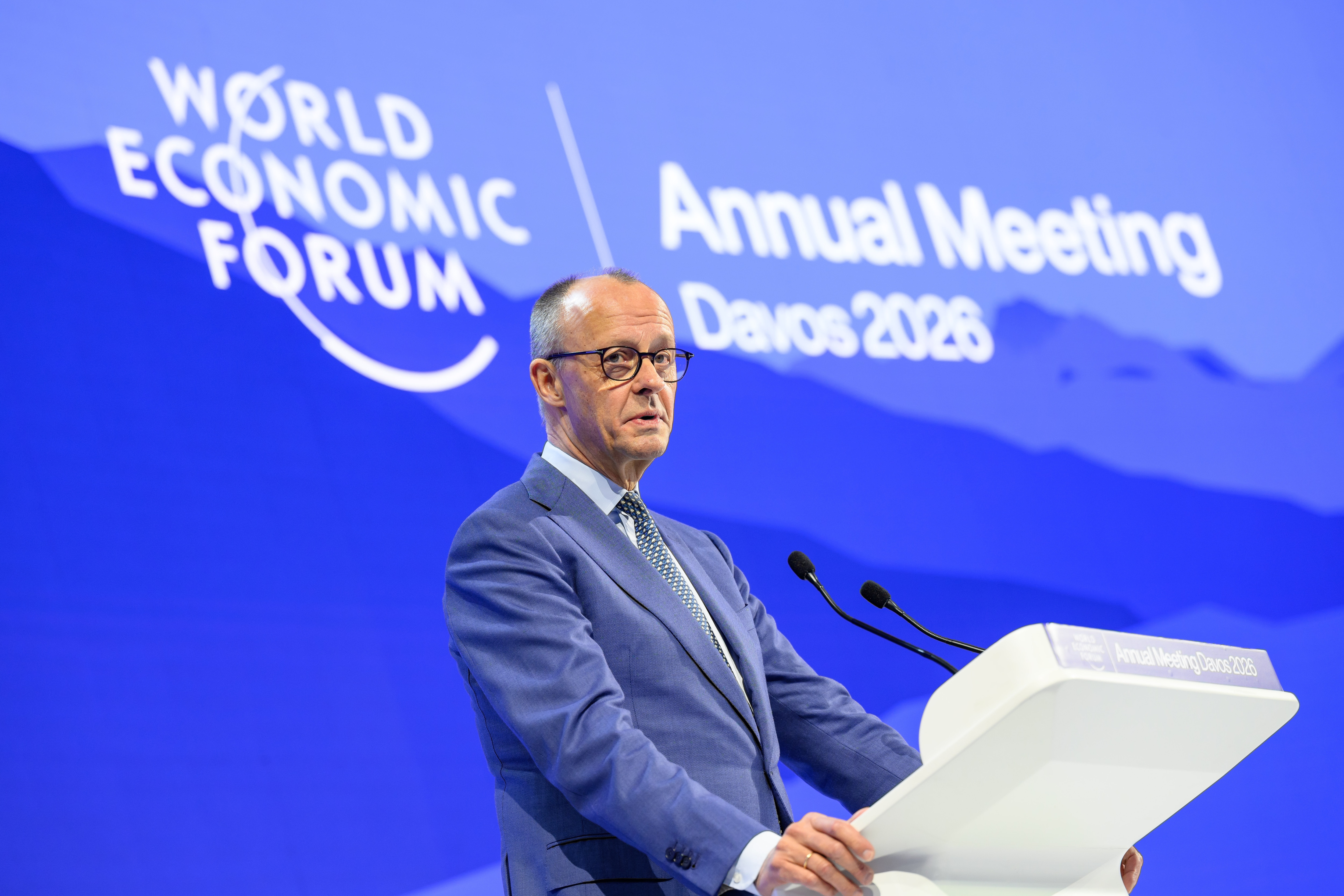
Federal Chancellor of Germany Friedrich Merz set out the new German government’s approach to a shifting global order in a special address at Davos 2026. Image: ©2026 World Economic Forum / Sandra Blaser
- This blog contains the full transcript of a special address by Friedrich Merz, Federal Chancellor of Germany, delivered at the World Economic Forum's Annual Meeting 2026 in Davos.
- Merz urged that Europe should strengthen defence, economic competitiveness, and unity to navigate an era of great power rivalry.
- He pledged higher defence spending, deeper NATO cooperation and support for Ukraine, while stressing sovereignty and territorial integrity.
This transcript was produced using AI and subsequently edited for style and clarity. The edits do not alter the substance of the speaker’s remarks.
Now, President Børge Brende, ladies and gentlemen, the calm and peace up here on the magic mountain in Davos is at stark contrast to a world whose old order is unravelling at breathtaking pace.
Let me share with you how the new German government is looking at these tectonic shifts and how we are addressing them.
These shifts have the most profound ramifications for our freedom, for our security, and for our prosperity.
In these weeks and months, we are witnessing a new era has already begun.
Russia's war of aggression against Ukraine has been the most drastic expression so far, but change runs much deeper.
China, with strategic foresight, has worked its way into the ranks of the great powers.
The United States’ global pole position is being touched. And Washington reacts by radically reshaping its foreign security policy.
We have entered a time of great power politics.
The international order of the past three decades, anchored in international law, has always been imperfect. Today, its very foundations have been shaken.
This new world of great powers is being built on power, on strength, and when it comes to it, on force. It's not a cosy place.
We do not have to accept this new reality as fate. We are not at the mercy of this new world order. We do have a choice.
We can shape the future. To succeed, we must face harsh realities and chart our course with clear-eyed realism.
Two days ago, Mark Carney said in this hall, from this place, we must no longer rely only on the power of our values. We must also recognize the value of our power. I share that view, and when I look into this room, into this hall, I want to say most of us share it, and that is a good starting point.
European friends, if I may say so, our power today rests on three pillars: our security, our competitiveness and our unity.
First, we must invest massively in our ability to defend ourselves, and we are doing this.
Second, we must rapidly make our economies competitive, and we are doing this.
Third, we must stand closer together among Europeans and among like-minded partners. We are doing this.
As we forge ahead, we must never forget one thing: a world where only power counts is a dangerous place. First, for small states, then for the middle powers and ultimately for the great ones.
I do not say this lightly. In the 20th century, my country, Germany, went down this road to its bitter end. It pulled the world into a black abyss.
So let us bear in mind that our greatest strengths remains the ability to build partnerships and alliances among equals, based on mutual trust and respect.
I remind you: after 1945, the United States of America inspired us Germans to embrace this logic. On this foundation, NATO became the strongest alliance in history.
This is why we hold true this idea.
Now, in recent days, the United States administration has vehemently demanded greater influence in Greenland. Washington argued that this is an imperative to counter security threats in the High North.
We welcome that the United States is taking the threat posed by Russia in the Arctic seriously. This threat is itself an expression of great power and rivalry.
It is aimed both at Europe and the United States. We experience it daily in hybrid attacks in the Baltic Sea, and in Russia's Winter War against the people of Ukraine.
We share the conviction that as European NATO allies, we must do more to secure the High North as NATO. This is a common transatlantic interest.
Germany is doing just that. We are doing it in the framework of NATO, and we will do more.
Our neighbours and partners in Europe, including Denmark and the people of Greenland, can count on our solidarity.
We will protect Denmark, Greenland, the North from the threat posed by Russia.
We will uphold the principles on which the transatlantic partnership is founded, namely sovereignty and territorial integrity.
We support talks between Denmark, Greenland, the United States on the basis of these principles.
I have discussed this with President Trump, Prime Minister Frederiksen, Secretary-General Mark Rutte, and others in these days.
The aim of these talks is to agree for closer cooperation amongst allies in the High North and beyond.
It is good news that we are making steps into that right direction.
I welcome President Trump's remarks from last night. This is the right way to go.
This is the right way because any threat to acquire European territory by force would be unacceptable. And ladies and gentlemen, new tariffs would also undermine the foundations of transatlantic relations.
If they are put in place, Europe's answer would be united, calm, measured and firm.
As we proceed, we are guided by a clear compass.
Firstly, in the new age of great powers, Europe must stand together resolutely and sovereignly.
And secondly, we should not give up on NATO.
At the historic NATO summit in The Hague last June, we created the material prerequisites for this.
Europe will invest hundreds of billions of euros in its security. It was a remarkable transatlantic success.
Now we must repair the trust on which the alliance is built.
Europe knows how precious it is. We feel deeply that it can be the United States' strongest competitive advantage in an age of great powers.
Democracies do not have subordinates. They have allies, partners and trusted friends.
Let me paraphrase this in German in a few words.
[The following is translated from German]
We are entering in a new era of great powers. We are right in the middle of it.
In this world, the winds are very harsh, and this wind will give us threats, and that's what you are feeling and that we all are feeling, but we have to be very clear.
This world, we are not subordinate to it. We can form it with our force. We have to be valid. We have to use our own strength. We are doing exactly that. We are massively investing in our own security. We are working on the competitiveness of our economies, and we are working together in Europe between European partners, and that will help us in these new times.
This will open up new doors and will give new opportunities for all of us.
As far as our sovereignty is concerned, we will uphold that firmly with our neighbours and our neighbours can build upon our solidarity.
Although it's frustrating over the past few months to see the development of this transatlantic partnership, but we have to uphold it.
And I would like to claim the principle of hope, and we as Europeans know how important it is to have that trust in NATO.
In this era of great powers, the US will also have to count on that trust between us. That is our main competitive advantage for them and us.
Well, dictators might have subordinates, but we have to be partners and reliable friends.
That is a sentence that will form the basis of our work, and we will work hard on it so that it will not be forgotten.
[Merz returns to speaking in English]
Under my leadership, the new German government set two goals. First, Germany has to regain economic strength.
Second, we want to make Europe a key player again in global politics economically and particularly in defence.
We need to be able to defend ourselves, and we need to do so fast.
These goals are complementary. Economic competitiveness and the ability to shape global politics are two sides of the same coin.
Germany can only lead the way in Europe if we are economically strong.
And Europe's geopolitical influence and our defence capability largely depends on the continent's economic momentum.
Ladies and gentlemen, our policies now need to be exceptionally ambitious and courageous. We must make progress in four simultaneous areas.
We must continue supporting Ukraine in its fight for just peace.
We must become capable of defending ourselves on our own in Europe.
We want to reduce dependencies that currently make us vulnerable.
And fourth, we want to ensure that our economy can tap into its full potential for innovation and growth.
This will only work if we work together as one European Union, and be assured, Germany pledges to take a special responsibility here.
That is why we decided right at the start of my tenure to increase Germany's defence spending up to 5% of GDP. That is a huge increase.
Boosting our military capabilities means to assert our sovereignty.
By systematically strengthening our defence, we are reducing our economic and technological dependencies.
There is no room for isolationism and protectionism in this agenda. Instead, we are talking about strategically coordinated ties worldwide.
Europe's trade ambitions are crystal clear. We want to be the alliance offering open markets and trade opportunities.
We want to strengthen the rules for fair trade and level playing fields.
Europe must be the antithesis to state-sponsored, unfair trade practices, raw material protectionism and tech prohibition and arbitrary tariffs.
Tariffs again have to be replaced by rules, and those rules need to be respected by trading partners.
On this, the EU is making great progress. Mercosur has been signed, and by the way, I deeply regret that the European Parliament has put another obstacle in our way yesterday, but rest assured, we will not be stopped.
The Mercosur deal is fair and balanced. There is no alternative to it if we want to have higher growth in Europe, and most likely, this agreement will provisionally be put in place.
In a few days’ time, the President of the European Commission will travel to India to establish the principles of a free trade agreement between the subcontinent and the European Union.
I was in India a week ago, and I have no doubt whatsoever that the era of great powers presents an opportunity for all of us, and for all countries that favour regulations above arbitrary rule and see greater benefit in free trade than in protectionism and isolationism.
Europe is joining forces with new partners, as you do see in our efforts to finalize trade agreements with Mexico and Indonesia.
In order to make best use of these new partnerships, we need to put our house in order at home.
We are aware of those problems. Both Germany and Europe have wasted incredible potential for growth in recent years by dragging feet on reforms in unnecessarily and excessively curtailing entrepreneurial freedoms and personal responsibility.
We are going to change that now.
Security and predictability take precedence over excessive regulation and misplaced perfection.
We must reduce bureaucracy substantially in Europe.
The single market was once created to form the most competitive economic area in the world, but instead, we have become the world champion of overregulation. That has to end.
I have therefore mobilized EU leaders to convene for a special summit on February 12, at which we intend to set the course.
Giorgia Meloni and myself, we have formulated a set of proposals we would like to see addressed. Amongst them are some new ideas.
We propose an emergency break for bureaucracy and discontinuity for legislative work.
A modernized EU budget putting competitiveness centre stage.
We want to have a fast, dynamic Europe and a service-oriented administration.
I will insist that rapid progress be made, including on the capital markets union.
We cannot allow our European champions to continue being dependent on capital markets outside Europe. Instead, they should be able to grow in Europe. They should be able to be financed in Europe, and they should be able to go public in Europe.
At home, we are making Germany competitiveness again as a place for business and investment, both in industry and our many small and medium-sized enterprises.
Let me tell you, the so-called Mittelstand in Germany has to be reckoned with.
We are providing more targeted support to innovators, removing obstacles from their path, and making it easier for them to access capital markets.
We have reduced energy costs. The focus for our electricity supply is on a combination of renewable energies, storage and modern gas power plants.
In the coming years, you will see massive investments in state-of-the-art power plants, power lines and heat supply.
We will speed up efforts to expand and modernize infrastructure. €500 billion have been made available for this purpose.
At the heart of our efforts lies digital transformation. Artificial intelligence requires industrial scale.
Germany has one of the world's largest pools of industrial data. That is just one reason why we are investing in high-performance AI, gigafactories, speeding up the expansion of data centres and creating the digital infrastructure for a competitive AI economy in Germany.
Our research and technology policy is guided by a new high-tech agenda.
We are global leaders in so many areas of cutting-edge research. We want to ensure that innovation gets to market more consistently, building industries of the future.
And whoever wants to invest in the future, let me be clear, you will find a very strong partner in Germany.
We want to be a leading investment location for global capital.
Our policy is to mobilize private sector investments in infrastructure, high-tech and industrial transformation with clear rules, strong institutions and long-term reliability.
Now, ladies and gentlemen, let the headlines of the day not confuse you. I urge you, look at the bigger picture.
The world around us is changing at unprecedented pace. The direction it takes must worry us.
A world of great powers is a new reality.
Europe has gotten the message. Germany has as well gotten the message.
We must and will live up to these challenges.
My government will do its homework and pursue an ambitious reform agenda revolving around security, competitiveness and European unity.
Let us be inspired by what is maybe the most important lesson of enlightenment: our fate is in our hands.
It is in our responsibility and our freedom to shape it.
This historic task lies ahead of us. Germany wants to play a key role in mastering it.
Many thanks for your attention.
Don't miss any update on this topic
Create a free account and access your personalized content collection with our latest publications and analyses.
License and Republishing
World Economic Forum articles may be republished in accordance with the Creative Commons Attribution-NonCommercial-NoDerivatives 4.0 International Public License, and in accordance with our Terms of Use.
The views expressed in this article are those of the author alone and not the World Economic Forum.
Stay up to date:
Germany


Forum Stories newsletter
Bringing you weekly curated insights and analysis on the global issues that matter.