5 human rights leaders have a message for Davos
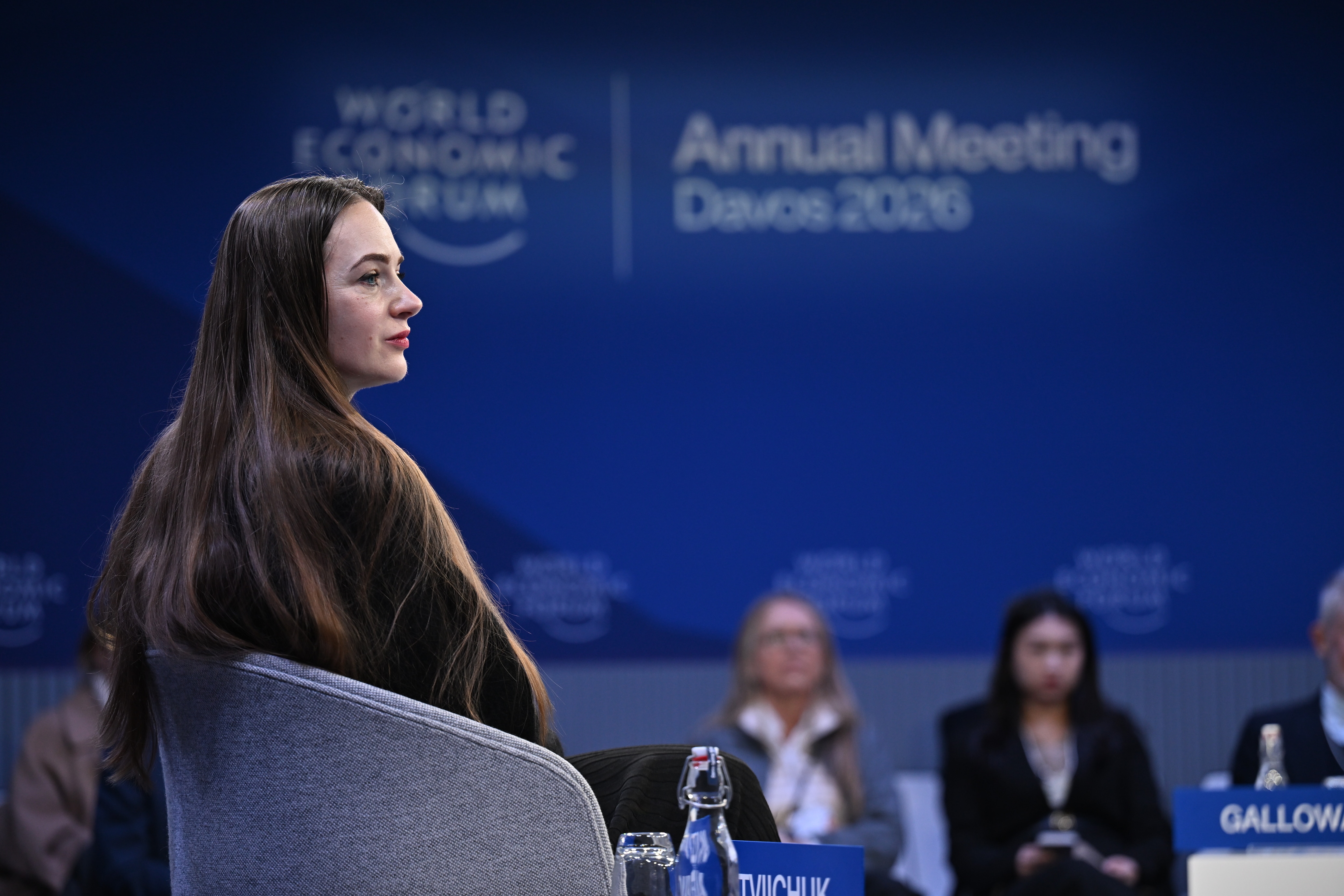
Oleksandra Matviichuk, Head of the Center for Civil Liberties Ukraine, is among the human rights leaders attending Davos 2026. Image: World Economic Forum/Harold Cunningham
- Participants at the World Economic Forum's Annual Meeting 2026 included more than 60 heads of state and government – one of the highest-level gatherings in the meeting's history.
- During the World Economic Forum Annual Meeting 2026, we asked 5 human rights leaders about the main message they'd like to deliver to these participants.
- From democracy and technology to violence and anger, here's what these human rights leaders had to say.
Even amid a shifting geopolitical picture, global leaders must keep corporate responsibility, economic inequality and inclusive development at the top of their agendas.
Economic and political change affects everyone and so protecting the fundamental rights and freedoms of people around the world is crucial – whether that relates to investing in people, deploying new tech in an ethical way or rebuilding prosperity within planetary boundaries.
Nearly 830 CEOs and corporate chairs gathered in Davos, Switzerland, for the World Economic Forum's Annual Meeting 2026 this week. There were also hundreds of political leaders – including more than 60 heads of state and government.
We asked five human rights leaders about the message they'd like to deliver to those in attendance.
Philippe Bolopion, Executive Director, Human Rights Watch
"There has been an all-out assault on human rights globally in the last few years. I would say that the human rights movement has lost ground, unfortunately. The world has become more hostile to human rights. We have many countries that are less free today than they were 20 years ago.
"You see many countries around the world that are realizing that, alone, they are under threat. But together, they could be strong. And for this effort to be meaningful, these countries need to rally around more than just common interest. They need to rally around the idea of a defence of democracy, a defence of human rights, because otherwise these values are really under threat.
"For world leaders in Davos, it should not be business as usual. We are living in a dangerous time, a lot of the human rights, the norms, the progress that have been made over the last two decades on international justice and the protection of civilians is under threat.
"World leaders, especially the leaders of middle power democracies, need to take this as a wake up call and join forces to defend human rights and defend democratic values."
Agnes Callamard, Secretary-General, Amnesty International
"For those who argue that human rights is not a priority, I want to remind them that the birth of the organized system of human rights protection is very specific in time. It came out of an attempt to destroy the world. The Universal Declaration of Human Rights [adopted in 1948] was the statement by humanity: never again. Because when there is no human rights protection, you have World War II. Human rights need to be protected exactly for avoiding the world falling into an abyss.
"Davos 2026 is based on dialogue – a notion that we need to have effective dialogue. It's a great topic, it could not be more timely. Looking around, where is the evidence of good dialogue? We actually have the opposite. We are seeing a number of very powerful leaders moving away, in fact trampling on even the notion of dialogue.
"Davos should insist upon dialogue, but when dialogue fails because the other side does not want dialogue, there is only one response. Not capitulation, resistance. And I hope that during this Davos, we will have many examples of leaders – political or economic – saying: We're prepared to dialogue, but if we're not going to be listened to, if the other side is not prepared to dialogue, if the other side only wants capitulation, then we will stand up and we will resist for the sake of humanity."
Gary A. Haugen, Chief Executive Officer, International Justice Mission
"Two things I really want leaders here at Davos to appreciate is that, first of all, violence against the poor is devastating economies and opportunities for billions of people around the world. And yet, it is now more possible than ever to see that violence and criminality drastically reduced in a way that was never possible previously in history.
"Secondly, [I want leaders at Davos] to understand that violence is just an absolute reality. The power of explosive technology and AI will be bringing that power of violence and harm to more and more people around the world because we are developing tools that criminals can use to hurt more people at scale and to hide it better.
"And so now is the opportunity to do two things: To take responsibility if you're building technology and AI, to think in advance, how can I make sure this is not used by criminal capacities in the world? And then, how could I also build accountability with government, with business and civil society to make sure that those who abuse these tools are actually properly brought to account?
"And when we do those things, we can make sure we're protecting the future for our children."
Oleksandra Matviichuk, Head, Center for Civil Liberties
"I don't know how historians in the future will call this historical period, but the world order, which is based on UN Charter and international law, is collapsing before our eyes. And Ukraine finds itself in the epicentre of the event, which will shape the world future. Because it's not just the war between two states. This is a war between two systems, authoritarianism and democracy.
"It's easy to predict that such fires, and worse, will emerge more and more often in different parts of the globe because this international wiring is faulty and sparks are everywhere. And this means that our generation – not just in Ukraine, I mean globally – have a huge historical responsibility to start a cardinal reform of international system of peace and security.
"It has to provide human rights guarantees and security all people, regardless of where they live."
Amitabh Behar, Executive Director, Oxfam International
"My message to the powerful leaders – and pretty much everyone at the level of real politics – look around, don't get blinded by the narratives being created in the social media or media.
"And I'm sure these politicians are super-smart politicians. They know the pulse. There is anger, and it is growing enormously. I travel, my job makes me travel. I meet citizens' groups. I can see that there's anger.
"It's important for these leaders to listen to that anger. And the anger is just about ensuring a life with dignity for everyone. And that is also the call of the leadership role they play. So I hope they can deliver on that."
License and Republishing
World Economic Forum articles may be republished in accordance with the Creative Commons Attribution-NonCommercial-NoDerivatives 4.0 International Public License, and in accordance with our Terms of Use.
The views expressed in this article are those of the author alone and not the World Economic Forum.
Contents
Philippe Bolopion, Executive Director, Human Rights WatchAgnes Callamard, Secretary-General, Amnesty InternationalGary A. Haugen, Chief Executive Officer, International Justice MissionOleksandra Matviichuk, Head, Center for Civil LibertiesAmitabh Behar, Executive Director, Oxfam International
Forum Stories newsletter
Bringing you weekly curated insights and analysis on the global issues that matter.
More on Civil SocietySee all

Murchana Roychoudhury
March 8, 2026


