Three ways chairs can enhance their board’s effectiveness to drive resilience

Research by Deloitte has revealed the changing role of board chairs. Image: Getty Images
- Boards today must navigate short-term disruption to drive long-term value.
- Chairs have a key role in that, across C-suite communication, performance, board culture and more.
- Research by Deloitte has revealed the changing role of board chairs.
In today’s dynamic global landscape, business leaders are having to constantly adapt their response to new challenges and opportunities.
The need to navigate ongoing short-term disruption while positioning their organizations to capture long-term opportunities means boards and C-suites are revisiting both their strategic priorities, approach to scenario planning and their ways of working.
Boards beyond traditional models of governance
The fundamental role of a board, whatever the environment, is to enable the success of an organization while protecting its long-term resilience. Today’s complexity is causing boards to look beyond traditional models in the way they engage and work with their management teams. This is particularly important when it comes to building resilience – whether this means mitigating today’s risks, or reshaping business models to secure long-term growth.
Deloitte Global research conducted with nearly 750 board members and executives in more than 50 countries explores how the Board-C-suite relationship is evolving. Findings point to an increasingly proactive approach to oversight and governance, with most respondents (86%) saying their boards have increased their focus on monitoring risk, overseeing growth strategies and bolstering long-term resilience. The report also shows chairs and their boards communicating more frequently and openly with the C-suite.
An increasingly active role for Chairs
A running thread through the research is the multi-faceted role that board chairs are playing to elevate board-management engagement. Here, the survey results reflect my own experience and observations from exchanges with peers – with chairs finding themselves pulling multiple levers to increase their board’s productive engagement with the C-suite.
Chairs have a significant role when it comes to organizational resilience, and it is evident that the demands placed on them and their boards to challenge, support and add value to management are growing.
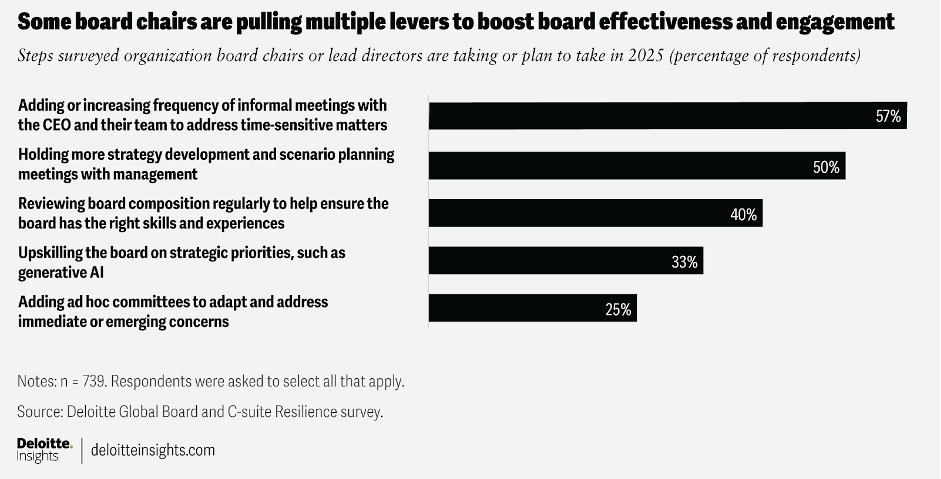
How can chairs make boards more effective?
All things considered, there are three key areas chairs should focus on to enhance how their boards engage with the C-suite, ensure effectiveness of discussions and help make their organization future-ready.
1. Partnering with the CEO for strategic alignment and ongoing guidance
The relationship between chair and CEO is evolving to be more fluid: more than half (57%) of survey respondents say their chairs are now having more informal meetings with their CEOs. Chairs can serve as a thought partner for their CEOs by being a reliable, challenging and supporting sounding board - while maintaining clear boundaries between oversight and execution.
To enable effective board discussions, chairs and CEOs also need to work together to shape board agendas, ensuring they appropriately balance oversight of short-term activities with longer term strategic matters. Many recognize this need, with half (50%) of the survey respondents saying their chair is holding more strategy development and scenario planning meetings with management than previously.
2. Optimizing board composition and structures
There has never been a more important time for chairs to ensure they have the right governance structures, skills and levels of commitment in their boardroom.
Chairs can elevate their board’s engagement and performance by:
Re-evaluating their board’s structure in line with external and internal environments – optimizing governance pathways, committee constructs, remits and interdependencies to provide the full board with more capacity to focus on strategic matters.
Carrying out appropriate assessments of the skills, capabilities and attributes required in the boardroom to enable the right blend of expertise across strategic industry topics; across governance areas from risk management to scenario planning; and mixing long-serving and newer members to balance experience with new perspectives.
Creating clarity with the entire board regarding the expectations of all directors in terms of engagement, preparedness and self-education. Chairs should support directors across these aspects, while holding them accountable for their own commitment and contributions.
Providing continuous learning opportunities for all directors through an agile board education program or by bringing in external expertise on specific topics.
Establishing a thought-through board effectiveness review programme, at a cadence appropriate for the business, to garner external and internal views on the effectiveness of the board, success factors to build on and development areas to address.
3. Fostering a board culture of trust and accountability
With many discussions requiring nuance and balance, creating the conditions for constructive debate and fresh thinking is essential. In the survey, two thirds of respondents view open, transparent communication between the board and CEO as the top leadership factor impacting resilience.
Harnessing the board’s diversity of thought is particularly important at this time. Chairs should encourage all members to express opinions, stressing that an absence of debate and discussion implies agreement in the boardroom. Relationships are at the heart of building trust, and chairs need to increasingly spend time with board members to canvas their views and concerns, and to encourage them to contribute fully to discussions. Providing opportunities for directors to input in advance of meetings and share one-on-one feedback on the chair’s approach is also key.
It is equally important for the chair to facilitate an ongoing dialogue with the C-suite, to help ensure the right sessions are planned for the board meetings, that management priorities and concerns are understood and, importantly, to enable that the discussions are set up for success.
Future-ready governance
The challenges we face today require boards and management teams to work closer together than ever before to steer their organizations through volatility, and toward long-term growth and resilience. By working closely with their CEO, increasing their board’s impact, and fostering trust and collaboration between their board and management, chairs can help prepare their organizations for the unexpected and position them to thrive in the future.
Don't miss any update on this topic
Create a free account and access your personalized content collection with our latest publications and analyses.
License and Republishing
World Economic Forum articles may be republished in accordance with the Creative Commons Attribution-NonCommercial-NoDerivatives 4.0 International Public License, and in accordance with our Terms of Use.
The views expressed in this article are those of the author alone and not the World Economic Forum.
Stay up to date:
Corporate Governance
Related topics:


Forum Stories newsletter
Bringing you weekly curated insights and analysis on the global issues that matter.
More on BusinessSee all

Laura Veldkamp
March 4, 2026


