Two football legends on learning from failure, building resilience, and the power of education
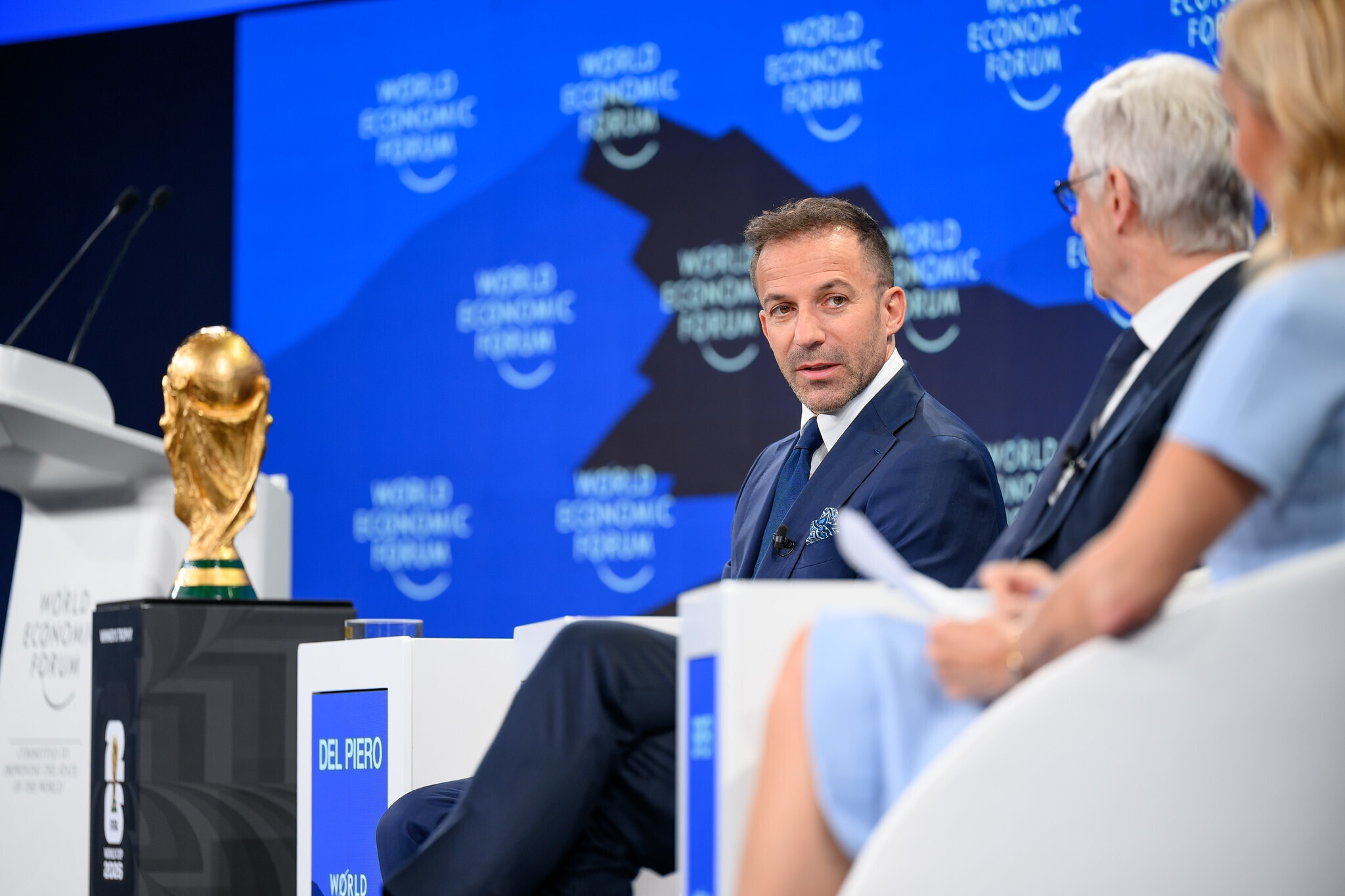
Football’s biggest stages reward more than talent alone — with learning from failure and building resilience key to long-term success at the elite level. Image: World Economic Forum
- Football’s biggest stages reward more than talent alone — with learning from failure and building resilience key to long-term success at the elite level.
- Strong education systems play a decisive role in player development, with a clear correlation between learning, judgement and success in senior football.
- These themes were explored by Alessandro Del Piero and Arsène Wenger at the Davos Kick-off for the FIFA World Cup 2026, alongside FIFA President Gianni Infantino.
A world champion and an Invincible took to the Davos stage to explain why football’s greatest lessons are often learned long after the final whistle.
At the session Davos Kick-off for the FIFA World Cup 2026, FIFA President Gianni Infantino and football legends Alessandro Del Piero and Arsène Wenger discussed what makes the beautiful game so special — and what to expect from the tournament this summer.
For the first time, 48 teams will compete across three countries — Canada, Mexico and the United States — in what promises to be the biggest World Cup the game has ever seen. But as Infantino, Del Piero and Wenger made clear, the tournament is about far more than numbers, venues or trophies.
Infantino opened the session by framing football as a force with unique social power. Holding up a football, he called it a “magic instrument that transforms people into happy people”, arguing that football can shift the mood of individuals, communities and even nations. “There is nothing anywhere close to what football does,” he said, pointing to its economic impact, but also to its ability to bring people together in moments of shared joy.
That sense of football as a human journey was echoed by Del Piero, who reflected on winning the World Cup with Italy in 2006. Lifting the trophy, he said, makes you feel “complete as a footballer, of course, and also as a human being”. His story, however, was not one of uninterrupted success. Del Piero spoke candidly about the importance of mistakes and defeats, particularly for young players coming through the system.
“Making mistakes is also good,” he said. “You need to make mistakes in order to grow up. You need lose games in order [to win] games…you learn much more from defeats than from wins.” For Del Piero, failure is not something to be feared or hidden from, but an essential part of development. The modern pressure on young athletes, amplified by social media, risks creating a fear of error that ultimately limits growth. Resilience, he argued, is built by experience — by coping with loss, pressure and disappointment long before players reach the top tier.
Wenger picked up that thread and extended it beyond the pitch. Now FIFA’s Chief of Global Football Development, he has spent recent years examining why some nations consistently succeed. One conclusion stands out. “There was a huge correlation between the quality of education and the ranking at the senior level,” he explained. Countries with stronger educational foundations tend to perform better at the top of the game — not by coincidence, but because education shapes judgement, decision-making and the ability to keep learning throughout your career.
For Wenger, football education is not just about drills or tactics. “The mistake is educational,” he said. Young players must be encouraged to try, to take initiative and to process information at speed. That capacity — to recognize situations, recall past experiences and respond decisively — is what separates elite players from the rest. Education, in this sense, underpins resilience: it gives players the tools to adapt when things go wrong.
As the conversation returned to the World Cup, both men spoke of joy — a word Del Piero used repeatedly. In a volatile world, football offers moments of collective happiness and connection. The 2026 tournament, with its expanded format and global reach, will test players mentally and physically. But it will also showcase the values that sustain the game: learning from failure, investing in education and building resilience over time.
Watch the full session to hear more of their conversation.
Don't miss any update on this topic
Create a free account and access your personalized content collection with our latest publications and analyses.
License and Republishing
World Economic Forum articles may be republished in accordance with the Creative Commons Attribution-NonCommercial-NoDerivatives 4.0 International Public License, and in accordance with our Terms of Use.
The views expressed in this article are those of the author alone and not the World Economic Forum.
Stay up to date:
Future of Work


Forum Stories newsletter
Bringing you weekly curated insights and analysis on the global issues that matter.
More on Education and SkillsSee all

Shivam Parashar
March 4, 2026


