'What drives you?' Perspectives from leaders at Davos 2026
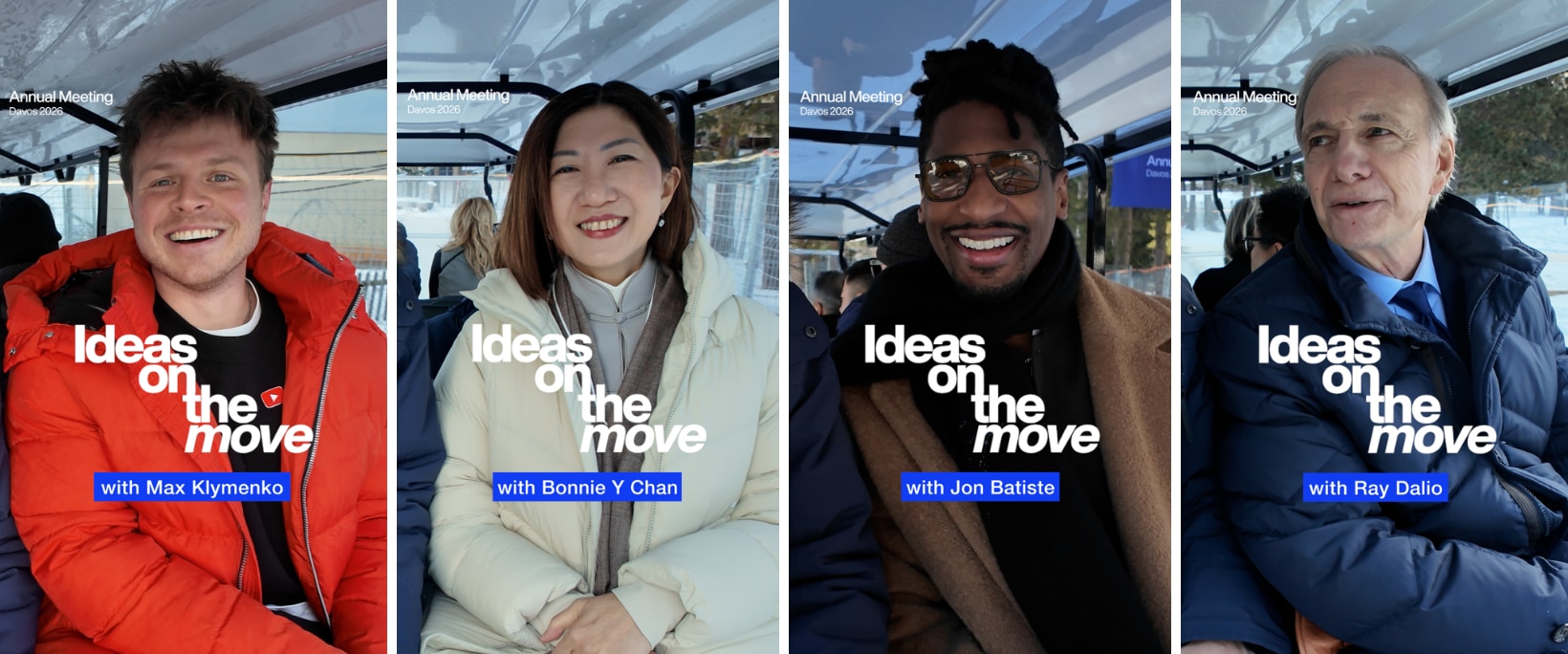
Ray Dalio, Jon Batiste, Bonnie Y Chan and Max Klymenko were just a few of the leaders interviewed in the Davos golf cart on 'what drives them'.
- The World Economic Forum's Annual Meeting in Davos took place between 19 to 23 January under the theme 'A Spirit of Dialogue'.
- In between appearing in panel sessions seeking solutions to the planet's biggest challenges, participants took time to answer a simple question: What drives you?
- From Sabrina Elba to Ray Dalio, here's what 11 leaders and experts told us on the back of a golf buggy.
For one week of the year, the Alpine ski resort of Davos is transformed into a global hub for dialogue, convening leaders to move the needle on some of the most urgent issues we face today.
But there's snow and ice on the ground – so suits are worn with boots, and a golf buggy operates between the flag-decked Congress Centre and Kurpark Village, where more sessions are held and podcasts recorded.
This year, the buggy itself became centre stage in a new video format, which saw a diverse group of leaders, influencers, artists and experts answer the question: 'What drives you?'
In case you missed it on the Forum's social channels, we've gathered all the interviews together here in one place.
People's optimism – Max Klymenko
Max Klymenko is a Ukrainian-born, UK-based content creator with millions of followers who has had more than 2,000 conversations with people about their jobs in his Career Ladder series.
He said: "I have an absolute dream job where I get to chat to people who are so inspired by what they do, so fulfilled with their jobs and so optimistic about the future."
Being part of the solution – Gita Gopinath
"It's very important for me to be a part of the solution," said Gita Gopinath, Harvard professor of economics and former First Deputy Managing Director of the International Monetary Fund (IMF). "I don't want to be a person who is sitting on the sidelines just letting events unfold.
"My time at the IMF gave me that opportunity to be a part of the solution – and I'm going to try and do it differently now I'm back in academia.
"I'm doing some very interesting research on stablecoins and the impact of tariffs. This is a fantastic time to be an international macroeconomist, so there's a lot going on for me to research."
Turning visions into reality – Ray Dalio
Ray Dalio, the founder of Bridgewater, the world's largest hedge fund, is widely known for having anticipated the 2008 financial crisis.
"Thrills drive me. I'm thrilled when I'm around smart people, who work together to make amazing visions happen – and then to turn those vizualizations into actualizations," said the Davos veteran.
"At this stage in my life, at 76 years old, I'm thrilled about being able to pass along anything that I have that's of value to help others."
Changing narratives – Sabrina Elba
Canadian model, CEO and activist, Sabrina Elba, is also a Goodwill Ambassador for the International Fund for Agricultural Development (IFAD), representing rural communities.
"Born to Somalian parents, I was always passionate about the narrative around rural people and Africans in particular because it was so different from what I was hearing in school, among colleagues and from my family back home.
"Africans aren't waiting for a handout; they're hardworking people who contribute to global stability and a lot of products that we know and love. You drink your coffee in the morning, and you've got to ask, where are a lot of these commodities coming from?
"I was always passionate about changing narratives and doing that particularly for people in rural areas and smallholder farmers."
Curiosity – Marina Mogilko
"There are so many people coming up with things every single day, inventing and discovering things, and I just want to learn about them."
Content creator and entrepreneur Marina Mogilko was in Davos to interview experts and leaders, including a Nobel Prize-winning quantum physicist, for her podcast Silicon Valley Girl.
"The question I'm going to be asking is how is this going to change our lives in a year or two – because change happens really fast and we have to be really prepared. But it's also really exciting to see what's happening."
The quest for truth – Johan Rockström
Johan Rockström is the Director of the Potsdam Institute for Climate Impact Research (PIK). He joined the panel on two sessions at Davos on the future of the planet.
"What really drives me is the quest for truth and scientific advancements and understanding what it takes to have a prosperous, equitable future for us humans on a stable, resilient, life-supporting, healthy planet."
He listed his three sources of hope for the future:
1: "All the scientific evidence shows the window is still open to turn this around. It's not too late."
2. "I have the privilege to interact with so many actors, from business leaders to policymakers and civil society representatives, who still stay on course and show that we have sustainable solutions that can bring better outcomes for humans."
3. "We have ample scientific evidence today that the energy transition, the food system transition, sustainable pathways are not sacrifices. In most cases, they give better economic outcomes – and better outcomes for health, security and stability. So, it's a winning pathway."
The inner voice – Jon Batiste
The Oscar and Grammy Award-winning musician Jon Batiste opened the Annual Meeting with a concert on Monday evening.
He said, "I believe there's a voice, an advocate. There's a visionary, a spiritual guide, a still, small voice – and I believe if we put ourselves in quiet, we can hear it."
Prayer, meditation, reading and "being around loved ones" help him to tune into the voice.
Batiste also spoke about the power of music as "the most direct, most immediate form of emotional dialogue, it's the language of the invisible, it's the language of invention".
Finding ways to fix problems – Yoshuo Bengio
Professor Yoshuo Bengio is a Canadian computer scientist at the University of Montréal and one of the so-called 'Godfathers of AI'.
He said he realized three years ago we were "on a dangerous trajectory with AI" because of how it's trained. "It could be misused in dangerous ways, it could also act in bad ways, in spite of our training.
"I am driven by the idea that there is a way to fix the problem, but it's a bit urgent – and it's going to need a lot of effort."
Making people's lives better – Adam Grant
The organizational psychologist is a regular panellist at Davos. This year, he joined panels to discuss the Hyper Connected and the Hyper Lonely and Healing with Sounds and Words alongside Jon Batiste.
He said two things drive him: "To try to make people's lives better and to ask questions that I find endlessly fascinating. That combination of exploring curiosity and seeking impact keeps me endlessly engaged."
Grant related to Charlotte's Web author E.B. White, who said: "I wake up in the morning torn between a desire to enjoy the world and a desire to improve the world, and that makes it difficult to plan the day."
In Davos, he wanted to elevate people who value generosity, humility and integrity because, "at the end of the day, character matters more than charisma and maybe even more than competence".
People in need of aid – Tom Fletcher
"I'm driven by the people we serve. Hundreds of millions of people out there who are in need of life-saving support," said Tom Fletcher, the United Nations' Under-Secretary-General for Humanitarian Affairs and Emergency Relief Coordinator, Office for the Coordination of Humanitarian Affairs.
He said it's a great privilege to go to Darfur, Gaza and Syria, where people are facing challenges but have "incredible courage and dignity and compassion and solidarity: I draw my energy from them".
Meeting those needs requires significant resources. "We're trying to save 87 million lives this year, and to do that, we need $23 billion – less than 1% of what is spent on guns and arms. We've got a plan, we're going to go out there and deliver it, but we need help."
Funding innovation and growth – Bonnie Y Chan
Bonnie Y Chan is the CEO of Hong Kong Exchanges and Clearing Limited. She is driven by "the desire to make a difference".
The key objective of the Hong Kong Stock Exchange is to match capital with opportunities, she said.
"If we are successful, it would mean we are able to continue helping investors to find exciting opportunities to invest in and help companies around the world to get funding to support their innovation and growth."
License and Republishing
World Economic Forum articles may be republished in accordance with the Creative Commons Attribution-NonCommercial-NoDerivatives 4.0 International Public License, and in accordance with our Terms of Use.
The views expressed in this article are those of the author alone and not the World Economic Forum.
Contents
People's optimism – Max KlymenkoBeing part of the solution – Gita GopinathTurning visions into reality – Ray DalioChanging narratives – Sabrina ElbaCuriosity – Marina MogilkoThe quest for truth – Johan RockströmThe inner voice – Jon BatisteFinding ways to fix problems – Yoshuo BengioMaking people's lives better – Adam GrantPeople in need of aid – Tom FletcherFunding innovation and growth – Bonnie Y Chan
Forum Stories newsletter
Bringing you weekly curated insights and analysis on the global issues that matter.
More on Forum in FocusSee all

Jaci Eisenberg
March 10, 2026


