Yemen: 4 lessons in unlocking prosperity in fragile states
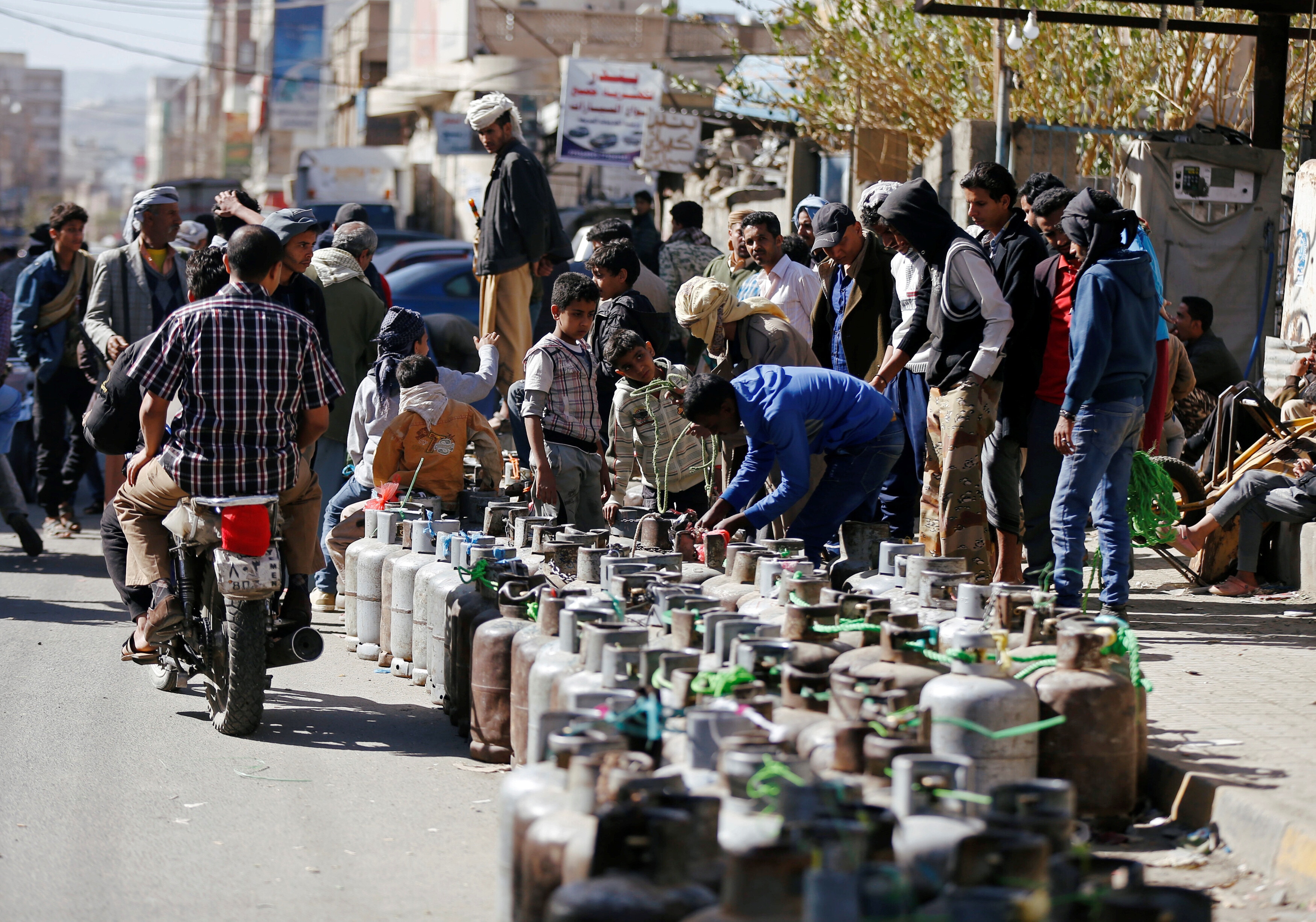
People wait to fill their cooking gas cylinders in Sanaa, Yemen. Image: Reuters/Khaled Abdullah
- Yemen's experience demonstrates how the private sector can be a stabilizing force in fragile states, supplying a vital engine of growth and supporting the population.
- The business community must complement the public sector through innovation, investment and partnership.
- Private sector actions in crisis zones should be rooted in four key principles and foreground local talent and solutions.
In fragile states, prosperity is often said to be impossible. Yemen proves otherwise. Over the past decade of conflict, something previously considered unachievable has occurred: Private sector innovation is helping hold the country together. Business resilience, when combined with vision, investment and commitment, can anchor livelihoods and build hope, even where institutions falter.
When conflict erupted in Yemen, multinational companies faced a stark choice: Exit, or face extraordinary risks. HSA Group chose the harder path: We stayed. We kept factories running, supply lines open and payrolls active – not out of charity, but because we believed that commercial continuity can give ordinary people the chance to live with dignity and predictability.
Today, we remain the largest private employer in Yemen, providing 20,000 Yemenis with stable employment and financial security, and serve as the country's leading importer and distributor of essential foodstuffs, household goods and commodities. Agility, resilience and adaptability in the face of significant challenges have since proved essential to the private sector’s critical role in the Yemeni market and continued development in recent years.
The private sector can, and should, be a stabilizing force in fragile states – but only if it embraces four principles centred on people, innovation and partnerships. These principles, if adopted at scale, can transform instable and insecure regions from zones of crisis to engines of growth and dignity.
1. Augment, not displace, jobs
The private sector bears responsibility for creating employment, not displacing it. In fragile and conflict-affected states, where job security is precarious, companies must strategically deploy technology, including AI tools, to enhance employee productivity. This will enable employees to focus on higher-value, higher-impact work; skilled, engaged people are the foundation of resilient organizations and communities. Replacing workers who are the lifeblood of the economy will only harm the country’s economic security and stability, undermining the private sector’s bottom line and mission.
Training initiatives to ensure employees are tech-literate and can harness innovation are a key part of creating employment in a dynamic and complicated environment. We operate such training through our graduate programme and strategic partnerships with leading educational institutions, including Al-Saeed University in Yemen, the American University in Cairo, and University College London, and with international private sector organizations such as SAP and Cisco.
2. Leverage partnerships to supercharge innovations
Isolated innovations have a limited impact. It is essential to find synergies across teams, partner organizations and emerging technologies to amplify impact to create high-leverage, scalable opportunities for progress. Put differently, combining the strengths of multiple actors can drive genuine, system-wide transformation.
In Yemen's underdeveloped dairy sector, where domestic production meets only one-third of national demand, we are working with others to turn structural challenges into opportunities for investment, job creation and improved food security. Under our partnership in this domain, Tetra Pak brings global expertise through its Food for Development programme, UNIDO provides end-to-end industrial systems knowledge, and HSA Group contributes deep local networks and operational reach. Together, we are modernizing Yemen’s dairy value chain and ensuring that nutritious products reach the communities that need them most, including schoolchildren.
3. Innovate to future-proof
Fragile and conflict-affected zones are riven with business challenges – including the erosion or destruction of physical and digital infrastructure. Approximately one-third of Yemen’s roads have been destroyed, nearly all of its airports are no longer functioning, and most of its seaports are closed. Meanwhile, an estimated 40% of residential homes, water and sanitation, and healthcare infrastructure have been partially or completely destroyed during the ongoing conflict. Finding potential weak points and strengthening resilience are vital for ensuring that the private sector can not only continue to operate now, but also chart a path forward to a stronger and more prosperous future.
As Yemen’s largest provider of essential goods, we have had to adapt quickly to keep communities supplied in an exceptionally challenging environment. In 2019, we partnered with Microsoft to move our systems to a unified cloud platform, strengthening resilience against damaged infrastructure, cyber risks, and disruptions to in-person work. In 2023, we expanded this digital transformation through a partnership with SAP, modernizing our operations to protect the continuous flow of food, medicine and vital products, while giving us the scale and insights to grow sustainably.
4. Foster and harness homegrown innovation
Top-down intervention will not rebuild economies – homegrown solutions will. Local solutions are critical for harnessing the expertise and culture context of the communities served – and also for empowering individuals, particularly young people, to have a say in their future. Instead of relying on foreign governments and NGOs to solve challenges on the ground (an increasingly unlikely reality, given political and budgetary headwinds around the world), the private sector would be well-served by tapping local talent, which is so often high-quality and under-utilized.
Our Social Innovation Lab and Accelerator Program, supported by the EU and the ROWAD Foundation, channels local innovation toward economic development challenges, particularly in key sectors such as agriculture, education and health. The five-year partnership, which began in 2025, has already reached more than 500,000 youth, crowdsourced 1,000 innovative solutions, supported two national hackathons, and incubated 30 promising projects addressing food security and economic growth.
How the Forum helps leaders make sense of regional, trade and geopolitical shifts
If fragile and conflict-affected states are to move from crisis to possibility, we must abandon generic prescriptions and embrace solutions rooted in the communities themselves. The private sector has a unique capacity to do this – not by replacing public institutions, but by complementing them through innovation, investment and partnership. When businesses commit to these principles, they do more than survive instability; they help societies endure it, recover from it and ultimately rise above it. That is the path to a more resilient, more inclusive and more prosperous future for millions.
Don't miss any update on this topic
Create a free account and access your personalized content collection with our latest publications and analyses.
License and Republishing
World Economic Forum articles may be republished in accordance with the Creative Commons Attribution-NonCommercial-NoDerivatives 4.0 International Public License, and in accordance with our Terms of Use.
The views expressed in this article are those of the author alone and not the World Economic Forum.
Stay up to date:
Yemen
Related topics:


Forum Stories newsletter
Bringing you weekly curated insights and analysis on the global issues that matter.
More on Economic GrowthSee all

Pooja Chhabria
February 27, 2026


