How Egypt is reimagining education for the future of work
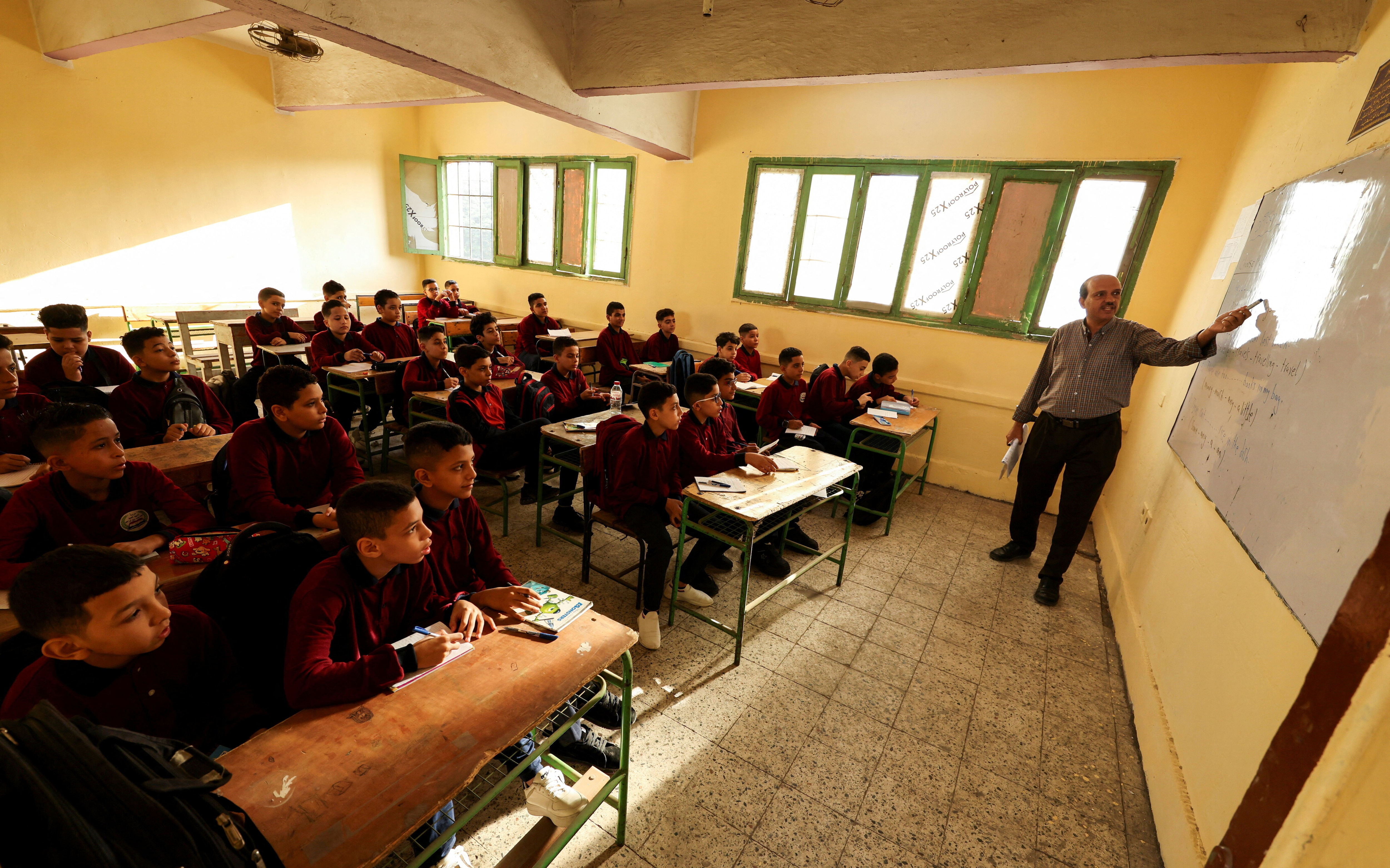
Egypt's education system saw an intense overhaul in 2025, improving outcomes for pupils. Image: Reuters/Mohamed Abd El Ghany
Mohamed Abdel Latif
Minister of Education of Egypt, Ministry of Education and Technical Education of Egypt- Egypt's education system has faced challenges like declining attendance that have limited opportunity for students and held back national competitiveness.
- 2025 saw Egypt's education sector undergo intense transformation grounded in verified national data and carried out through coordinated, practical action.
- The African country hopes that its experience will contribute to a broader dialogue on how education systems can recover, modernize and innovate.
Education is the story a nation writes about its future. For many years, Egypt’s story was shaped by difficult realities. Classrooms struggled with declining attendance, teachers were stretched beyond their capacity, and curricula no longer reflected the skills young people needed to thrive.
These challenges limited opportunity for students and held back national competitiveness. They also weakened public trust in the promise that education should offer every child.
In 2025, Egypt decided that this story had to change. The shift began with a simple but profound commitment: every child must have a reason to come to school, every teacher must be supported and present, and every lesson must prepare students for a world that is moving faster than ever before.
From that commitment grew a year of intense transformation grounded in verified national data and carried out through coordinated, practical action.
Transforming Egypt’s education system
One of the earliest signs of progress appeared where it mattered most – students returned to their classrooms. Attendance, which had fallen sharply after the COVID pandemic years, rose again through renewed accountability, strengthened school leadership and a collective effort to make learning meaningful.
Today, national attendance holds above 80% across all pre-university stages. This rise is not merely a numerical recovery. It signals the restoration of a relationship of trust between families and their schools.
At the same time, Egypt confronted the challenge that had undermined learning for years. The country faced a severe teacher shortage that left many classrooms without qualified educators. In 2025, Egypt resolved this shortage through rapid recruitment, redistribution of teaching staff and targeted training.
As confirmed in the national dataset submitted through CAPMAS to international reporting agencies, every core subject classroom now has a teacher. This achievement has reshaped the daily reality of learning for millions of students and strengthens the foundation on which all other reforms depend.
Modernizing data to define and guide education policy
A modern system also requires modern information. For years, Egypt’s international education data remained outdated and incomplete, preventing the full scope of national progress from being visible to global partners. This year, Egypt produced a comprehensive and verified education dataset that reflects the current reality of schools, teachers, learners and infrastructure.
It is a dataset built not only from numbers, but from stories. Behind every figure stands a student whose attendance has improved, a teacher who has returned to the classroom, and a parent who has regained confidence in the system.
These statistics are more than measurements. They are reflections of lived experience, and they guide every decision we make. Policy becomes stronger and more humane when it is anchored in data that truly represents the people it serves.
With the fundamentals stabilized, Egypt turned to the quality and relevance of what students learn. The curriculum reform of 2025 replaced a model centred on memorization with one that encourages reasoning, depth and application.
New textbooks introduced clearer learning progressions and greater alignment with international benchmarks, while teachers received training to support this shift and to help students engage with complex ideas in ways that build confidence rather than anxiety.
A modern education system also depends on digital readiness. Throughout 2025, Egypt expanded smart classrooms, improved connectivity and strengthened teacher digital skills. New digital platforms and assessment tools are helping students practice, explore and demonstrate learning in more authentic ways.
Egypt’s ICT in education indicators have now been formally reported to the International Telecommunication Union, marking a significant step toward transparent and internationally aligned digital monitoring.
Egyptian Baccalaureate prioritizes understanding and creativity
Alongside these improvements, Egypt has begun preparing a transformation at the secondary level that reflects how rapidly the world of work is changing. The Egyptian Baccalaureate, scheduled to begin in 2026, is being designed as a flexible and competency-based pathway that values understanding over memorization and creativity over conformity.
It aims to provide students with opportunities to explore academic and technical interests, engage in problem solving, and use digital tools as part of everyday learning. The programme aligns with global Education 4.0 visions and is intended to open new doors in higher education and employment.
Egypt’s progress reflects a simple principle. Real transformation begins with clear priorities and practical steps. Restoring attendance strengthens trust. Stabilizing the teacher workforce strengthens the system. Modernizing curricula strengthens learning. Expanding digital readiness strengthens opportunity. Improving data quality strengthens decision making. And preparing a new secondary pathway strengthens the future.
There are lessons in this journey for countries facing similar constraints. Large systems can change when reforms focus on what is essential, when implementation is paced and sequenced, and when decisions are guided by accurate, timely data. Egypt’s verified 2025 dataset, shared with international organizations, provides a transparent record of what has been achieved and what remains ahead.
How Egypt’s transformed education system can inspire others
As global conversations increasingly focus on future skills and human capital, Egypt hopes that its experience will contribute to a broader dialogue on how education systems can recover, modernize and innovate.
While international reporting cycles may not yet reflect the reforms of 2025, this moment offers an opportunity to share the progress achieved, highlight the direction of change, and invite engagement with a system that is redefining itself through data, clarity, and determination.
Egypt is ready to share its story not as a finished model, but as a nation determined to redefine what is possible. When classrooms are full, when teachers are present, when data drives policy, and when learning is relevant and future oriented, education becomes a force that lifts an entire society. This is the story Egypt is writing today. And it is a story still unfolding.
How the Forum helps leaders make sense of regional, trade and geopolitical shifts
Don't miss any update on this topic
Create a free account and access your personalized content collection with our latest publications and analyses.
License and Republishing
World Economic Forum articles may be republished in accordance with the Creative Commons Attribution-NonCommercial-NoDerivatives 4.0 International Public License, and in accordance with our Terms of Use.
The views expressed in this article are those of the author alone and not the World Economic Forum.
Stay up to date:
SDG 04: Quality Education


Forum Stories newsletter
Bringing you weekly curated insights and analysis on the global issues that matter.
More on Education and SkillsSee all

Cathy Li and Agustina Callegari
March 20, 2026


