How edge AI can unlock productivity for India’s MSMEs
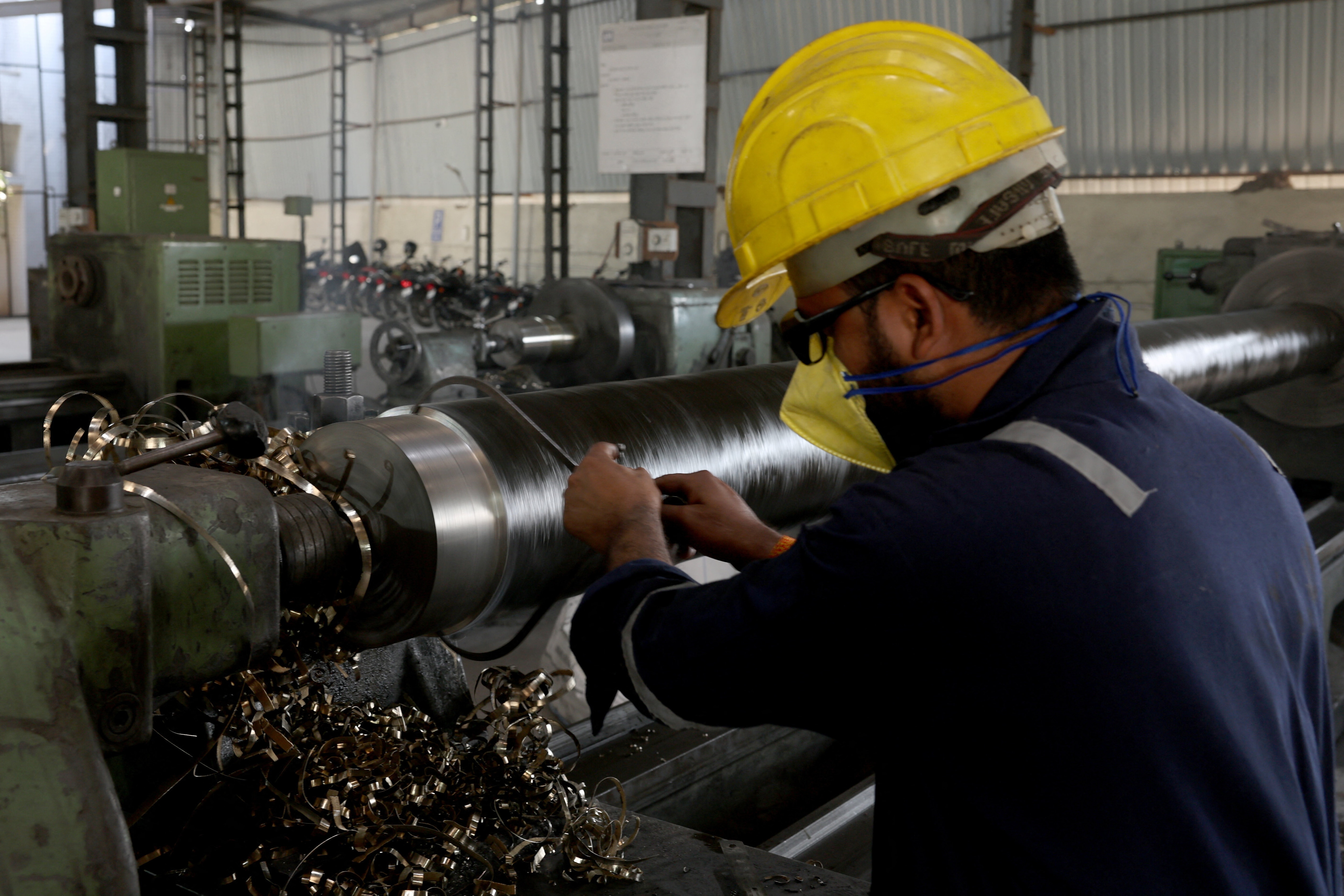
Edge AI is the most viable path for India's small businesses to unlock growth. Image: REUTERS/Amit Dave
- Micro, small and medium enterprises contribute about 30% of India's gross domestic product and support over 250 million jobs; but productivity constraints limit profitability and competitiveness.
- Edge AI is emerging as the most viable pathway for real-time, shop-floor transformation by unlocking improvements in quality, machine maintenance, compliance management and energy efficiency.
- Cluster-led deployment models will be critical to scaling adoption since they enable peer learning, shared infrastructure, and ecosystem partnerships.
For years, micro, small and medium enterprises (MSMEs) have been described as the backbone of the Indian economy. The phrase is so often repeated, it risks sounding ceremonial; however, the numbers are unambiguous.
MSMEs contribute nearly a third of India’s gross domestic product and over 250 million jobs. The sector is a critical anchor for India’s manufacturing, services and export competitiveness.
This recognition is now more clearly reflected in policy. India’s 2026-27 Union Budget’s INR 100 billion outlay for MSMEs signals that the next phase of India’s economic trajectory cannot rely solely on large enterprises; growth must be unlocked inside India’s MSME clusters and supply chains.
However, increased productivity is necessary to deliver this shift. This can be measured through reduced machine downtime, lower defect rates, improved energy efficiency, tighter inventory cycles and more predictable output.
India does not lack artificial intelligence (AI) policy frameworks or technology intent, but it does lack translation at scale – the ability to use AI to generate measurable productivity gains on the shopfloor across most MSMEs. Adoption remains uneven and fragmented – execution, not intent, is now the binding constraint.
Why AI is so vital to the future of India's MSMEs
Indian MSMEs today face multiple pressures. Input costs are volatile. Skilled labour is scarce. Compliance requirements are rising. Global buyers are demanding higher quality, greater consistency and traceability. At the same time, competition – domestic and global – is intensifying.
Traditionally, MSMEs have navigated these challenges through experience, intuition and manual oversight. That model delivered resilience but has also reached its limits. Margins are thin, defects are expensive and decisions are often reactive rather than anticipatory.
AI shifts this equation from reactive to predictive. For instance, from fixing machinery once it breaks down to predicting its breakdown and scheduling maintenance accordingly.
Many MSME promoters now describe AI as operating as a de facto co-founder in day-to-day decision-making.
”Instead of seeing it as a futuristic add-on, it needs to be embraced as a tool for everyday decision-making. In our consultations, many MSME promoters now describe AI as operating as a de facto co-founder in day-to-day decision-making.
Beyond augmentation, it reduces defects, anticipates machine failures, optimises energy consumption and stabilises output quality – gains that directly shape profitability and business survival. AI is obviously useful; the question is: which form of AI is viable for India’s MSMEs?
Why AI for MSMEs must be built differently
Most dominant AI architectures are designed for large enterprises with cloud-heavy systems, centralized data lakes and long experimentation cycles. This model does not and cannot map well onto MSME realities.
MSMEs do not have large IT teams or clean data lakes. They operate in environments with intermittent connectivity and decisions must be made in real time. Waiting for cloud processing or building a complex data infrastructure is neither affordable nor practical.
This is where edge AI becomes critical – intelligence sits directly on or near the machine, not in a distant cloud server. Instead of sending production data to the cloud for analysis and waiting for a response, algorithms run locally, on devices connected to machines or production lines. The insight, whether it is a defect, a vibration anomaly or an energy spike, is generated in real time, on the shop floor.
Consider a small auto-components manufacturer in a cluster. Today, quality checks may be manual and periodic. With an edge AI-enabled camera installed on the line, defects can be detected instantly as components move through production.
The system flags inconsistencies immediately, reducing scrap, rework and wasted material. This ensures faster decisions where they matter. In contrast, a cloud-first workflow would require production data to be continuously transmitted to a remote server for processing before an alert is generated.
That adds latency, increases data transfer costs and creates dependence on stable connectivity.
Why piloting in clusters is so essential
In consultation with hundreds of ecosystem partners and MSMEs themselves, the World Economic Forum recently published an AI Playbook for India’s MSMEs. This document reflects the ground realities of Indian MSMEs and proposes a clear, actionable framework to ensure they get timely access to the technology.
However, frameworks only matter when they are tested against reality. This is why piloting in clusters is essential.
MSMEs rarely operate alone – they operate in clusters. For example: automotive components, textiles, food processing, electronics. Firms can share suppliers, skills, labour and challenges. Most importantly, clusters enable learning about peer success.
Ecosystem stakeholders converge on peer learning as the single most important factor motivating MSMEs to try new technologies. Add in the advantages of cost sharing and capability pooling and clusters offer a natural unit for deployment and diffusion of any technology.
Who are India's MSME cluster pilots?
In this context, several industry and ecosystem actors are initiating pilot deployments across MSME clusters in India. Industry bodies such as the National Association of Software and Service Companies (NASSCOM) and the Confederation of Indian Industries (CII) are enabling MSME cluster pilots through Centres of Excellence and smart manufacturing testbeds.
Dozens of technology providers, including the likes of Industry.AI, Flutura, Detect Technologies and Altizon Systems, are working on deploying use cases around visual quality inspection, predictive maintenance, compliance management and energy optimization in industrial settings, including through edge AI.
Moving from playbook to pilot and from pilot to scale is how India’s MSMEs step confidently into their AI edge moment.
”Through its work on AI adoption for MSMEs, the Forum aims to advance a cluster-led approach, including efforts to build cluster-level capacity and recognize early adopters under its MINDS programme.
This framework will serve to generate implementation insights and demonstrate credible, responsible AI adoption pathways for MSMEs. This combination matters because implementation without knowledge sharing does not scale and recognition without capacity building does not sustain.
The intention is to create a feedback loop that encourages adoption while continuously raising standards.
Why the timing is so critical for India’s AI
The timing of this shift is critical. India is positioning itself as a global manufacturing and supply-chain partner at a moment of geopolitical and economic reconfiguration. MSMEs are deeply embedded in this opportunity but only if they can scale productively.
Edge AI provides this precise leverage. If government, industry, technology providers and financial institutions align around cluster-led deployment, shared infrastructure models, early-stage financing and coordinated capacity-building, India can unlock productivity at scale.
Moving from playbook to pilot, and from pilot to scale, is how India’s MSMEs can step confidently into their AI edge moment.
Don't miss any update on this topic
Create a free account and access your personalized content collection with our latest publications and analyses.
License and Republishing
World Economic Forum articles may be republished in accordance with the Creative Commons Attribution-NonCommercial-NoDerivatives 4.0 International Public License, and in accordance with our Terms of Use.
The views expressed in this article are those of the author alone and not the World Economic Forum.
Stay up to date:
Artificial Intelligence
Related topics:


Forum Stories newsletter
Bringing you weekly curated insights and analysis on the global issues that matter.
More on Artificial IntelligenceSee all

Neeti Mehta Shukla
February 27, 2026