Japan’s ‘satoumi’ initiative is reviving seagrass and advancing blue carbon for climate action
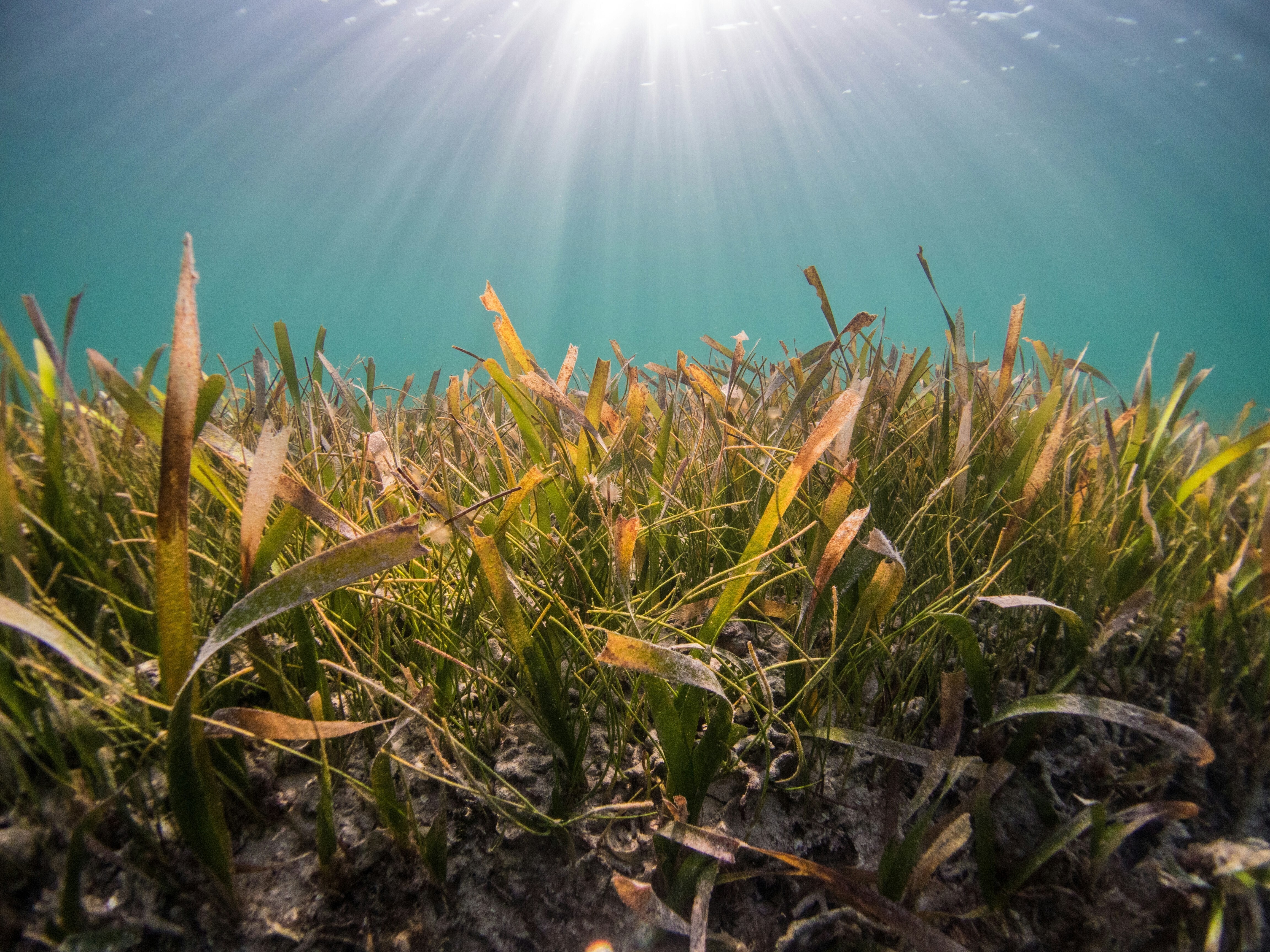
Japan is approaching coastal conservation through the concept of "satoumi," which balances human livelihoods with marine ecosystems. Image: Unsplash/Benjamin L Jones
- Although seagrass meadows cover less than 1% of the ocean, they account for roughly 10% of annual ocean carbon sequestration.
- Japan is approaching coastal conservation through the concept of "satoumi," which balances human livelihoods with marine ecosystems.
- The government of Japan is using the J Blue Credit system to convert blue carbon absorption into tradable credits, encouraging corporate participation.
Seagrass beds, often described as the “forests of the sea,” line coastal areas worldwide, providing habitat and spawning grounds for marine life. They also play a critical ecological role by decomposing organic matter, absorbing nutrients and carbon dioxide, and releasing oxygen that helps maintain water quality.
Although they cover less than 1% of the ocean’s surface, seagrass meadows are estimated to account for roughly 10% of the ocean’s annual carbon sequestration.
In Japan, these ecosystems are gaining renewed attention from a climate perspective. In April 2024, Japan became the first country to include 350,000 tons of carbon dioxide (CO2) absorption from seagrass beds in its official greenhouse gas inventory submitted to the United Nations.
Yet despite their ecological and economic importance, Japan’s seagrass meadows are shrinking. A nationwide survey conducted in 1977 and 1978 recorded 2,076 square kilometres of seagrass coverage, which decreased by 22.1% after 2000.
Satellite-based assessments conducted between 2018 and 2020 show that coverage has fallen to 1,643 square kilometres. Rising sea temperatures, coastal development and grazing damage are among the factors driving this loss.
Japan is therefore repositioning seagrass restoration as a core component of its climate and coastal resilience strategy.
Revitalizing coasts through ‘satoumi’
In February 2025, the Japanese government announced a new climate action plan that sets targets to increase CO2 absorption from blue carbon ecosystems to 1 million tons by fiscal year 2035 and 2 million tons by fiscal year 2040.
Central to this ambition is the restoration and creation of seagrass meadows, alongside the expansion of the “J Blue Credit system” to offset emissions.
These efforts are grounded in the concept of “satoumi,” which is a model of coastal stewardship in which healthy marine ecosystems and human livelihoods coexist in balance.
Under this framework, Japan’s Ministry of the Environment promotes the conservation, restoration and creation of seagrass beds and tidal flats, while leveraging local industries and community participation to address environmental, economic and social challenges simultaneously.
In April 2025, the government issued a practical implementation guide outlining standardized survey and evaluation methods, as well as pathways to link ecological assessment results to financing and institutional strengthening.
The guide features model initiatives, including the deployment of land-cultivated seagrass seedlings to encourage natural seabed attachment and integrated restoration projects that combine sea urchin removal with community engagement to reverse coastal degradation.
Unlocking private-sector participation through blue carbon markets
Market mechanisms are also playing an increasingly important role. The J Blue Credit system certifies CO2 absorption from blue carbon ecosystems and converts it into tradable carbon credits.
Administered by the Japan Blue Economy Association since 2020, the system allows project developers to generate revenue while enabling companies to offset a portion of their emissions. Certified credits have now reached approximately 10,000 tons, reflecting increasing corporate interest.
Private-sector actors are scaling their involvement. Sumitomo Osaka Cement has spent more than two decades developing “seaweed-enhancing reefs” that promote kelp growth.
The company has installed approximately 4,000 units off the coast of Nagasaki Prefecture, generating around 40 hectares of new seagrass habitat. With the introduction of J Blue Credit, the company has strengthened its blue carbon strategy and aims to expand domestically and internationally, targeting JPY 10 billion in blue carbon-related revenue.
The renewable energy firm Influxe is pursuing a complementary approach in its blue carbon business. By supplementing iron fulvate, a nutrient historically supplied to coastal waters through river systems but reduced as a result of flood control infrastructure, the company seeks to restore marine productivity and combat “isoyake,” or coastal barren grounds.
Beginning with pilot projects on Izu Oshima, the company is partnering with offshore wind developers and fisheries cooperatives to link ecosystem restoration with regional economic revitalization through blue carbon credits.
Japan’s approach illustrates how integrating ecosystem restoration into national climate strategy, supported by market mechanisms and digital innovation, can create a scalable model for coastal regions globally.
”From digital innovation and national strategy to global model
Technological innovation is further accelerating progress.
Traditionally, seagrass monitoring required divers and expert analysis, with surveys taking up to two days per hectare. As part of its Ocean Digital Twin initiative, Fujitsu has developed autonomous underwater drone navigation technology capable of high-precision data collection, alongside AI-based tools that identify seagrass species and coverage with more than 85% accuracy.
The system reduces measurement time by approximately 100-times and supports streamlined certification for blue carbon credits.
Restored seagrass ecosystems deliver benefits that extend beyond carbon sequestration. They strengthen fisheries, enhance biodiversity and improve coastal resilience against storm surges and erosion. In doing so, they demonstrate how nature-based solutions can align climate mitigation, economic revitalization and community resilience.
Annually, 1 March marks the UN-designated World Seagrass Day to highlight that enhancing ecosystems are critical to achieving the Sustainable Development Goals.
Japan’s approach illustrates how integrating ecosystem restoration into national climate strategy, supported by market mechanisms and digital innovation, can create a scalable model for coastal regions globally.
The revitalization of satoumi shows that restoring marine ecosystems is not only an environmental imperative, but also a pathway to climate resilience, economic renewal and nature-positive growth.
Don't miss any update on this topic
Create a free account and access your personalized content collection with our latest publications and analyses.
License and Republishing
World Economic Forum articles may be republished in accordance with the Creative Commons Attribution-NonCommercial-NoDerivatives 4.0 International Public License, and in accordance with our Terms of Use.
The views expressed in this article are those of the author alone and not the World Economic Forum.
Stay up to date:
Ocean
Related topics:


Forum Stories newsletter
Bringing you weekly curated insights and analysis on the global issues that matter.
More on Nature and BiodiversitySee all

Adriana Mata and Judith Ketelslegers
April 9, 2026


