How Cape Town is addressing the hidden urban and human costs of on-demand delivery
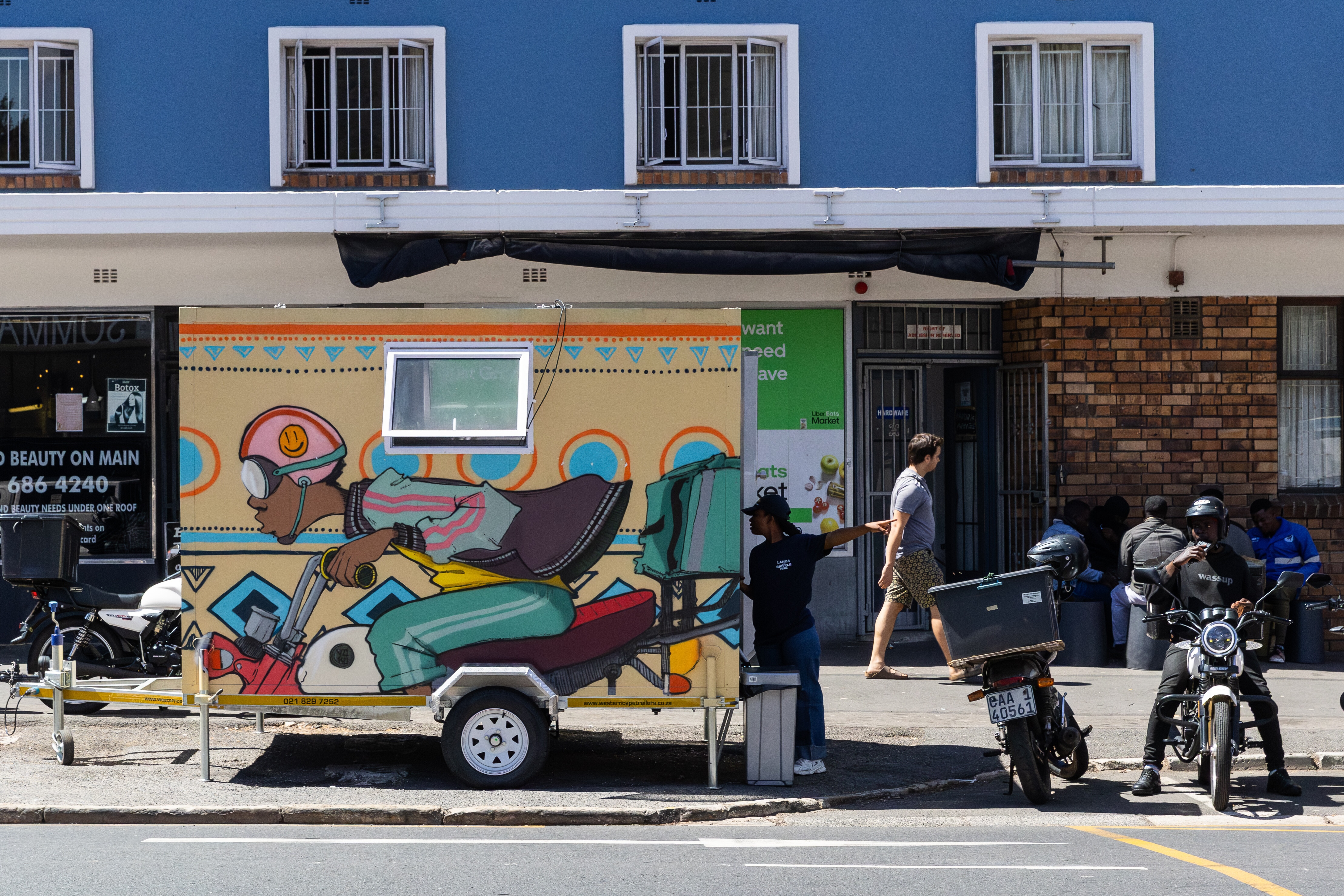
On-demand delivery in Cape Town has created opportunities as well as pressures Image: Ashraf Hendricks
Shabari Shaily-Gerber
Head, Urban Economic Development South Africa, Foreign and Commonwealth Office of the United Kingdom- Rapid on-demand delivery growth in South Africa has created thousands of income opportunities but has brought serious trade-offs, including traffic, emissions and precarious working conditions.
- The City of Cape Town and private businesses have attempted solutions to address the problems associated with on-demand delivery but they remain lacking and unsustainable.
- A pilot initiative is testing micro-mobility hubs that provide facilities to aid drivers and reduce pedestrian congestion and other problems.
Mobile-app innovations have changed our cities. In Cape Town, this impact is visible on the streets, as an increasing number of delivery bikes are becoming integral to its urban logistics.
With an estimated 50,000 scooter delivery vehicles operating across South Africa (3,800 of them electric vehicles (EVs)), last-mile deliveries have created jobs in a struggling economy, with the majority of these opportunities concentrated in the major metros such as Cape Town.
However, the uptick in delivery vehicles has come at an environmental cost, with increased traffic congestion and a social cost, including drivers' precarious working conditions.
The rise of on-demand delivery in Cape Town
On-demand delivery via mobile apps started in South Africa in 2016. Within five years, it had quickly ballooned into a major industry, currently valued at ZAR 14 billion, with significant projected growth in market share compared to traditional retail.
The strength of the on-demand delivery market has led to a concomitant increase in micro-entrepreneurs joining platforms as drivers.
Much like the e-hailing sector, platform providers have designed their systems on the assumption that micro-entrepreneurs are constantly on the go, collecting and dropping off deliveries.
However, this is not the case in developing economies such as Cape Town and South Africa. Each business day has clear peaks and troughs in demand, while supply remains high.
In Cape Town, delivery scooters are concentrated in commercial areas for much of the day. Many businesses and shopping centres using delivery services do not permit drivers to use their facilities for bathroom breaks, rest or recuperation, as they prioritize traditional customer footfall in their establishments.
With absent public infrastructure serving drivers’ needs, public urination is common, scooter engine repairs take place on the sidewalks and drivers have to bear the full range of weather conditions with whatever cover is available.
Why solving on-demand delivery problems is hard
A 2025 systematic review in the Journal of Transport and Health concluded that last-mile delivery drivers consistently showed higher risk of injury, mental health issues and other psychosocial outcomes.
The vulnerability of drivers affects other urban residents as well, particularly in how public space is used and experienced. When drivers lack access to basic facilities such as toilets, shelter, or organised parking, sidewalks can become informal waiting and repair zones.
Pressure has been mounting on city governments to provide more public toilet infrastructure, convert public parking bays to accommodate scooters and deploy law enforcement to deter the negative impact on pedestrian infrastructure.
The City of Cape Town has gone some way towards adapting public spaces to this new micro-mobility freight distribution model but these government solutions are not sustainable.
While it relies on reallocating scarce public space and ongoing municipal management, the reality is that on-demand delivery is replacing traditional shopping trips. As a result, interventions remain piecemeal, while constrained budgets and slow, and complex regulatory processes make it hard for the government to keep pace with a rapidly evolving, market-driven system.
Likewise, we have seen private-sector actors respond with solutions tailored to their own needs. Major supermarket chains have designated cover, Wi-Fi and mobile charging ports to provide opportunities for rest at a handful of their locations.
These are exclusive in nature, are located on private property and tend not to serve multiple individual owner-drivers but rather a single-company structure.
The public realm remains a challenge. Globally, last-mile deliveries are expected to increase carbon emissions by 60% by 2030, according to a World Economic Forum report.
With limited access to EVs, the unregulated fleet of delivery bikes will continue to pose an environmental challenge in cities and will require strategic interventions that protect jobs and foster vibrant, healthier and safer public spaces.
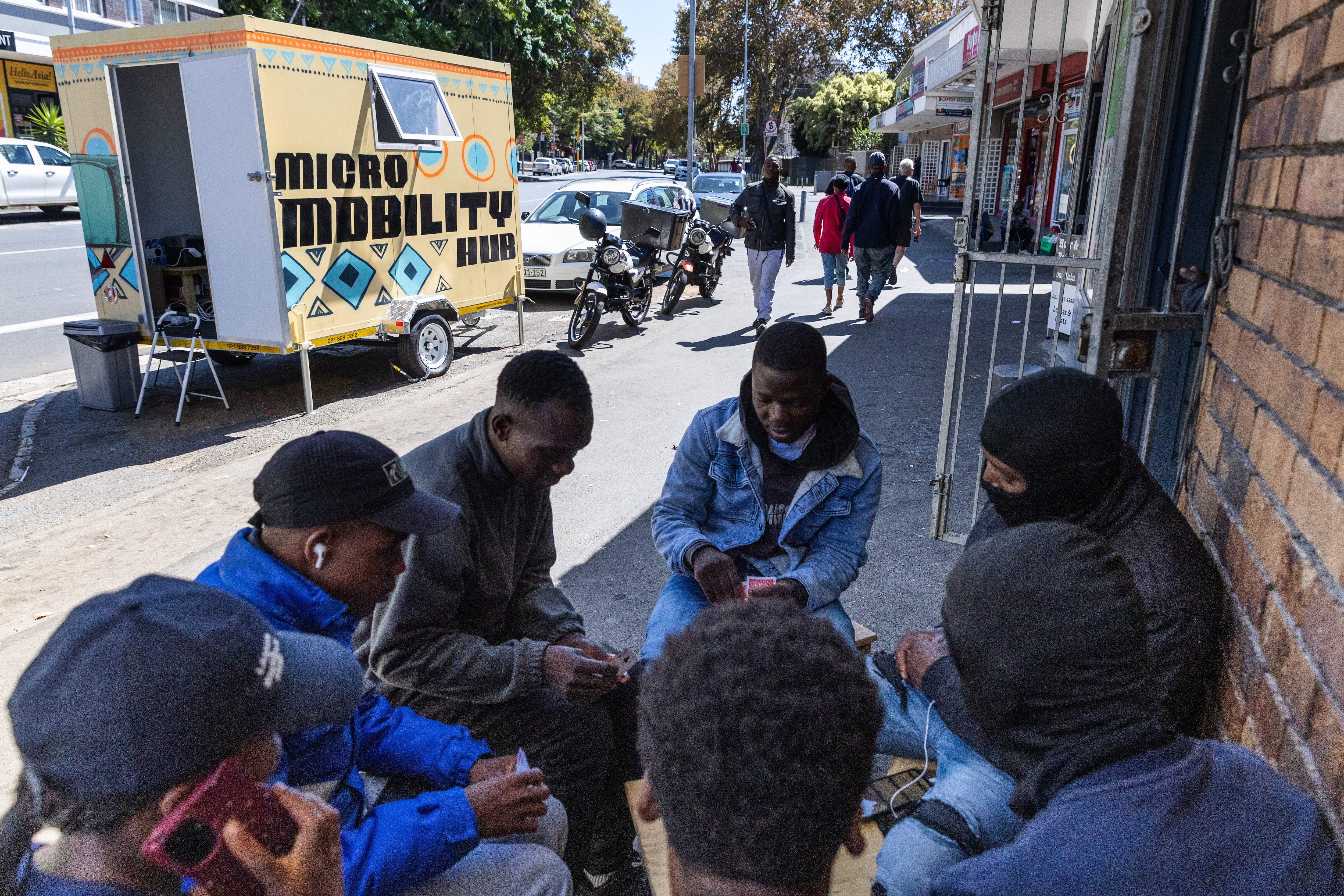
Micro-mobility hubs a potential solution
To address the dearth of locally relevant data demonstrating possible solutions to this multifaceted challenge, a recent workshop hosted by the University of Cape Town brought together local government officials, a local shopping centre operator, UberEats Marketplace and civic partners to explore a pilot of micro-mobility hubs in South Africa’s capital.
The pilot, funded by the UK Government’s Foreign, Commonwealth & Development Office, aims to test scalable, cross-sector responses to the negative externalities of decentralized micro-freight distribution.
The intervention is intentionally simple but strategically positioned: the provision of shade, toilet access, drinking water, Wi-Fi and plug points for phone charging at two high-demand delivery nodes in Cape Town.
Beyond basic amenities, the hubs aim to function as managed staging areas, helping to organize scooter parking, reduce sidewalk congestion, create safer pedestrian conditions and provide a dignified waiting environment for drivers during off-peak periods. The pilot also generates data on usage patterns, peak times, rider needs and spatial impacts.
While still early days, some initial insights are unsurprising: there is deep mistrust among drivers, shaped by years of precarious working conditions and compounded by xenophobia and fears of hidden agendas. In addition, riders make keen use of practical services such as free Wi-Fi, water and toilets.
Yet beneath these basic needs lies far greater potential. If hubs are expanded across the city and designed to include additional services and partnerships, they could become a new layer of urban freight infrastructure that supports decentralization and supports micro-enterprises.
The real opportunity is to create the conditions for collaboration between platform companies, city governments, retailers and property owners to co-design these spaces and unlock creative funding models. This pilot may be small but the structural need is undeniable and cities cannot afford to wait much longer to respond.
Don't miss any update on this topic
Create a free account and access your personalized content collection with our latest publications and analyses.
License and Republishing
World Economic Forum articles may be republished in accordance with the Creative Commons Attribution-NonCommercial-NoDerivatives 4.0 International Public License, and in accordance with our Terms of Use.
The views expressed in this article are those of the author alone and not the World Economic Forum.
Stay up to date:
Cities and Urbanization


Forum Stories newsletter
Bringing you weekly curated insights and analysis on the global issues that matter.
More on Built Environment and InfrastructureSee all

Guy Grainger
March 3, 2026


