Japan’s family structure is changing – and reshaping children’s lives and communities
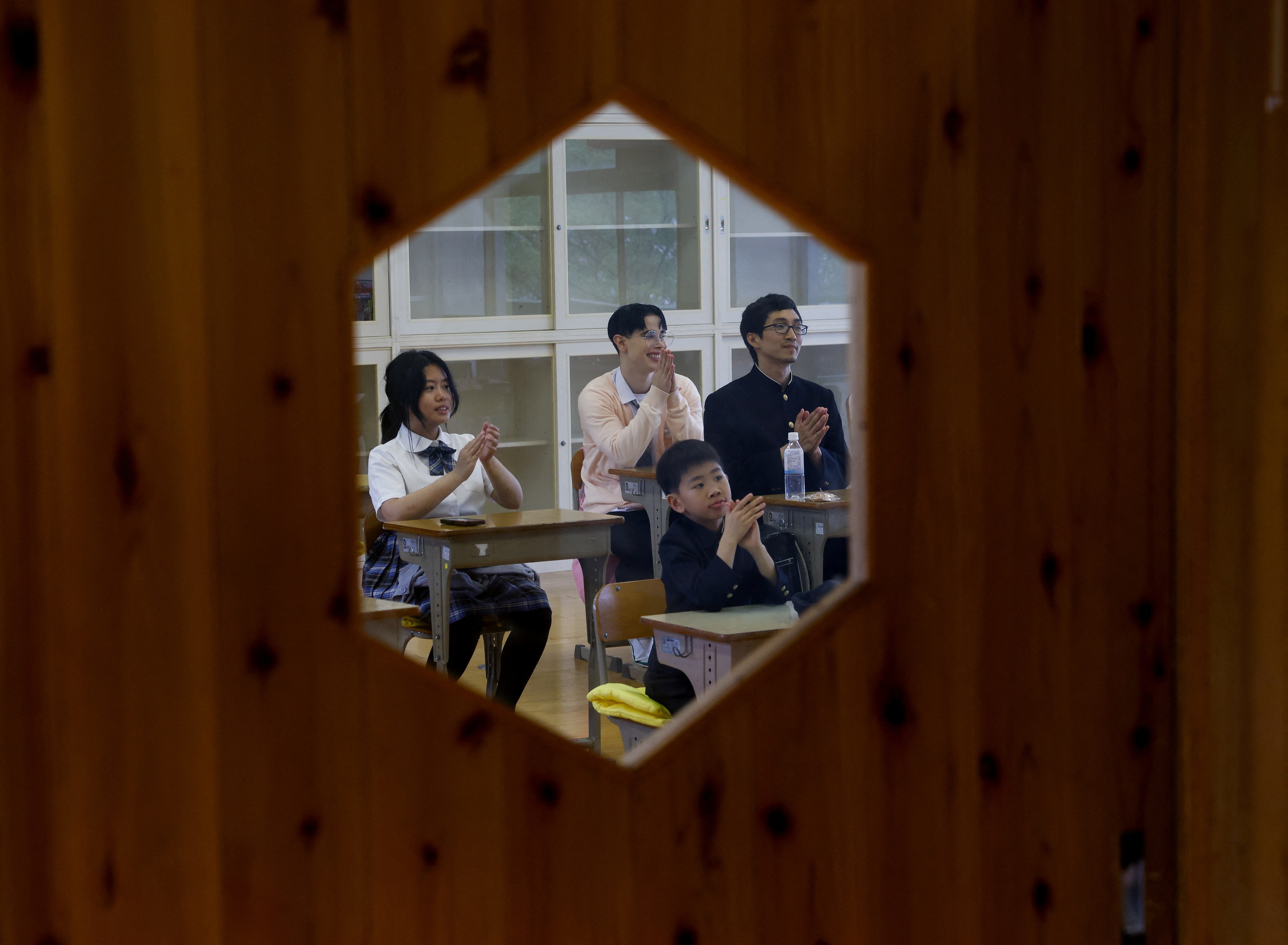
The lives of Japanese children are changing, as the rise in dual-income homes means more of them are spending time outside their homes. Image: REUTERS/Manami Yamada
- In Japan, more families than ever are dual income, meaning both parents are often working out of the home.
- That shift impacts children – who are spending more time than ever outside the home.
- Japan is adapting to this shift, and providing support for families while securing and enriching how children live in their communities.
As dual-income households become more prevalent in Japan, systems that support families with children are undergoing significant transformation.
In recent years, collaboration among national and local governments, businesses and community groups has expanded efforts to support children at the community level. These initiatives not only help working families, but are increasingly seen as an important foundation for strengthening broader social resilience.
According to the annual results of the Labour Force Survey released in 2025 by Japan’s Statistics Bureau, the number of dual-income households continues to rise, highlighting structural shifts in the country’s labour market and family dynamics. The survey shows that the number of dual-income households reached 13 million, an increase of 220,000 from the previous year’s 12.78 million. By contrast, households with a full-time homemaker totaled 5.08 million – 90,000 lower than the previous year, meaning dual-income households now outnumber them by roughly 2.6 times. The survey also reports that approximately 60% of dual-income households include children.
While the number of dual-income households has grown, Japan is also characterized by a relatively high proportion of women working part-time within those households. There are 4.96 million households in which both spouses work full-time for 35 hours or more per week, compared with 5.36 million households in which the female partner works part-time, exceeding the number of full-time dual-income households. Regardless of employment arrangements, the increasing prevalence of dual-income families with children reflects broader changes in Japan’s child-rearing environment.
Children' s environments are also changing. Along with social shifts including the widespread use of mobile phones and social media, longer parental working hours mean that children are spending more time outside the home. As a result, there is growing demand for integrated support systems that ensure children’s safety while supporting their development. In response, initiatives that bring together public, private and community actors to support children collectively are gaining increasing attention in Japan.
Expanding after-school care social infrastructure
One of the most prominent responses to these changes has been the expansion of after-school care programmes, both public and private, that provide care for elementary school students after classes. As dual-income households increase, enrolment in after-school programmes has steadily grown. In fiscal year 2024, the number of registered children reached a record high of 1,570,645, an increase of 50,693 from the previous year.
At the same time, waiting lists remain a significant challenge. The number of children unable to secure a place reached 16,330, and capacity shortages and the need to expand childcare infrastructure remain pressing issues for many municipalities.
In response, Japan’s Children and Families Agency announced the Comprehensive Package for After-School Care 2026 in December 2025, aimed at reducing waiting lists. With rising female labour force participation, the number of registered children in after-school care programmes is projected to peak at around 1.65 million by 2030. The government is therefore working to expand capacity and diversify care provision. One of the policy’s key pillars is the development of new childcare models that leverage corporate and community partnerships to provide services beyond elementary school facilities.
Private-sector involvement is already growing, with private companies accounting for approximately 12% of after-school care services. One example is After-School GakuDo Kengun School, which opened in April 2024 in the Kengun shopping district of Kumamoto City. Operated by a local gymnastics school, the facility was established with the aim of revitalizing the shopping district while also providing care services for children. Through experiential programmes offered by local businesses, the facility encourages interaction between children and the surrounding community. It also provides care not only after school but during long school holidays. Initiatives such as these support children’s development while also helping to strengthen local economic and social linkages.
Large companies are also introducing new models of after-school services. The education company Benesse, for example, locates programmes near to senior care facilities, creating opportunities for interaction between elderly residents and children. Other activities they offer include online social studies field trips, providing learning experiences that are difficult for many public programmes to deliver.
Technology-enabled community safety networks
In Shinagawa Ward in Tokyo, elementary school students attending public schools are provided free personal safety alarms equipped with GPS and communication functions known as “Mamorucchi.” When a child activates the alarm, the device connects to the Mamorucchi Centre located at the Shinagawa Ward office. Depending on the situation, notifications are sent to parents, teachers, local volunteers, community safety patrol members or the police. The initiative began in 2005 and has continued to evolve through updates developed with telecommunications company KDDI based on user feedback.
Similarly, the service “otta”, which connects municipalities, businesses and residents in a community-wide child monitoring network, has been expanding across Japan. The system uses dedicated receivers installed at monitoring points and in taxis to track children’s locations and create a local safety network. In Shimabara City in Nagasaki Prefecture, approximately 90% of lower-grade elementary school students use the service. In Minoh City in Osaka Prefecture, reports of suspicious approaches to children and purse-snatching incidents have reportedly been reduced by half since the system was introduced.
From family support to social resilience
As dual-income households become more common, strengthening community involvement in supporting families with children can help ensure that children remain safe even when parents are not present. Systems in which residents, businesses and local governments collaborate to support and safeguard children not only assist working families but also strengthen social cohesion and trust. Over time, such initiatives can contribute to building more resilient, inclusive and sustainable communities.
Don't miss any update on this topic
Create a free account and access your personalized content collection with our latest publications and analyses.
License and Republishing
World Economic Forum articles may be republished in accordance with the Creative Commons Attribution-NonCommercial-NoDerivatives 4.0 International Public License, and in accordance with our Terms of Use.
The views expressed in this article are those of the author alone and not the World Economic Forum.
Stay up to date:
Changing Customers and Demand
Related topics:


Forum Stories newsletter
Bringing you weekly curated insights and analysis on the global issues that matter.
More on Geographies in DepthSee all

Dan Cowen and Oscar Yang
March 30, 2026