Now we know investing in nature generates returns. Here are 50 opportunities to watch

The question is not whether investing in nature makes sense – but where the right opportunities are. Image: Getty Images/iStockphoto
- With the nature-positive economy potentially worth $10 trillion annually, the business case for green investing is obvious.
- The new Investible Opportunities for a New Nature Economy report sets out 50 rigorously assessed green focus areas for investors.
- Unlocking their full potential will depend on financial institutions identifying, financing and scaling up these opportunities.
For financial institutions, nature is increasingly becoming a material financial issue. Economic activity across sectors relies heavily on natural systems including land, freshwater, oceans and biodiversity. As these systems come under growing pressure from resource depletion, pollution, climate change and land use change, companies are facing rising operational risks that can directly affect revenues, supply chains and long-term asset value. These pressures ultimately flow through to company performance and investment portfolios.
At the same time, the economic opportunity linked to investing in nature is becoming increasingly clear. Research suggests the nature-positive economy could generate more than $10 trillion in annual business value by 2030. The broader green economy, largely focused on decarbonization and the energy transition, already represents nearly $8 trillion in listed equity market value and has outperformed global equities by roughly 59% since 2008. The question is therefore no longer whether investing in nature makes financial sense. The real question for investors is where these opportunities sit within the real economy and how capital can be deployed to capture them.
Nature is the keystone infrastructure regulating our planetary system, and therefore also our economy. Science is very clear about the fact that we need to rethink our economy around nature – our most important capital and the basis for human health and well-being. This requires understanding, valuing and investing in nature to transform our economy, building resilience and adapting it to the new normal we have entered, rather than to offset for its failure. We are committed to deploying private capital at scale before we reach irreversible tipping points.
—Hubert Keller, Senior Managing Partner, Bank Lombard Odier & Co., Switzerland”The breakthrough: 50 investible opportunities
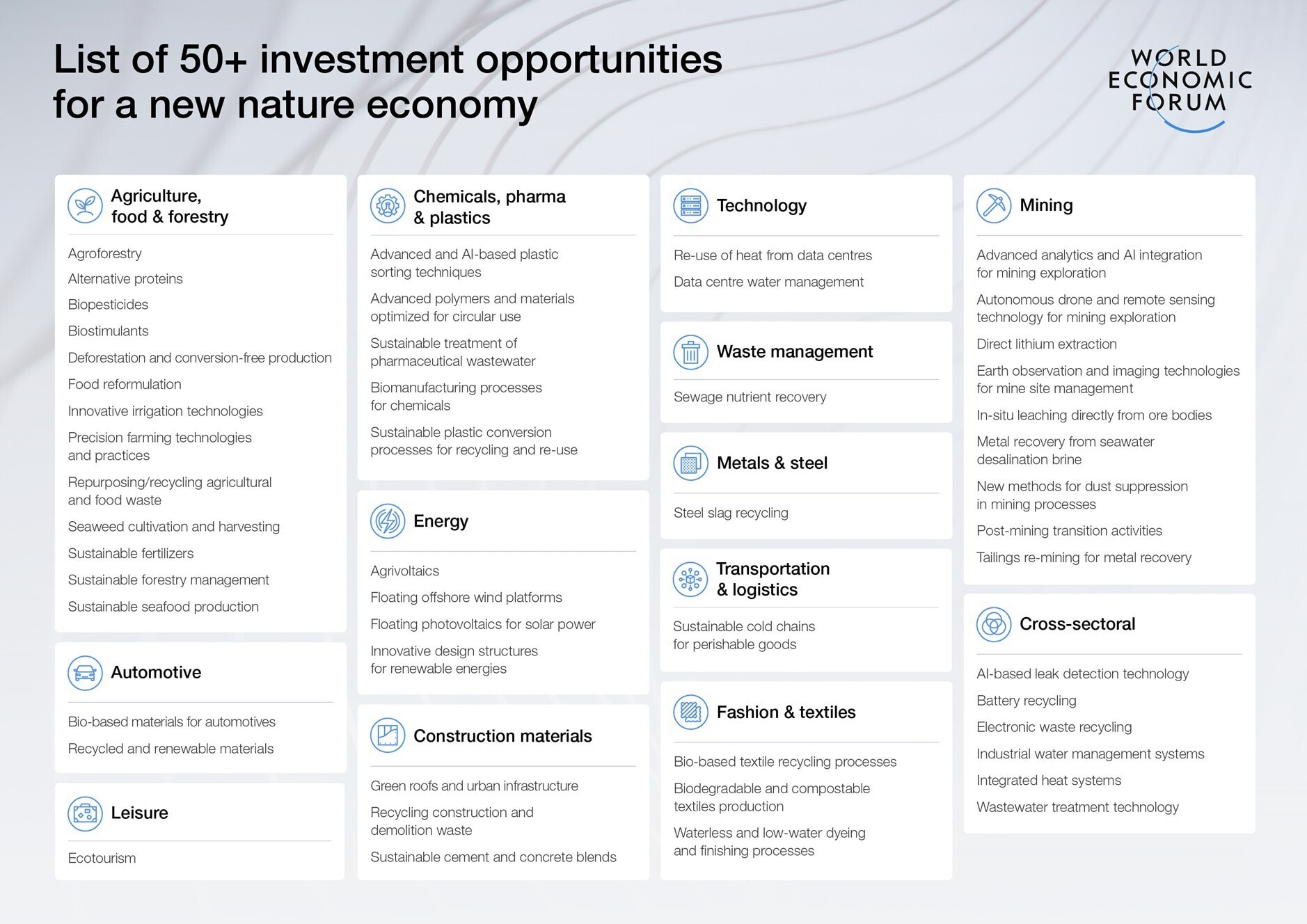
This is exactly what the Investible Opportunities for a New Nature Economy report set out to address. The report identifies 50 opportunities that generate strong financial returns or significant cost savings. They are spread across 13 sectors that play a major role in the global economy and have significant impacts on nature: agriculture, food and forestry; automotive; construction materials; chemicals, pharmaceuticals and plastics; energy; fashion and textiles; mining; technology; leisure; metals and steel; transportation and logistics; and waste management.
Each opportunity has been rigorously assessed based on its market outlook, technological maturity, capital intensity and scalability, alongside both environmental and financial outcomes. The analysis also mapped where each opportunity sits within industry value chains, identified the key actors involved and examined where capital is required and what types of financing instruments could support deployment. This makes the opportunities far more tangible for investors assessing risk, return and implementation pathways.
To further clarify the landscape, the report groups opportunities into four archetypes: operational uplifts, scalable opportunities, emerging innovations and ecosystem enablers. This structure helps financial institutions understand how different types of capital can support different opportunities. Some are ready to scale today and can be financed through conventional lending or corporate investment, while others may require venture capital, blended finance or coordinated action across value chains to reach commercial scale.
At ING, we recognize the interdependencies between nature, climate and social topics. That’s why we’re embedding nature into our business decisions, and supporting clients to drive down pressures on nature, like deforestation and pollution. At the same time, we aim to use our financing to help clients build up the nature-based solutions that protect and restore biodiversity and help society mitigate and adapt to climate change
—Anne-Sophie Castelnau, Global Head, Sustainability, ING Group, Netherlands”Case studies
For financial institutions, these 50 opportunities represent practical entry points for investment teams, lenders and sustainability specialists looking to originate deals, structure financing and integrate nature-positive opportunities into portfolios and strategies. Let’s zoom in on two examples:
- Data centre water management is one focus area. As digitalization and AI accelerate, global capital expenditure on data centres is projected to exceed $1 trillion by the end of the decade. These facilities rely heavily on water-intensive cooling systems, creating growing pressure on freshwater resources in many regions. The report highlights technologies and operational practices that improve cooling efficiency and reduce water withdrawals, helping companies lower operating costs while mitigating resource risks. For financial institutions, this creates opportunities to finance infrastructure upgrades, efficiency technologies and new cooling solutions as demand for data capacity continues to expand.
- Another opportunity lies in precision farming technologies. Agriculture remains one of the largest contributors to land degradation, water stress and biodiversity loss, yet it is also central to the global economy. Precision agriculture integrates data analytics, sensors and automated systems to optimize fertilizer, pesticide and water use. By improving input efficiency and crop yields, these technologies can increase farm profitability while reducing environmental pressure. For investors and lenders, the growth of agricultural technology companies and digital farming platforms represents a rapidly expanding market that can support both productivity gains and more resilient food systems.
Turning 50 opportunities into investments: the role of financial institutions
Identifying opportunities is only the first step. Unlocking their full potential will depend on how individual financial institutions identify, finance and scale these opportunities. The report outlines five priority actions for financial institutions: integrate nature-positive opportunities into core investment and lending strategies; develop pipelines of investible projects across sectors; mobilize capital using a broad range of financial instruments; collaborate across value chains to scale emerging solutions; and build internal expertise to better assess nature-related risks and opportunities.
How the Forum helps leaders align climate action with nature-positive growth
At its core, the report aims to bridge a long-standing gap by demonstrating the specific opportunities where nature impact, business value and investment opportunity can exist together within core economic activities. The opportunities exist, the business case is increasingly clear, and the financing tools are already available. The next step is to turn analysis into action by integrating these opportunities into deal pipelines, structuring financing solutions and mobilizing capital toward industries and technologies that support a nature-positive economy.
As a generational investor, we see nature-positive investing as backing smarter, leaner business models that grow value by using less – less land, less water, less extraction. Such opportunities reduce nature risk at the source while positioning investment portfolios for resilient, long-term returns in a nature-constrained world
—Franziska Zimmermann, Managing Director, Sustainability, Temasek”Don't miss any update on this topic
Create a free account and access your personalized content collection with our latest publications and analyses.
License and Republishing
World Economic Forum articles may be republished in accordance with the Creative Commons Attribution-NonCommercial-NoDerivatives 4.0 International Public License, and in accordance with our Terms of Use.
The views expressed in this article are those of the author alone and not the World Economic Forum.
Stay up to date:
The Net Zero Transition
Related topics:


Forum Stories newsletter
Bringing you weekly curated insights and analysis on the global issues that matter.