Opinion
The Third Pole is thawing. Here's why Pakistan needs action on glaciers now
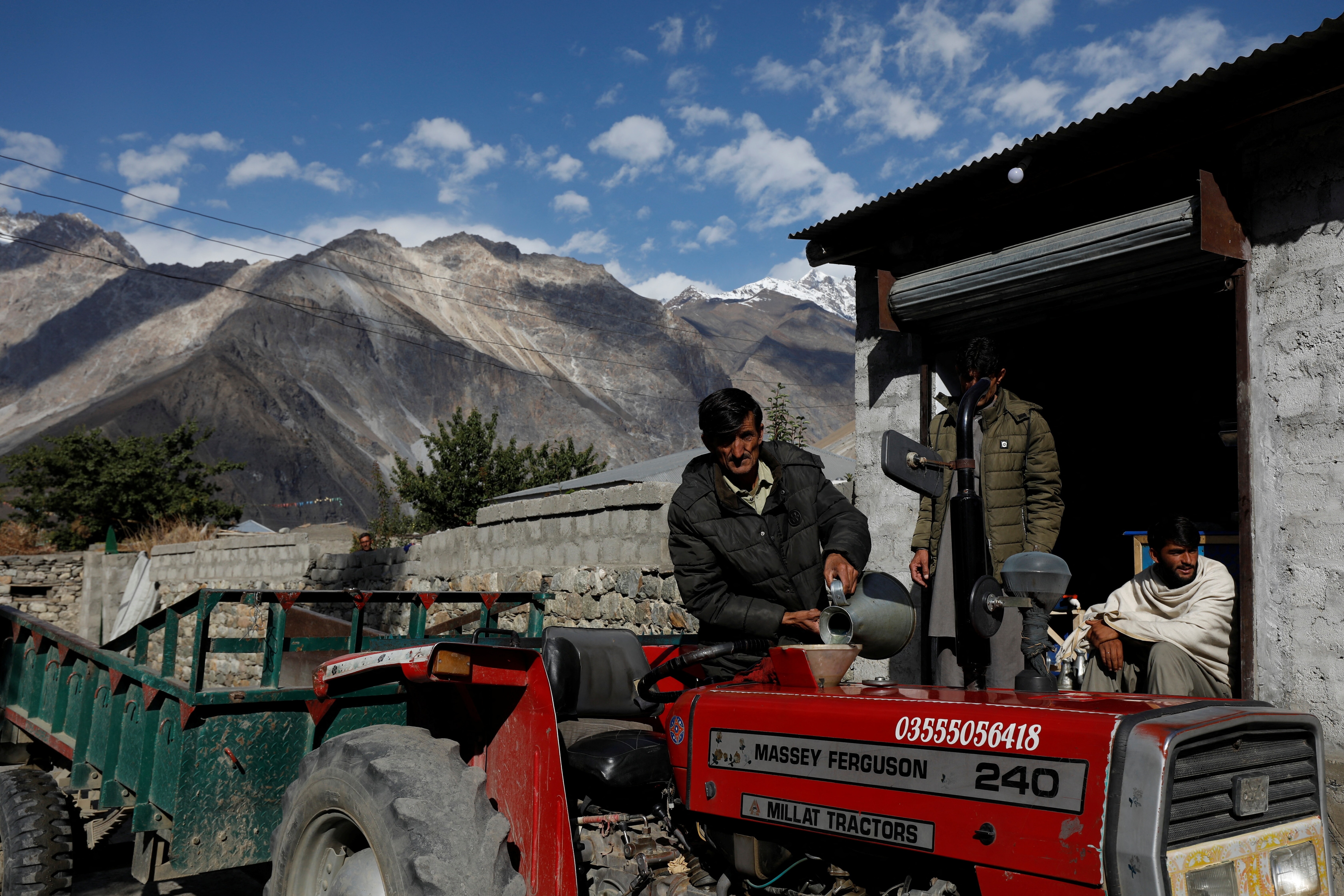
Glaciers melting are threatening livelihoods in regions of Pakistan. Image: Reuters/Akhtar Soomro
- Pakistan's 'Third Pole' glaciers sustain more than 220 million people, irrigate 90% of agricultural land, and generate a major share of hydroelectric power.
- But these same glaciers that have sustained generations of farmers are now threatening livelihoods across borders as they start to melt.
- As we enter the second year of the Decade of Action for Cryospheric Sciences, we must act now to preserve the world's largest non-polar ice reserve.
A glacier that has sustained generations of farmers in Pakistan's Hunza Valley has begun to imperil them, receding by metres annually and now posing a flood risk rather than a promise of irrigation.
As the Decade of Action for Cryospheric Sciences (2025-2034) enters its second year, this valley tells the story of a nation that holds the world's largest non-polar ice reserve but is witnessing its disappearance and still awaiting global action.
The scale of what is being lost demands context. Pakistan is home to the most glaciers in the world outside the Arctic and Antarctica, with those spread across the Hindu Kush Himalaya mountain ranges forming what is accordingly known as the ‘Third Pole’.
They are not merely geographic features; they are the water towers of civilization and the ecological foundation of an entire nation's survival.
'Third Pole' glaciers sustain over 220 million people
Feeding more than 60% of the country's water through glacial melt into the Indus River system, the Third Pole glaciers sustain more than 220 million people, irrigate 90% of agricultural land, and generate a significant share of hydroelectric power.
Their rapid retreat poses a direct and compounded threat to food, water, and energy security, and that retreat is now measurable in real time. Nearly 10,000 glaciers are retreating, creating 3,044 glacial lakes, 33 of which are now deemed highly unstable.
On March 21, 2025, the UN observed the first-ever World Day for Glaciers and simultaneously launched the Decade of Action for Cryospheric Sciences, a 10-year framework for international scientific cooperation to address glacier loss.
In Pakistan, the International Union for Conservation of Nature (IUCN) marked the occasion with a national conservation event, a rare instance of institutional prominence for a situation that seldom receives media attention outside the flood season.
Yet the question is no longer whether the world is aware; it's whether that awareness has led to anything measurable for communities that can't afford to wait.
Impact of the Himalayan glacial melt
Himalayan glaciers have been melting 65% faster since 2010 than in the preceding decade, with melt rates reaching 10-30 metres per year, faster than snowfall can replenish them.
The glacier area across the region has already shrunk by 40% since the Little Ice Age 400-700 years ago, and projections warn that between one-third and two-thirds of the remaining glacial volume could vanish by 2100, depending on warming trajectories.
Increased meltwater through the 2050s may sustain river flows temporarily but raises the risk of landslides and glacial lake outburst floods, jeopardizing food and water security for over a billion people reliant on the Indus, Ganges and Brahmaputra river systems.
The economic toll is already visible as the 2022 Pakistan floods alone erased an estimated 9.8% of the country's gross domestic product (GDP), wiping out years of growth.
Those consequences culminate in three interconnected vulnerabilities. First, water security: the Indus River receives 50% of its annual flow from glacial and snowmelt, yet Pakistan’s per-capita water supply is already approaching the scarcity threshold of 1,000 cubic metres per person.
Second, food and energy security: the Indus system sustains 319 million people across Pakistan, India, Afghanistan and China, while hydropower, dependent on glacial flow, supplies approximately 29% of Pakistan's electricity.
Both are now at risk as melt patterns grow erratic. Its destabilization is a regional catastrophe, not merely a national one.
Third, displacement: communities in Gilgit-Baltistan and Khyber Pakhtunkhwa have relocated twice in the past decade due to unpredictable snowmelt, prompting local men to leave their fields and migrate to cities.
Now the question falls hardest on Pakistan, which accounts for less than 1% of global emissions, yet it suffers more than its fair share of their effects.
Pakistan's efforts to preserve glacier reserves
Despite these mounting pressures, Pakistan has not been a passive observer.
The Glacial Lake Outburst Flood risk-reduction project (GLOF-II), led by the Green Climate Fund and United Nations Development Programme (UNDP), has deployed 218 early-warning systems that transmit real-time data, constructed 411 gabion walls, rehabilitated 317 irrigation channels, and established 60 safe havens across 24 highly vulnerable valleys in Gilgit-Baltistan and Khyber Pakhtunkhwa – benefiting more than 211,000 individuals.
The Recharge Pakistan programme uses wetlands and green infrastructure to mitigate flooding, and the Living Indus Initiative restores 25 Indus Basin ecosystems.
In 2025, Pakistan launched its Glacier Conservation Strategy to preserve glacier reserves and secure future water supplies. Yet the gaps are as significant as the gains.
Early warning systems still cannot reliably predict the timing of glacial lake eruptions, leaving people afraid rather than prepared. The provincial governments in Gilgit-Baltistan and Khyber Pakhtunkhwa lack the funds, skilled labour, and modern tools to address the crisis adequately.
These efforts remain islands of resilience in a sea of unaddressed risk that did not form in isolation. The countries whose emissions are melting the glaciers must now be held to account, not through declarations, but through binding, accessible, and fast-tracked financial commitments.
Why action on glaciers must be a global mandate
The recent World Day for Glaciers encouraged us all to act to preserve the vital role of glaciers in sustaining life on Earth for generations to come – and why action ought to be a mandate, not a commemoration.
Accordingly, as we enter the second year of the Decade of Action for Cryospheric Sciences the global community must now move from declaration to delivery.
Three demands must be met to determine whether that decade delivers tangible benefits for the communities living beneath Pakistan's vanishing ice.
First, glacier data collection on weather patterns, glacial volume and river flow must be mandated within every nation's climate commitments because conclusions made in the absence of precise mountain data are not policy; rather, they are conjecture.
Second, the United Nations Framework Convention on Climate Change (UNFCCC) Loss and Damage Fund must be fully capitalized and restructured quickly, as funds absorbed by administrative layers never reach the displaced families in Gilgit-Baltistan or the farmers in Hunza who need them.
Third, Pakistan must lead a South Asian glacial diplomacy programme that brings India, Nepal, Bhutan, China and Afghanistan to a common governance table on the Hindu Kush Himalaya because glaciers do not recognize borders, and neither can the response.
The glaciers above Hunza are still retreating. Whether the communities beneath it have time to adapt depends less on the ice than on the decisions made in capitals and conference halls far from the valley floor.
The glaciers of the Third Pole will continue to melt regardless of whether the world pays attention. But how quickly they disappear and how well humanity prepares for the implications of their loss remain political choices.
This is Pakistan in 2026. Silence is no longer an option when it comes to action on glaciers.
Don't miss any update on this topic
Create a free account and access your personalized content collection with our latest publications and analyses.
License and Republishing
World Economic Forum articles may be republished in accordance with the Creative Commons Attribution-NonCommercial-NoDerivatives 4.0 International Public License, and in accordance with our Terms of Use.
The views expressed in this article are those of the author alone and not the World Economic Forum.
Stay up to date:
Climate Crisis
Related topics:


Forum Stories newsletter
Bringing you weekly curated insights and analysis on the global issues that matter.
More on Climate Action and Waste Reduction See all

Anurit Kanti
March 23, 2026


