Critical minerals need more than capital. They need targeted de-risking to become investable

With critical minerals, the problem is not simply one of geological scarcity or even capital. It is whether projects are investable in the first place. Image: Getty Images
Tom Moerenhout
Director Critical Materials, Center on Global Energy Policy (CGEP), Columbia University- Demand for critical minerals is rising, but investment is still not scaling where risks, timelines and revenues remain hard to underwrite.
- Because different minerals face distinct barriers, a one-size-fits-all approach often fails.
- Building more resilient and diversified supply will require targeted de-risking tools that can crowd in private capital where it is most needed.
Critical minerals sit at the intersection of energy technology delivery, industrial competitiveness and economic resilience. From copper and lithium for electrification to rare earths for semiconductors, these materials increasingly shape how quickly countries can deploy clean energy, expand digital infrastructure and strengthen security. Demand is expected to rise significantly in the coming years, even as efforts to improve material efficiency, scale circularity and accelerate substitution continue.
Yet the real constraint is often misunderstood. The problem is not simply one of geological scarcity or even capital. It is whether projects are investable in the first place. Many still struggle to attract mainstream private finance because their risk profiles do not align with investor requirements. Long development timelines, high upfront capital needs, permitting complexity, policy uncertainty and weak revenue visibility make projects difficult to underwrite. Copper shows the scale of the challenge: despite a projected supply shortfall of 30% by 2035, investment projections indicate a $250 billion gap by 2030.
This is why the debate needs to move beyond calls for “more capital” and focus instead on what makes projects financeable. In a new report by the World Economic Forum in collaboration with the Center on Global Energy Policy at Columbia University's School of International and Public Affairs (SIPA), we outline a practical framework for closing the bankability gap: one that matches de-risking tools to the specific constraints facing different minerals, jurisdictions and stages of project development.
Start with the real constraint, not a generic funding gap
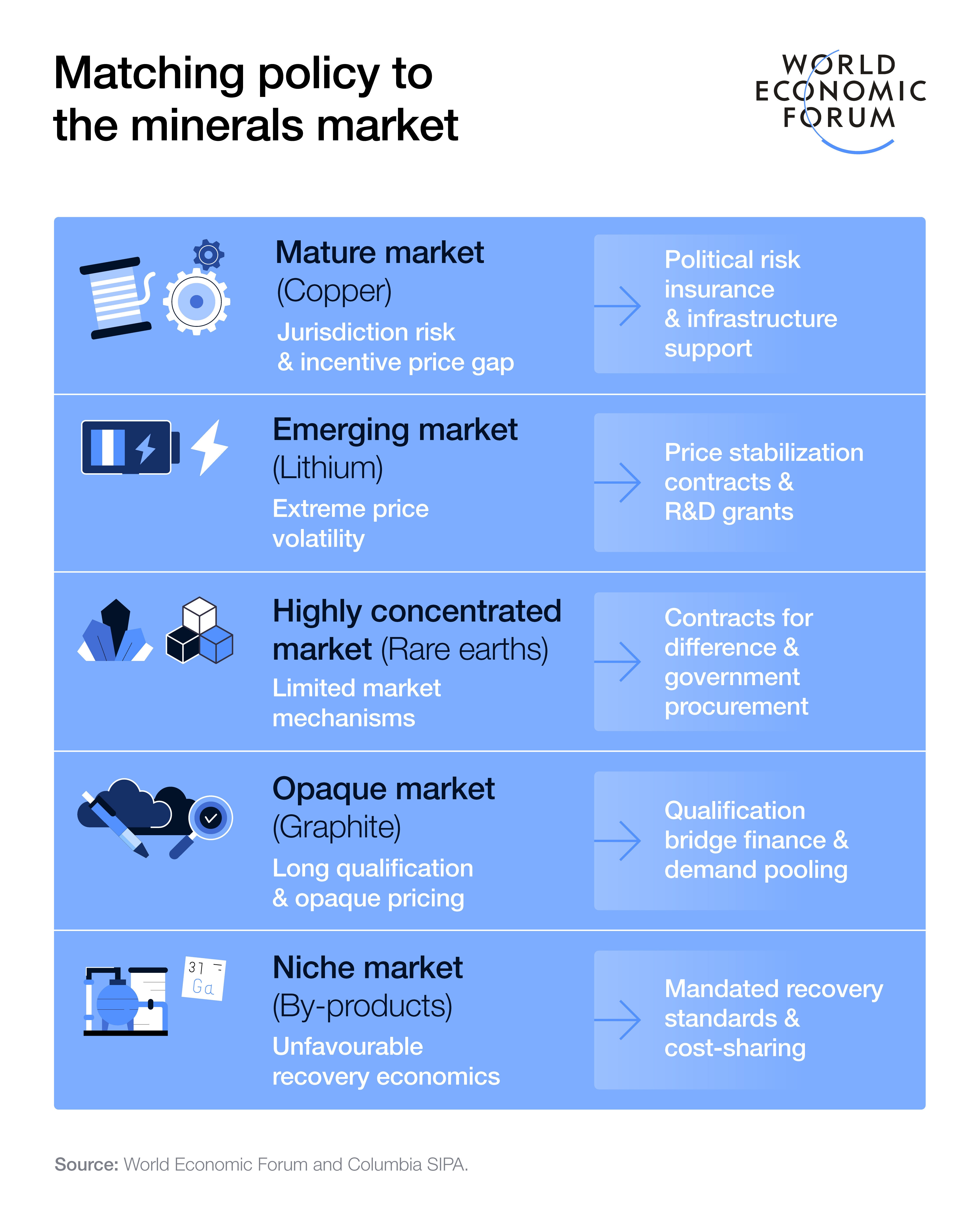
Critical minerals are often treated as a single policy category. In practice, each mineral has its own market structure, pricing dynamics, end uses and risk profile, and those differences matter for bankability. A copper project does not face the same financing barriers as a graphite, rare earths or by-product minerals project.
In mature markets such as copper, the challenge often lies less in price discovery and more in permitting, infrastructure and delivery risk. In emerging markets such as lithium, volatility and limited hedging options can make revenues harder to underwrite over the long term. In highly concentrated markets such as rare earths, new entrants may need stronger demand anchors and revenue support to compete with incumbent suppliers. In opaque markets such as graphite, long qualification cycles, weak benchmarks and uncertain offtake can delay projects even when demand is growing. By-product minerals present yet another challenge: they may be strategically important, but their economics are rarely strong enough on their own to justify dedicated investment.
The lesson is simple: if the constraint differs by mineral, then the policy response has to differ too.
Match the de-risking tool to the bottleneck
This is where policy often misses the mark. Too many interventions are broad, familiar and politically attractive, but not necessarily well matched to the actual barrier holding back investment. When that happens, public support can be expensive without being especially effective; in some cases, it can displace private capital rather than crowd it in.
A more effective approach is to identify what is actually holding a project back and then match the intervention to that problem. If the main issue is early-stage capital expenditure, then upfront capital support may be the right tool. If the problem is weak offtake or poor revenue visibility, then demand anchors or revenue-stabilization mechanisms may matter more. If political or jurisdictional uncertainty is the key deterrent, then risk mitigation instruments may be decisive. And where timelines, infrastructure gaps, or permitting delays are the real issue, structural reforms may matter more than direct financial support.
What matters is not deploying every instrument available. It is to use the minimum fit-for-purpose set of tools needed to close the bankability gap and unlock broader pools of capital.
Sequence support so that public capital unlocks private finance
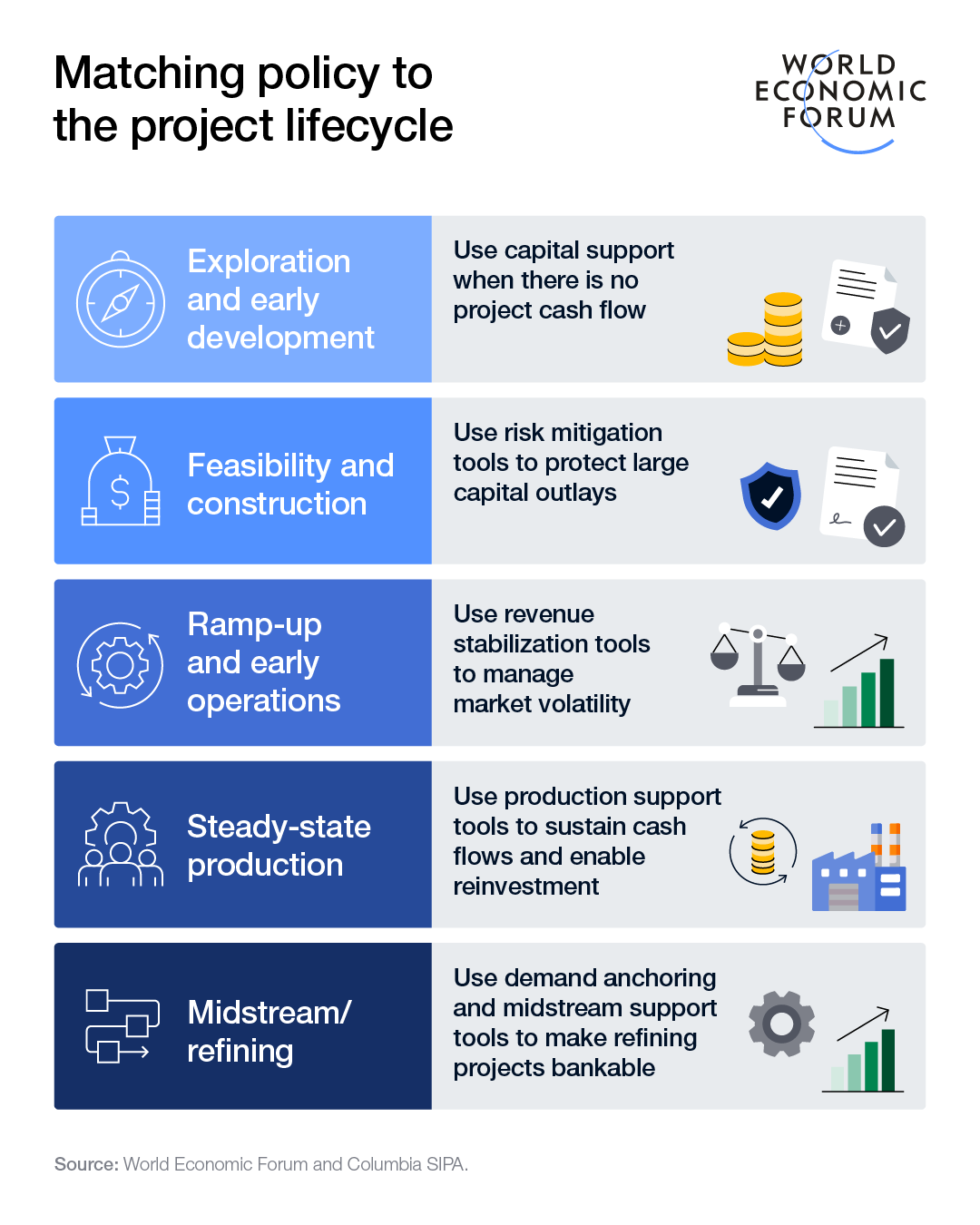
Projects face different barriers at different stages of development. Exploration and feasibility often require capital support because uncertainty is high and there is no project cash flow. Construction may need completion guarantees or other forms of risk sharing. Ramp-up may require revenue stabilization where price volatility or weak benchmarks undermine debt capacity. Midstream refining may need stronger offtake support, while steady-state production may depend more on production tax credits, floor-price mechanisms or strategic procurement in higher-cost markets.
This sequencing is crucial because the goal is to deploy public tools where they are most catalytic and then step-down support as risks decline and projects mature. That is how public finance can strengthen pipelines without undermining commercial discipline.
The same logic applies across jurisdictions. In low-risk, high-governance settings, the binding constraint may be permitting and infrastructure. In medium-risk settings, fiscal stability, foreign exchange tools and political risk cover may become more important. In fragile or highly strategic environments, a combination of guarantees, concessional finance and long-term offtake may be needed before private investors can participate at all.
Allocate risk strategically for resilient supply
The objective is not only to increase supply, but to diversify it. Today, concentration at key stages of critical mineral value chains creates exposure to disruption, with implications for industrial competitiveness, technology deployment and energy security. A more resilient supply base will require clearer risk allocation, more credible policy frameworks and stronger coordination across governments, industry, financial institutions and development finance partners.
If governments want more resilient mineral supply chains, and investors want financeable projects, the answer is not just more subsidies or more generic ambition. It is smarter de-risking: targeted interventions that match the right instruments to the right minerals, in the right jurisdictions, at the right stages. Critical minerals do need capital. But before that, they need a more practical pathway to becoming investable.
Don't miss any update on this topic
Create a free account and access your personalized content collection with our latest publications and analyses.
License and Republishing
World Economic Forum articles may be republished in accordance with the Creative Commons Attribution-NonCommercial-NoDerivatives 4.0 International Public License, and in accordance with our Terms of Use.
The views expressed in this article are those of the author alone and not the World Economic Forum.
Stay up to date:
Materials for Energy

Forum Stories newsletter
Bringing you weekly curated insights and analysis on the global issues that matter.