How the Middle East and North Africa can optimize the region's data centres and AI infrastructure

The MENA region's push into AI and data centres is a complicated endeavour that requires significant investment in infrastructure and smart policymaking. Image: Getty Images
- The Middle East and North Africa region's AI and hyperscale expansion is increasing pressure on electricity grids and water systems.
- The World Economic Forum and SRMG Think have developed a framework to align energy diversification with AI-enabled demand optimization.
- Smarter energy sourcing, efficient cooling and coordinated regulation can help scale digital infrastructure while safeguarding grid stability and resource resilience.
The Middle East and North Africa (MENA) region's rapid AI and hyperscale expansion is increasing pressure on electricity grids and water systems, making sustainable infrastructure planning a strategic necessity.
By integrating smarter energy sourcing, efficient cooling and coordinated regulation, the region can scale digital infrastructure while safeguarding grid stability and resource resilience.
MENA is moving quickly to position itself at the centre of the global AI economy. With AI projected to generate up to $4.8 trillion in economic value by 2033, governments across the region are investing heavily in hyperscale data centres and strategic partnerships with leading technology firms. Sovereign wealth is being channelled into digital infrastructure with a clear ambition: to move from technology consumer to technology shaper.
Scale however brings pressure. Electricity demand across much of MENA is already rising faster than supply. Installed capacity is estimated to require a 40% increase by 2030, yet current trajectories suggest growth closer to 15%. That gap exists before AI-driven demand is fully factored in. Without careful planning, the infrastructure meant to power digital transformation could instead strain grids, intensify water scarcity and unsettle investor confidence.
The question is no longer whether the region can build hyperscale capacity. It is whether it can build it sustainably.
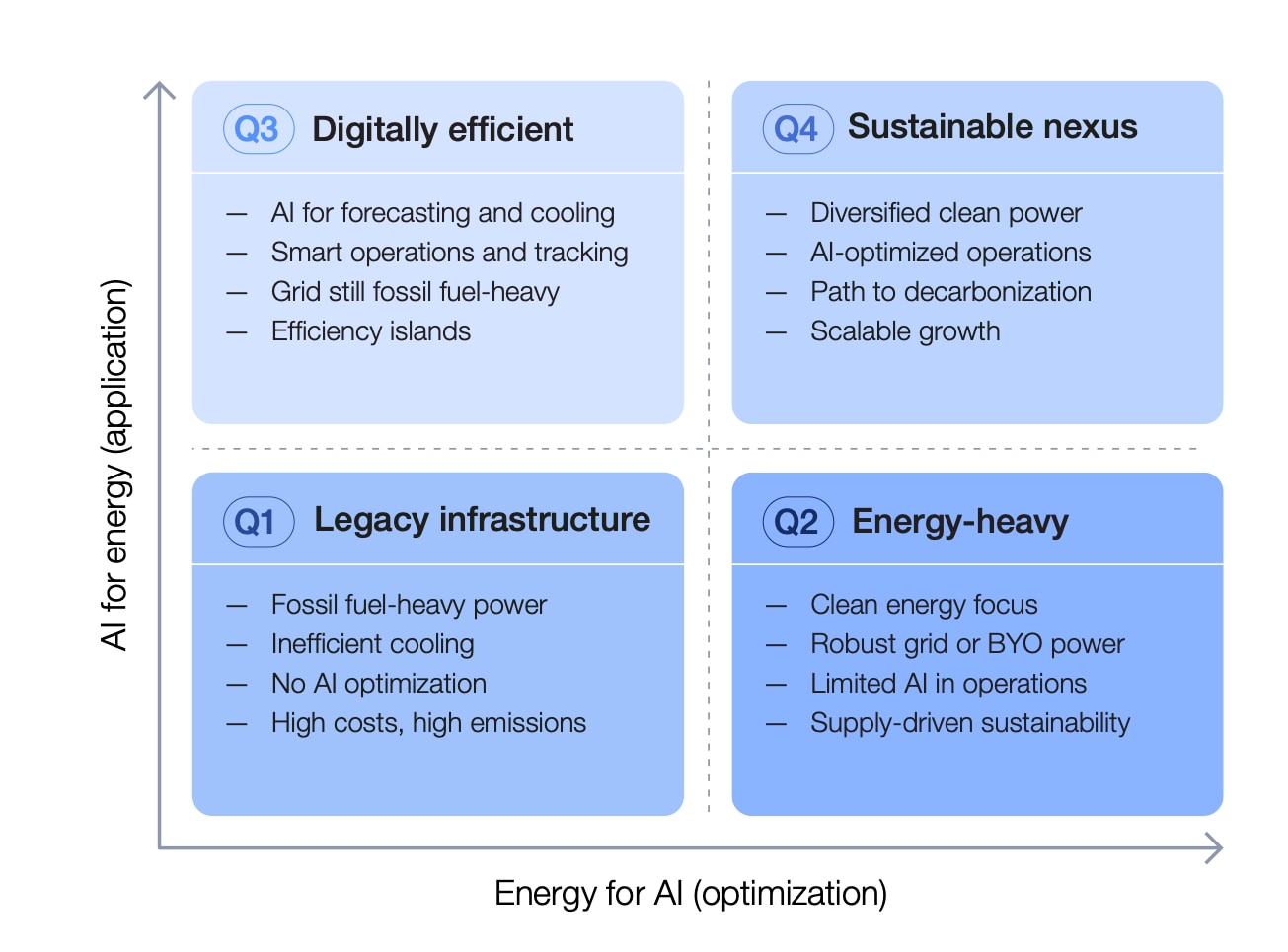
To address this, the World Economic Forum, together with SRMG Think, has designed a practical framework to support the resilient growth of hyperscale data centres and AI infrastructure across the region. Central to this approach is a resource–intelligence matrix that links energy planning with AI-driven demand optimization, helping ensure that expanding computing capacity remains aligned with responsible and efficient resource use.
Moving on from legacy infrastructure
Not all data centres are created equal. Some operate with limited efficiency gains and heavy reliance on fossil fuel-based grids. Others have integrated renewable sourcing, advanced cooling systems and AI-enabled load management.
We find it useful to assess facilities across two dimensions. The first is energy optimization: how power is sourced, diversified and secured. The second is intelligence optimization: how effectively operators use real-time data, automation and predictive analytics to manage demand.
At the lower end of both sits a growing risk: higher exposure to price volatility, vulnerability to grid instability and potential asset stranding as efficiency standards tighten. At the upper end lies the strategic “sustainable nexus.” Facilities in this category typically achieve Power Usage Effectiveness (PUE) below 1.3, integrate climate-adapted cooling systems and participate in demand-response markets. International experience shows that such facilities can reduce operational costs by 30–40%, while improving regulatory approval timelines and access to capital.
This is not simply an environmental upgrade, but rather a competitiveness strategy that should be prioritized by stakeholders. For governments in MENA, benchmarking where facilities sit on this spectrum is an essential first step in ensuring long term resilience and attractiveness. Digital ambition must be accompanied by infrastructure discipline and a clear sense of direction.
Building for adaptation and expansion
Resilient infrastructure is iterative. It is built, monitored and continuously improved.
Modular high-density construction can reduce development timelines – sometimes from two years to roughly one – while preserving flexibility for future upgrades. Embedding capacity for diversified energy inputs and evolving cooling technologies at the design stage prevents costly retrofits later and is a key consideration stakeholders should focus on.
Real-time monitoring is equally important. AI-driven systems can track power draw, cooling efficiency and water use against clear metrics such as PUE, Water Usage Effectiveness (WUE) and carbon intensity. Predictive maintenance reduces downtime. Transparent reporting builds trust with regulators and utilities.
Site selection, often treated as a secondary consideration, is in fact strategic. Grid robustness, access to renewable resources, seasonal free-cooling potential and even repurposed energy infrastructure can significantly alter long-term cost and risk profiles.
In a region where margins of energy and water are tight, these decisions carry national implications and directly impact competitiveness and attractiveness.
Energy optimization: The structural driver
Globally, data centres account for roughly 1%–2% of electricity demand, a share projected to reach 4% by 2030. In MENA, the implications are amplified.
Cooling already represents as much as 70% of residential electricity consumption in some markets. Transmission and distribution losses in parts of the region remain significantly above the global averages, at almost double.
Hyperscale facilities and AI infrastructure add concentrated, high-density demand to this system. AI training workloads are power-intensive and volatile. Without proper grid planning, sudden load spikes can create frequency instability and massive economic losses. This has forced regulators to intervene. In Texas, for instance, grid operators can curtail large data centre loads during emergencies to protect system integrity.
Energy sourcing, therefore, cannot be an afterthought.
Diversification beyond fossil-heavy grids is critical. Behind-the-meter generation – whether solar-plus-storage, hybrid gas systems or emerging low-carbon technologies, including modular nuclear reactors – can improve reliability and ease interconnection bottlenecks. Over time, these systems must align with credible decarbonization pathways.
Demand-side precision is equally important. AI training, inference and cloud services each carry distinct load profiles. Forecasting models and permitting processes must reflect these differences. Properly integrated, hyperscale infrastructure can support renewable integration and grid flexibility. Poorly integrated, it risks compounding stress.
Cooling and water are interlinked challenges in the Middle East
Cooling can account for up to 40% of a data centre’s electricity use. In water-scarce environments, this translates into significant resource implications. A conventional 1 MW facility for instance may consume up to 25.5 million litres of water annually, an amount equivalent to the daily needs of 300,000 people.
No single cooling solution fits every facility. High-density AI clusters may require advanced liquid or immersion cooling. Seasonal free cooling can be viable in select geographies. Hybrid approaches often provide the most resilient balance between cost, efficiency and performance.
Water efficiency, however, must also be treated as a policy issue, not solely an operational one. Conventional evaporative systems can consume 1.5–2 litres per kWh of cooling, particularly in arid climates. Closed-loop systems, dry cooling technologies and the use of treated wastewater can significantly reduce freshwater withdrawals.
There is an additional layer. In much of MENA, desalination requires approximately 3–4 kWh of electricity per cubic metre of water produced. As cooling demand rises, so too does the energy required to produce water. Energy and water planning cannot proceed in isolation.
Governing for scale
Hyperscale expansion cannot be overseen through siloed regulation. The scale, density and volatility of AI-driven infrastructure demand integrated governance that connects energy, water, digital policy and grid planning – along with stronger regional coordination.
The framework calls for a reassessment of how these facilities are governed. Data centres should be recognized as critical, dynamic loads that materially affect grid stability, rather than treated as standard commercial customers. Robust load forecasting, real-time consumption reporting and transparent cost-allocation mechanisms for grid upgrades are necessary to avoid systemic stress and inequitable tariff impacts.
Coordination must move from ad hoc consultation to formalized structures. Dedicated platforms can convene developers, utilities and regulators to manage routine operations and respond to grid stress events, supported by legal safeguards that protect commercial sensitivity while enabling aggregated data-sharing.
The Middle East's digital ambition
MENA’s digital expansion will only be sustainable if infrastructure growth is matched by resource discipline. The Forum–SRMG framework, anchored in the resource–intelligence matrix, provides a practical tool to align energy diversification, AI-driven load management, cooling efficiency and regulatory coordination from the outset.
By integrating these elements into planning and deployment decisions, policymakers and industry leaders across the Middle East can scale hyperscale infrastructure without undermining grid stability or water security.
Don't miss any update on this topic
Create a free account and access your personalized content collection with our latest publications and analyses.
License and Republishing
World Economic Forum articles may be republished in accordance with the Creative Commons Attribution-NonCommercial-NoDerivatives 4.0 International Public License, and in accordance with our Terms of Use.
The views expressed in this article are those of the author alone and not the World Economic Forum.
Stay up to date:
Middle East and North Africa
Related topics:


Forum Stories newsletter
Bringing you weekly curated insights and analysis on the global issues that matter.
More on Artificial IntelligenceSee all

Amanda Wolthuizen
September 22, 2026


