Could AI help the Middle East and North Africa unlock $200 billion in sustainable finance by 2030?

Is AI the key to creating more sustainable finance in the Middle East? Image: Getty Images/iStockphoto
- AI has the potential to unlock much-needed funding to support sustainability transformations globally.
- In the MENA region, AI-driven tools could help mobilize an additional $200 billion in sustainable capital by 2030.
- This could help close up to 30% of MENA’s $675 billion sustainability funding gap.
Artificial intelligence (AI) is growing at an exponential rate, with its market value set to reach $4.8 trillion by 2033 – a 25-fold increase in a decade, profoundly changing how businesses operate.
Although early use cases have generated impressive results – especially when it comes to automation and efficiency – AI can deliver even more meaningful outcomes by accelerating sustainability efforts for several stakeholders.
For the Middle East and North Africa (MENA) region, this is even more crucial, with AI applications serving as a multiplier to ongoing sustainability initiatives, particularly in financing, energy, resource management and decarbonization.
How the Forum helps leaders make sense of AI and collaborate on responsible innovation
AI as a strategic tool for the finance industry
The financial industry serves as a case in point for such promises, due to its unique combination of operational complexity, governance and regulatory challenges, as well as rising customer expectations. Globally, AI has transformed into a strategic tool that can help the industry’s approach to service and strategy.
It is a critical instrument that could help unlock over $600 billion annually in additional financing linked to net-zero projects, for example, by overcoming hurdles such as fragmented data sets, operational roadblocks and unclear risk models.
This is vital for the MENA region given that sustainable finance flows lag, accounting for just ~1% of regional GDP, compared to ~4.6% in blocks such as the EU. If not addressed, this would result in a cumulative funding gap that could reach $675 billion by 2030 (based on Bain’s proprietary Transition Finance model, calculated on the basis of the total investment needed in MENA to reach Net Zero and on the share of financing by banks) hampering regional development efforts.
How AI apps can advance sustainability in financial services
Building on AI’s potential across the industry and with the positive sustainability strides in the region, First Abu Dhabi Bank (FAB), Bain & Company Middle East and the World Economic Forum engaged in a collaborative project as part of the Forum’s Leaders for Sustainable Middle East Community. Its goal was to explore how AI applications could advance sustainability in financial services. A series of interactive, cross-functional workshops uncovered a set of high-impact use cases that outlined a range of benefits from AI applications across the industry, ranging from more precise intelligence on sustainable finance opportunities to stronger sustainability risk assessments and better client support.
A unique prototype of one high-impact use case utilized AI to help scan market developments and announcements, evaluate them against FAB’s sustainable finance criteria and uncover organizations that may require sustainable financing in the future. With intelligent prompting and powered by AI, the prototype can infer keywords, link insights and identify opportunities worthy of investigation.
This helped financial professionals gather data and pursue early-stage leads, often finding opportunities that were previously too nuanced to identify. A preliminary assessment estimated that this could generate ~50-135x ROI in five years (Bain analysis leveraging FAB’s confidential revenue and cost data) by increasing productivity, additional capital deployment and enhanced revenue margins.
AI apps indirectly benefit net-zero goals
What’s more important was the finding that focused and sustainably matched deals could positively impact decarbonization efforts and broader socio-economic priorities in line with global net-zero targets. In the same five-year period, it is estimated that deals enabled by the prototype can avoid 3.8 million tons of CO2 (MtCO2e) — comparable to removing more than 650,000 cars from the road (utilizing FAB’s methodology of emission tracking and reporting). Incremental increases in such deals would also generate ~50k new sustainable economy jobs – with 7.5 jobs created per every 1 million invested in energy efficiency and renewables.
This real-world use cases proves that AI can enhance performance across the sustainable financing value chain with a focus on three main touch points:
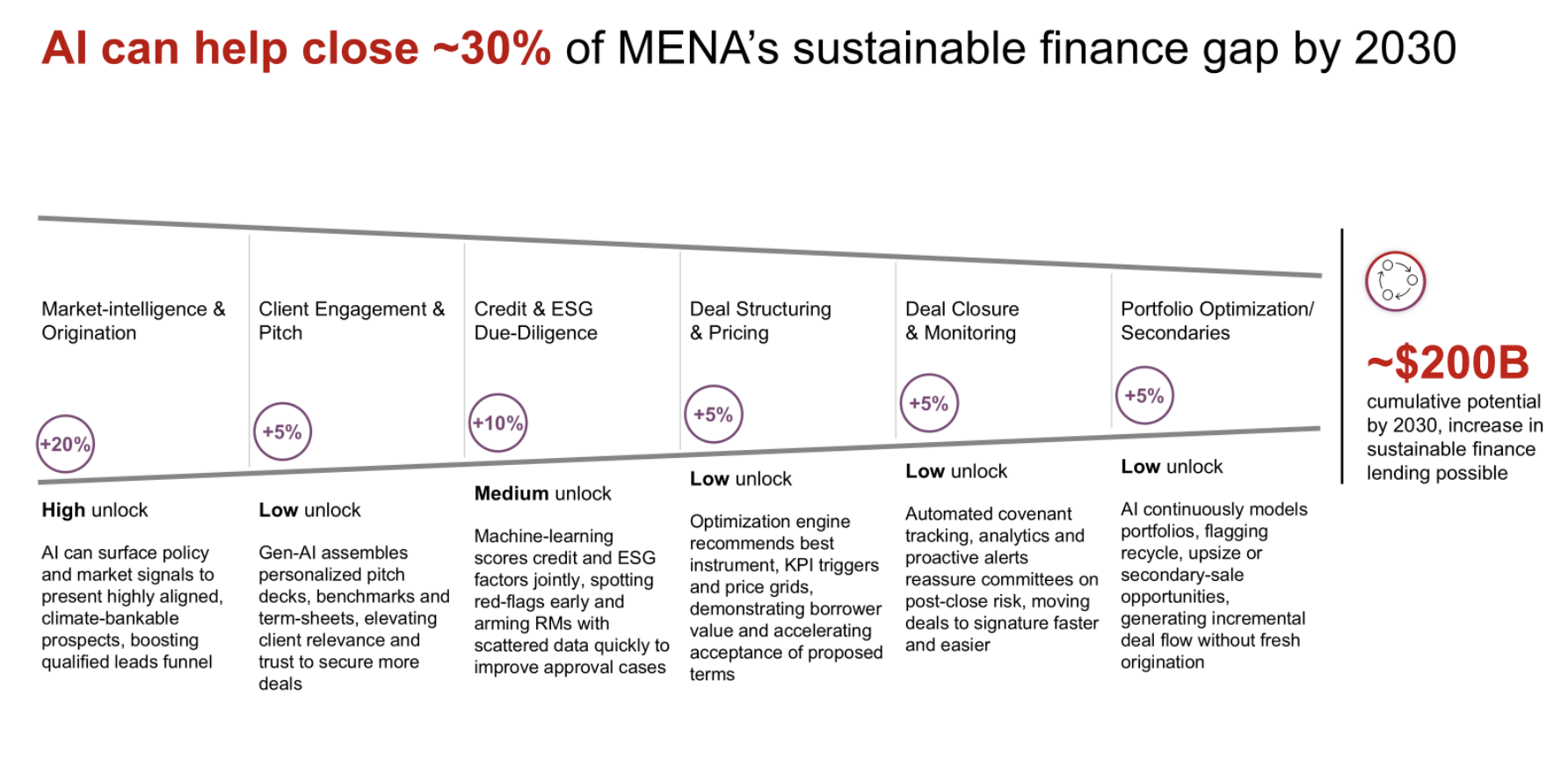
- Top of the funnel: by expanding the pool of qualified opportunities by surfacing overlooked prospects.
- Mid funnel: by improving the speed and accuracy needed to advance deals, while enhancing sustainability scoring, risk analysis and deal structuring.
- Post-deal: by seamlessly identifying upsizing and resale opportunities, further expanding commercial viability.
These far exceeding results from the real-world use case outline the value AI apps can unlock, especially as the developed prototype is scalable beyond FAB. This would help close up to 30% of the region’s cumulative funding gap by stimulating sustainable finance flows. At scale (assuming a 90-98% growth in adoption rates of AI across the sustainable finance market in MENA), the region could mobilize an additional $200 billion in sustainable finance by 2030 — and avert more than 60 million metric tons of CO2 through financed projects.
As with any technology, early adopters are paving the way. In this case, leaders are also creating sustained competitive advantage and positioning themselves to shape compliance, innovation and long-term growth.
If AI is applied across the value chain, it will radically change the industry’s approach to unlocking and creating value. Stakeholders, however, must concentrate on applying AI with focus, while fostering collaboration by sharing best practices.
Don't miss any update on this topic
Create a free account and access your personalized content collection with our latest publications and analyses.
License and Republishing
World Economic Forum articles may be republished in accordance with the Creative Commons Attribution-NonCommercial-NoDerivatives 4.0 International Public License, and in accordance with our Terms of Use.
The views expressed in this article are those of the author alone and not the World Economic Forum.
Stay up to date:
Artificial Intelligence


Forum Stories newsletter
Bringing you weekly curated insights and analysis on the global issues that matter.
More on Sustainable DevelopmentSee all

Cara Morton and Kiva Allgood
September 27, 2026


