Without the right data, AI could lock developing countries out of the global trade map
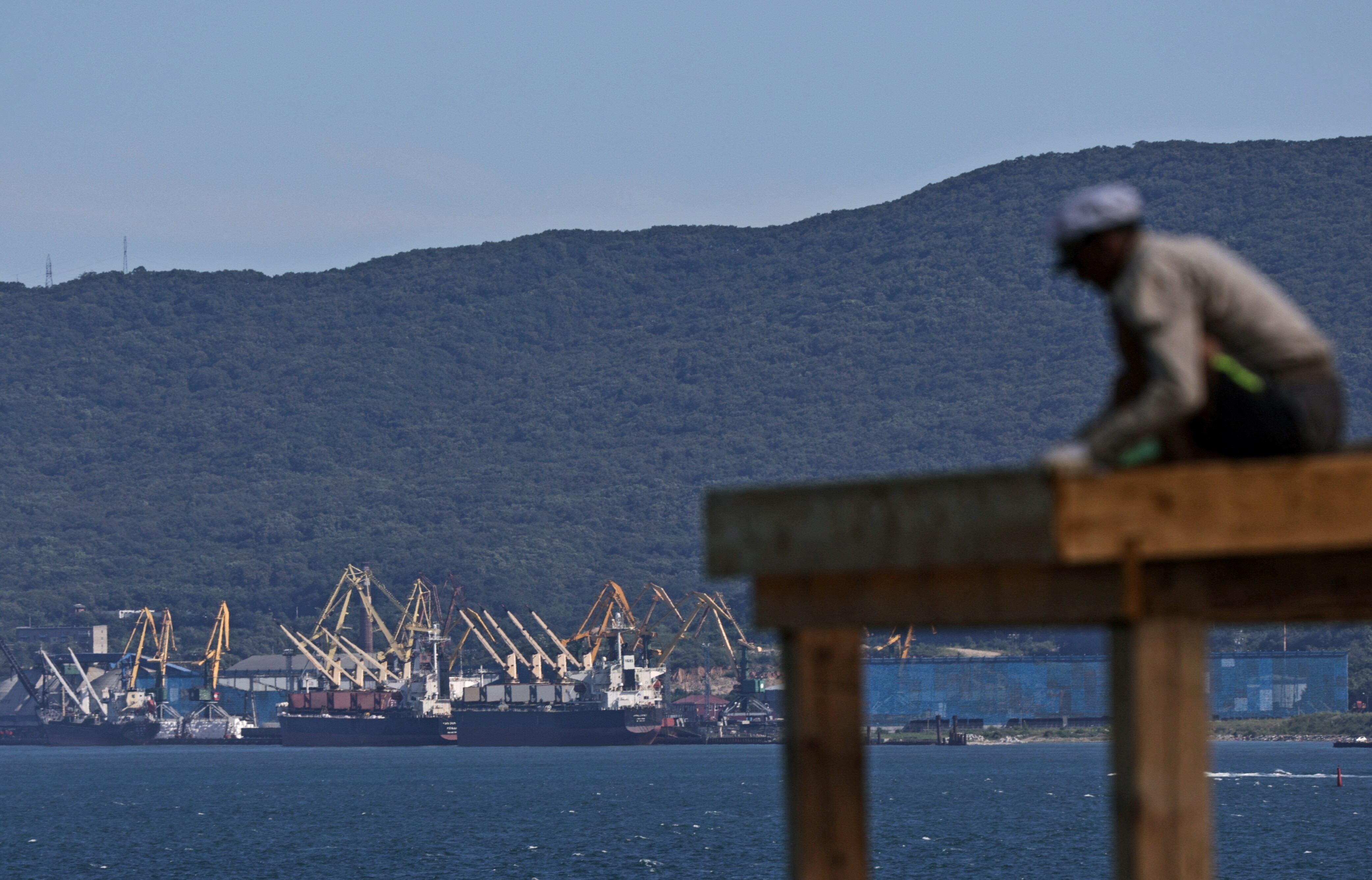
AI is being used to make global trade more efficient – but the wrong data could effectively lock developing countries out of global trade. Image: REUTERS/Tatiana Meel
- Global trade is changing as a result of geoeconomic fragmentation and a shift of global economic weight.
- AI is playing a role in that shift, but a risk vector is emerging: that trade AI is trained on data that no longer reflects the contours of global trade.
- That means fast-growing developing economies, with less historical data behind them, risk being written off by AI and locked out of the global trade system.
The corridors that global trade moves through are changing faster than at any point in the last three decades. This shift is well-documented, and is being assisted by AI. The risk now, though, is that trade AI has been taught to think along the rails of a trade system that no longer exists, locking some players out for good.
US imports from China fell 29.4% in 2025. Over the same period, a Citi survey found that 65% of global businesses are actively diversifying their sourcing base, with Vietnam, India, Thailand and Mexico emerging as the primary new destinations.
Artificial intelligence has come into trade finance with a real promise: faster underwriting, lower processing costs and credit extended to businesses that legacy models would have turned away. The gains are genuine. A question that has not been asked loudly enough is whether the data these models learn from reflects the trade map of the past or the trade map forming in real time.
What data is AI for trade finance trained on?
Most trade finance AI is being trained, overwhelmingly, on decades of transaction history from the corridors banks already understood: China-to-US, Europe-to-North America. These are routes with deep, long-standing data. An SME exporter in Monterrey or a contract manufacturer outside Ho Chi Minh City has almost none of that history in the data. To a model trained on the old map, these businesses are invisible.
This is not a hidden problem. Banks reject at least 40% of SME trade finance applications in ASEAN, the fastest-growing trade region in the world, citing incomplete credit histories and borrowers who do not fit established underwriting templates. The global trade finance gap stands at $2.5 trillion, concentrated almost entirely in the emerging market corridors where transaction data is thinnest. Trained on the data that exists rather than the data that should exist, AI risks making that gap permanent.
The IMF's Global Financial Stability Report flagged this dynamic explicitly, warning that AI models trained on existing financial data tend to perpetuate the biases embedded within it, creating a self-reinforcing cycle where markets already underrepresented become progressively harder to serve. In trade finance, that cycle shows up in a geography-specific way. The models do not know Vietnam or Monterrey because the databases were not built with those corridors in mind.
How AI could lock in the global trade map
The structural problem with AI trained on legacy data is that the blind spot compounds over time.
When a trade finance model has no transaction history for a corridor, it assigns higher risk. Higher risk means less financing is extended. Less financing means fewer completed transactions. Fewer transactions means the data gap widens rather than closes. The corridor never accumulates the history it needs to be seen accurately, because the model's own decisions prevent that history from being built.
This is the dynamic the Brookings Institution identified in AI credit systems: scoring systems that cannot accurately assess borrowers from underserved markets produce more conservative decisions, which deny those borrowers credit, which prevents the transaction histories that would enable accurate assessment from ever being created. The problem is structural, not individual.
The trade corridors most at risk are exactly the ones global supply chains are moving toward. A garment manufacturer in Vietnam that has grown from $5 million to $25 million in cross-border revenue over three years has a story any experienced human underwriter would recognize. A model trained on corridors that did not include that growth sees only the absence of historical data and treats novelty as risk.
The Forum’s TradeTech report notes that AI is reshaping trade finance at pace while flagging inclusivity as an active concern: smaller businesses from developing economies are disproportionately excluded from the systems being built. The speed of AI adoption in established corridors is running ahead of the data infrastructure being built in new ones. If that gap is not closed deliberately, it will be closed by default.
The window for emerging market corridors to build a transaction data footprint, and therefore a presence in the training sets of the models being built today, is open but not indefinitely. AI systems that harden before India, Vietnam, and Mexico accumulate sufficient data history will treat their absence as evidence of risk rather than evidence of novelty. That damage is difficult to reverse.
What does responsible AI in trade finance require?
The answer is not to slow AI adoption. The efficiency gains are real, and the industry needs them. The answer is to be deliberate about what goes into the models being built right now, before the architecture hardens.
Three things need to happen in parallel.
First, the data inputs need to change. AI models in trade finance need to be trained on transaction-level data from emerging market corridors, not just the routes banks have financed for decades. The raw material exists in the transaction data flowing through digital trade finance platforms operating in these markets. The question is whether the institutions building these models are willing to seek it out.
Second, explainability needs to become a requirement, not a feature. When a model declines a trade finance application from an SME in Ho Chi Minh City or Monterrey, the institution deploying that model should be able to explain the decision in terms of what data was present, what data was absent and what that absence actually means. AI that cannot explain its decisions cannot be held accountable for them.
Third, this needs to become a governance conversation, not just a technology one. The decisions being made today about how trade finance AI is trained, what data it draws from and which corridors it learns to see are not purely commercial decisions. They will shape the financial architecture of global trade for a generation. That makes them a matter of public interest, one that multilateral institutions, regulators, and the private sector need to address together.
Geoeconomic fragmentation is already one of the defining risks of this decade. It could cost the global economy up to $5.7 trillion. AI that embeds the old trade map into the financial infrastructure of the new one risks deepening that fragmentation – not through politics, this time, but through code.
Don't miss any update on this topic
Create a free account and access your personalized content collection with our latest publications and analyses.
License and Republishing
World Economic Forum articles may be republished in accordance with the Creative Commons Attribution-NonCommercial-NoDerivatives 4.0 International Public License, and in accordance with our Terms of Use.
The views expressed in this article are those of the author alone and not the World Economic Forum.
Stay up to date:
Artificial Intelligence
Related topics:


Forum Stories newsletter
Bringing you weekly curated insights and analysis on the global issues that matter.
More on Trade and InvestmentSee all

Stefano Salomoni
September 29, 2026